
When my father-in-law crossed the threshold of the new house for the first time, he looked around so carefully, as if he had come to take possession of an apartment that belonged to him.
He walked through the hallway, looked into the living room, glanced at the stairs, and finally said briefly:
— Not bad.
I had expected at least a simple “Congratulations.”
But I heard nothing like that.
A moment later, my husband Aaron came in behind him. He was holding a small notebook and a pen. At the time, I still didn’t understand what he needed them for.
His mother was already looking around the kitchen.
— We can put a large table here — she said. — And if we remove this cabinet, there will be room for an extra refrigerator.
I smiled, assuming she was simply imagining how the house could be arranged.
My parents were standing beside me.
Dad looked tired. For the past few weeks, he had been coming here almost every day after work to finish the small jobs. He had painted the walls in the children’s room himself and installed the shelves.
Mom was holding a box of homemade baked goods.
She was trying very hard to make the first meeting between our families go peacefully.
For my parents, this house was something special.
They had saved money for it for many years.
Mom sometimes joked that she had saved even when she wanted to buy herself a new coat.
— One day you’ll have a place that no one will be able to take away from you — she had told me when I was still a child.
And finally, that day had come.
The house had been transferred into my name.
My parents gave it to me when they learned that my pregnancy was experiencing complications. The doctor advised me to avoid unnecessary stairs and moving, while our previous apartment was on the fourth floor of an old building without an elevator.
Dad had said then:
— We’ve dreamed of having our own house for you for too long to back out now.
I was endlessly grateful to them.
Neither of them demanded gratitude.
No one said that from then on, they had the right to decide how I should live.
That was why what happened next came as a real shock to me.
Aaron opened his notebook.
— So — he said — I’ve roughly thought about how we should best divide up the rooms.
For a moment, I thought I had misheard him.
— Divide them?
He nodded.
— Yes. We need to plan everything in advance.
My father-in-law looked at his son approvingly.
— Exactly. The house is large. We can’t leave rooms unused.
I looked from one to the other.
— But this is our family home.
Aaron smiled.
— Exactly why.
He opened another page.
— On the ground floor, we can leave the guest room for my aunt. It’ll be more convenient for her because she has difficulty climbing stairs.
I felt the smile disappear from my face.
— Your aunt is going to live here?
— Not permanently — he answered quickly. — Sometimes.
His mother immediately interrupted:
— She’s really having a hard time right now. What’s wrong with helping family?
I looked at my husband.
— Why am I only finding this out now?
Aaron shrugged.
— Because you would have started worrying much earlier.
He turned the page.
— There’s another small room upstairs. I think we can give it to my cousin. He’s looking for a job right now and has nowhere to keep his things.
I didn’t even know what to say.
Meanwhile, my father-in-law pointed toward the room beside the stairs.
— We can make a space for tools here.
— What tools? — I asked.
— Mine — he replied. — I’ve needed a place to store them for a long time.
I looked at my parents.
Mom was silent.
Dad slowly placed his hand on my shoulder.
Aaron continued:
— And I also think we could convert part of the pantry.
— Into what?
— A small room.
— For whom?
He looked at me as if the answer were obvious.
— For my brother.
I closed my eyes for a few seconds.
Now everything became clear.
They hadn’t come to look at our new house.
They had already decided it was theirs.
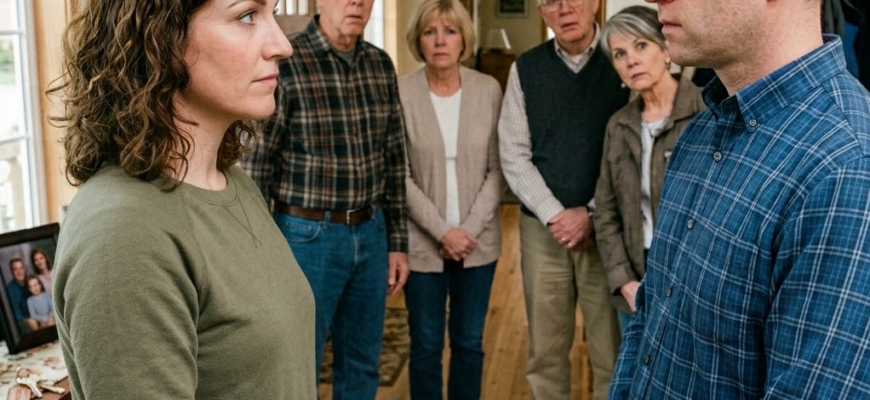
— Aaron — I said quietly — who gave you the right to decide who is going to live here?
He frowned.
— Don’t start.
— I’m asking seriously.
— It’s a big house. We shouldn’t keep half of it empty.
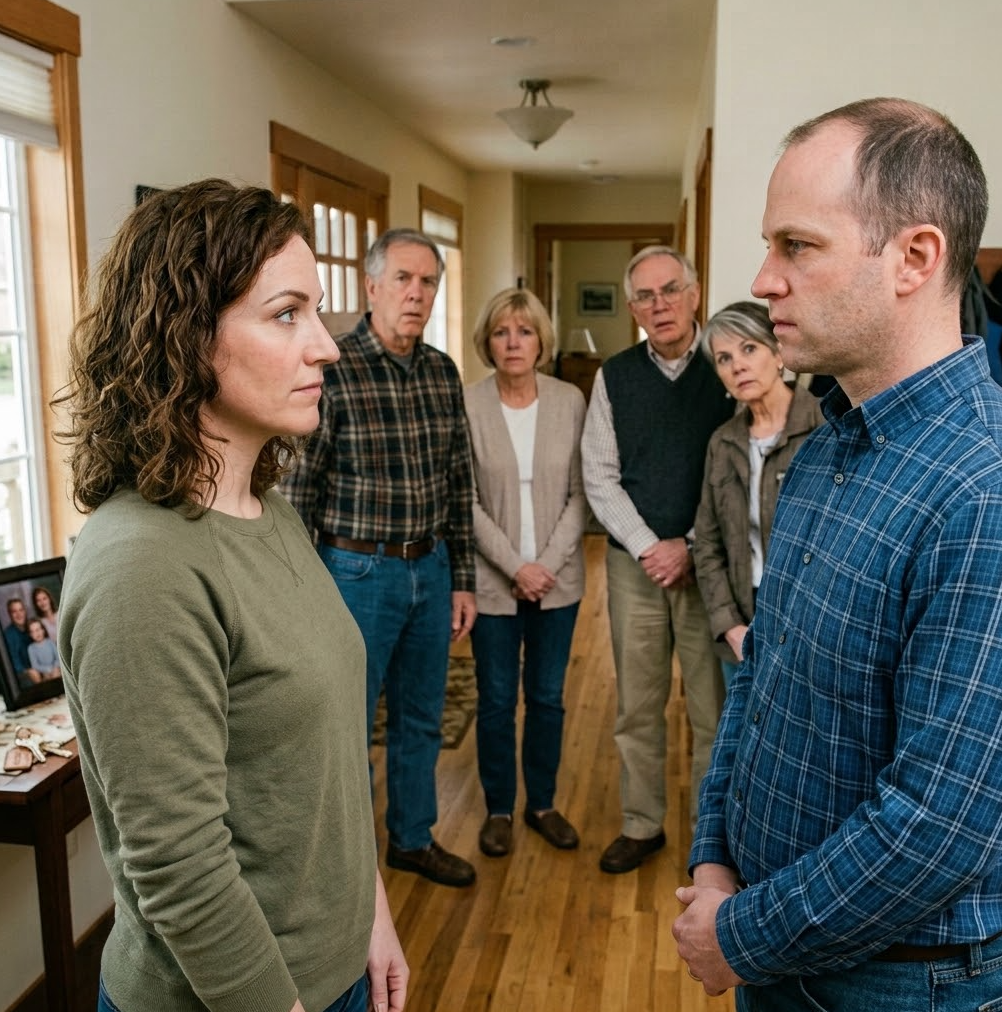
I looked around.
A photograph of my parents hung on the wall.
Next to it was a box of baby things that Mom had prepared for her future grandchild.
This house had not been created to become temporary accommodation for all of my husband’s relatives.
— The house belongs to me — I said.
Silence fell over the room.
My father-in-law smiled ironically.
— You’re my son’s wife.
— So what?
— That means decisions should be made together.
I looked at him.
— Decisions concerning our life together — yes. But not decisions concerning property that belongs to me.
Aaron abruptly closed his notebook.
— We’ve already talked about this.
— No. We never talked about you bringing your relatives here.
— I wanted to settle everything peacefully.
— Peacefully for whom?
He didn’t answer.
Then my father-in-law held out his hand.
— Give me the spare set of keys.
I looked at his hand.
— Why?
— We need to make a few copies.
Something inside me broke.
I remembered all the situations from the past few years that I had tried not to notice.
The way Aaron could make decisions on his own and then simply present me with a fait accompli.
The way he called my salary “family money,” while considering his own bonuses exclusively his.
The way his father sometimes allowed himself unpleasant comments about my parents, while Aaron preferred to remain silent.
I had always explained it away as part of his personality.
I’m tired — maybe I’m overreacting.
He’s busy — maybe he simply doesn’t want to argue.
His father is just like that.
But now, for the first time, I saw the whole picture.
They had become accustomed to getting what they wanted because they rarely heard the word “no.”
I looked at my husband.
— Do you remember our agreement?
Aaron froze.
His father frowned.
— What agreement?
I answered calmly:
— The one we signed before my parents helped us buy the house.
Six months earlier, we had indeed signed a prenuptial agreement.
It contained a separate provision stating that the property my parents had given me would remain my personal property.
At the time, Aaron didn’t even want to read the document carefully.
He said:
— If it will reassure your parents, I’ll sign it.
I thought the matter was settled.
Now I understood why he didn’t want to remember it.
My father-in-law looked at his son.
— You signed the documents?
Aaron answered irritably:
— Yes.
— And the house is registered in her name?
— Yes.
— Then why are you assigning the rooms?
Aaron said nothing.
For the first time, I saw genuine confusion on his father’s face.
He turned to me.
— But you’re family.
— Exactly. That’s why I expected respect from my husband, not an attempt to make decisions behind my back.
Mom finally put the box of baked goods on the table.
— We gave this house to our daughter — she said quietly. — Not to the entire family.
My father-in-law frowned.
— We’re family too.
Dad looked at him.
— No one is denying that. But being a relative does not automatically give you the right to someone else’s property.
Those words hung in the air.
Aaron walked over to me.
— Listen, I just wanted to help my loved ones.
— You can help people without giving them rooms in a house that doesn’t belong to you.
— You’re making everything complicated.
— No. For the first time, I’ve stopped simplifying everything for you.
He fell silent.
Then his mother said quietly:
— Aaron, maybe we should talk about this at home?
I smiled bitterly.
— And that’s exactly the problem.
She looked at me.
— What is?
— All of you call this “Aaron’s house.” But it was never his.
My husband pressed his lips together.
— What are you going to do?
I looked him straight in the eyes.
— Nothing special. Just set some boundaries.
That evening, for the first time in a long while, we truly talked.
Aaron admitted that his father really had been counting on some of their relatives being able to move in with us temporarily after we moved.
“Temporarily” turned out to be a very flexible word.
Everyone already had their own plans.
Someone intended to live there for several months.
Someone wanted to leave their belongings there.
Someone else planned to come on weekends.
And my father-in-law even believed that a large house should have a workshop for him.
I listened and realized that no one had even thought to ask me.
Not because they had forgotten.
But because they had assumed I would agree.
The next day, I gathered all the documents concerning the house and went to a notary to check once again that my rights were properly protected.
Everything was in order.
I also changed the locks.
Not out of revenge.
I simply wanted to feel safe in my own home again.
Aaron was unhappy.
Very unhappy.
— You really changed the locks?
— Yes.
— You didn’t even tell me?
— I told you I didn’t want the keys being handed out without my permission.
He was silent for a long time.
— So you don’t trust me?
I didn’t answer immediately.
— After what happened, I’m no longer willing to entrust you with decisions concerning my property.
That hurt him more than any argument could have.
A few days later, we began meeting with a lawyer who specialized in family law.
That was where Aaron first realized how seriously I was taking the whole situation.
The lawyer calmly explained to him that the property my parents had given me was my separate property and that, without my consent, he could not dispose of the house or give anyone the right to live there.
Aaron sat in silence.
When we left the office, he said:
— I didn’t think it would go this far.
I looked at him.
— For you, it started today. For me, it started much earlier.
We still tried to talk.
But our relationship was no longer the same.
The problem wasn’t the house.
And it wasn’t even his relatives.
The problem was that my husband considered it normal to make important decisions for me and then expect me to simply agree.
A few months later, we began divorce proceedings.
It wasn’t easy.
We had a child, there were difficult conversations ahead of us and many unpleasant decisions to make.
But not once did I regret saying “no” that day.
My parents remained by my side.
Dad finished decorating the children’s room.
Mom planted several rose bushes in front of the house.
And I slowly began turning the rooms into the space we had always dreamed of.
One evening, I stood by the window of the children’s room and looked out at the garden.
Mom came over to me.
— Are you happy?
I thought for a moment and answered:
— Now I’m at peace.
She smiled.
And then I understood one simple thing.
A home is not the number of rooms or the value of a property.
A home is a place where no one forces you to earn the right to feel safe.
My parents gave me more than walls, a roof, and a garden.
They gave me the ability to decide for myself what my life would look like.
And finally, I learned to appreciate that gift not only as property, but also as the right to say:
“No. This is my decision.”