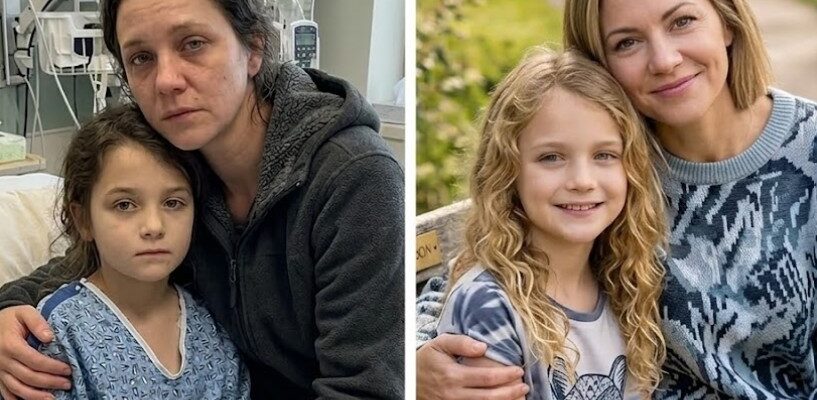

My daughter, Emily, became seriously ill, and the bill for her surgery at the hospital was $150,000. Four years later, a stranger approached us and said, “I owed it to you.”
My husband died of cancer when Emily was four years old.
Two years later, Emily’s heart condition suddenly worsened — an illness that doctors had been closely monitoring since her birth.
When she turned seven, she collapsed on the school playground. An ambulance took her to the hospital, and the cardiologist used the words “urgent” and “cannot be postponed.”
The cost of the surgery was enormous. The insurance company refused to pay three times. The last letter arrived late at night, at two in the morning. I sat at the kitchen table reading it by the light of a lamp, barely holding back my tears.
I thought: how is it possible that numbers on paper are more important than my daughter’s life? How can a denial code be more important than the beating of her heart?
The next morning I called a real estate agent.
I put the house up for sale. It was the only valuable thing I had left, and I told myself: “Jamie and I will figure things out later.”
That same day I went to the hospital to pay the deposit. The employee in the accounting department was entering my data into the system and suddenly stopped. Slowly she turned the monitor toward me:
“Ma’am, your daughter’s account balance is zero.”
I thought it was a mistake. She pointed to a line on the screen: a bank transfer recorded that very morning — the full amount, anonymous.
I don’t remember how I fell. I remember the cold tile under my face and a nurse who sat beside me repeating my name. I remember thinking: “I have to take the house off the market.”
Three days later Emily had the surgery.
Everything went perfectly. The surgeon said the operation was “perfect, just like in the textbook.” I cried in the hallway while a volunteer sat next to me and held my hand for twenty minutes until I calmed down.
For the next four years I never stopped thinking about the person who saved my daughter’s life.
Last March Emily turned eleven. Now she is a tall, confident girl with an opinion about everything. She plays soccer twice a week and reads at a level beyond her age.

I got my life back: the house remained, I returned to working remotely, and life seemed to be back on track. But I still didn’t know who had saved my daughter.
Until last Monday.
Late in the evening we were in the park. Emily was hanging upside down on a bar, her hair almost touching the ground, happier than ever.
At that moment, a black sedan stopped by the sidewalk.
A man stepped out. Dark blue suit, shiny shoes, a confident and calm walk.
He approached me, and there was a determination in his eyes that instinctively made me step in front of Emily.
“Lorena?”
He took off his glasses, his gaze calm. He introduced himself: Michael. He said he recognized me and Emily immediately.
I was completely confused.
“Do we know each other?” I asked.
“Yes, I’m the one who paid the hospital bill,” he said.
My heart froze.
“What? Why did you do that?”
Michael looked at Emily, who was still hanging upside down, and then at me.
“I owed it to you, Lorena. Once you saved someone. Maybe you don’t remember it anymore.”
His phone rang.
“I’m late. I’m sorry. I hope we’ll see each other again.”
He smiled and returned to his car.
“Wait! How can I find you?”
He didn’t answer. The sedan drove away, and I remained on the path with my heart beating wildly.
I began looking for Michael: social media, professional websites, local foundations.
On the third night I found an article about a foundation that quietly funded urgent surgeries for children. The foundation’s representative was a man named Michael.
Continuing my search, I came across a photo from the day of Emily’s surgery in the hospital newsletter. I was sitting at the reception desk, and in the background a man in a dark suit was barely visible, his hands resting on his knees.
It was him. He had seen everything and decided to help.

The next day I asked the hospital for documents related to the payment. Everything was confirmed: the anonymous transfer came from a trust fund created that very same day, and the only signature was Michael’s.
I went to his office. He greeted me calmly, with his sleeves rolled up, with a look as if everything had been waiting for this moment.
“Lorena… will you come with me? I’ll explain everything. First, I want to show you something.”
We drove to a cemetery on the northern outskirts of the city. It was a quiet, well-kept place, as if outside of time.
Michael stopped in front of a small granite monument.
“This is my father. He passed away last year.”
He told me that four years earlier his mother had been admitted to the hospital with heart problems. His father visited her every day, and Michael came whenever he could.
That week they saw me in the waiting room.
“You were talking to people,” Michael said. “To families who were afraid, sitting late on those chairs. You simply sat next to them, talked, and cared about them.”
He told me that almost a year before Emily’s surgery, his daughter had nearly been hit by a car, and I had saved her just in time.
“It was you, Lorena,” Michael said. “My father tried for a long time to find you. He couldn’t. And then he saw you in the hospital.”
Everything suddenly made sense.
“So you paid $150,000 because your father saw that I saved your daughter?”
“Yes,” Michael replied. “When someone saves your child, it’s not enough to say ‘thank you.’ You also have to protect their children.”
Since then we have had dinner together twice. Last Saturday the girls met in the park. Emily was teaching Michael’s daughter how to do a handstand, and she kept falling over laughing.
After twenty minutes they were running together as if they had known each other for years.
Sitting on the bench, I thought about how quietly destinies intertwine.
One moment of decision in a park can return to you four years later — in the form of a girl trying to do a handstand with your daughter.
Michael sat beside me and stayed silent for a while. I learned to appreciate that.
I don’t yet know what exists between us. But I know one thing: our daughters are laughing, fresh flowers lie on his father’s grave, and somewhere in the middle of all this, kindness has returned.
Kindness always comes back.