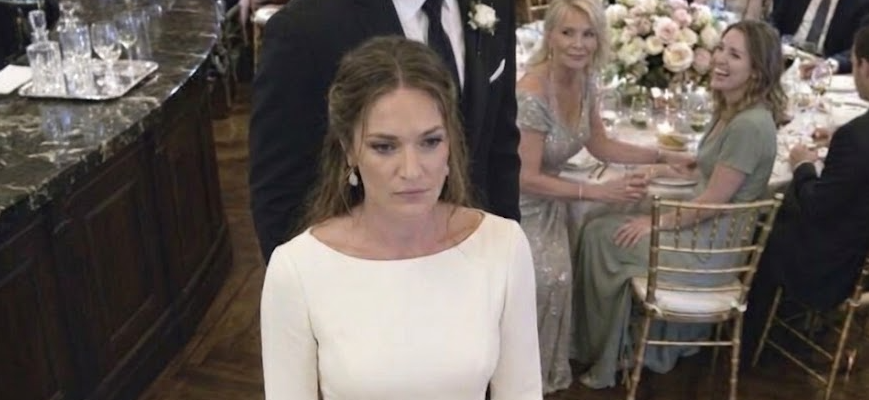

At my husband’s brother’s wedding, my mother-in-law gave my seat to my husband’s coworker — and that same night, he realized he had lost me
I said nothing.
I simply took my name card and moved to another table.
Then I went home by myself.
That night, my husband called me eleven times.
I didn’t answer a single call.
I came to my husband’s younger brother’s wedding wearing an ivory-colored dress.
Not by mistake.
Deliberately.
The dress was elegant, perfectly fitted to my figure, and looked expensive precisely because it didn’t try to prove it.
My mother-in-law, Margaret, had spent three weeks calling relatives and guests, coordinating the colors of their outfits.
The bridesmaids were supposed to wear dusty pink.
The cousins — soft green.
The older female relatives — shades of champagne.
When she called me, I calmly said:
“I’ll choose something appropriate.”
She fell silent.
That moment was probably enough for her to realize that I had noticed far more than she wanted me to.
“Wonderful, dear,” she replied.
And I immediately heard that characteristic politeness in her voice, the kind that always concealed irritation.
My husband, Daniel, didn’t notice the dress until we were already leaving the house.
He looked at me from the driver’s seat.
“You’re really planning to go in that?”
I turned my gaze toward the window.
“Yes.”
He didn’t ask anything else.
By then, he had already learned to recognize the moments when it was better to stay silent.
My name is Eliza.
Daniel and I had been married for four years.
From the outside, our relationship looked almost perfect.
He worked as a project manager at an architectural firm.
I was a corporate lawyer and was gradually moving toward becoming a partner at a large law firm.
We earned good money.
We had a beautiful house.
We traveled.
We smiled in photographs.
But photographs never show what happens after the camera is turned off.
I had paid for most of the house we lived in.
I had made the down payment from my own savings.
But we both preferred to call it “our home.”
Daniel liked feeling like the main breadwinner.
Even though my salary was almost twice his.
He never openly said that it bothered him.
But I noticed the little things.
He called my salary “your money,” while his was “what I earn.”
He almost never attended my professional events.
Yet he expected me to be present at every dinner connected to his company.
And his mother always supported that arrangement.
Margaret never caused open scenes.
She was far too well-mannered for that.
She operated more subtly.
She could “forget” to add me to the family group conversation.
During Christmas dinner, she might suddenly mention Daniel’s ex-girlfriend.
She could look at me and say:
“Some women feel insecure when they aren’t wearing jewelry.”
And then smile.
Everyone would laugh.
And Daniel would usually just pour himself another glass of wine.
But at his brother’s wedding, for the first time, she decided to stop pretending.
I knew the bride well.
Her name was Klara.
She was honest, kind, and completely unlike the other members of that family.
When she was preparing for the wedding, I helped her review the contract with the wedding venue.
I found several clauses that could have cost them nearly eight thousand dollars.
Klara was grateful.
She sent flowers to my office.
Several times, she told me she considered me a real sister.
And that was precisely why I especially didn’t want to ruin her wedding.
The ceremony was being held at an old estate on the outskirts of the city, about forty minutes from our home.
Tall windows.
Stone walls.
A grand staircase.
A garden decorated with garlands.
Everything looked perfect.
We arrived twenty minutes before the ceremony began.
I was tired.
The previous day, I had been involved in negotiations until late in the evening, and that morning I had gotten up at five to finish an urgent contract.
But when Klara appeared beside her father, I smiled.
She was radiant.
And the groom looked at her as though no one else in the world existed.
I was genuinely happy for them.
Until the reception.
After the ceremony, the guests began looking for their assigned seats.
A silver numbered card was placed on every table.
I found two cards.
One said:
Daniel — Table 3.
The other:
Eliza — Table 11.
I looked at my husband.

She frowned.
“Probably a mistake.”
“Probably,” I replied calmly.
We found Margaret at the bar.
She was talking to two sisters.
Daniel showed her the cards.
“Mom, I think there’s been a mix-up. We have different tables.”
Margaret looked at the cards.
She wasn’t even surprised.
“Oh, no, dear. Everything is correct.”
She placed a hand on his shoulder.
“There simply wasn’t any room left at the family table.”
Daniel blinked.
“But why is Eliza sitting separately?”
Margaret looked at me.
“Table eleven is very nice. It’s even close to the windows.”
She smiled.
And that was when I understood.
It wasn’t a mistake.
She had done it deliberately.
I took out my phone.
“I’ll be right back.”
In the restroom, I locked myself in a stall and simply stood there motionless for a few seconds.
Then I texted my assistant, Laura:
“Please send me a copy of the contract with the wedding venue concerning the Clark matter.”
She replied almost immediately.
“Of course. Is everything okay?”
I wrote:
“For now.”
I went outside, washed my hands, and looked at myself in the mirror.
I was wearing an ivory-colored dress.
I knew Margaret would notice it.
And I knew she wouldn’t like it.
But for the first time, I genuinely didn’t care.
At table number 3 sat the closest relatives.
Daniel’s parents.
His grandmother.
Uncles and aunts.
A cousin.
And the woman I knew as his coworker — Sofia.
She was the one Margaret had decided to put in my seat.
Sofia was wearing the same delicate green dress that had been designated for a particular group of guests.
She was laughing at Daniel’s father’s joke.
Next to her was my husband’s name card.
Her hand rested on the back of the neighboring chair.
She wasn’t touching Daniel.
But she was sitting close enough.
I watched them for a few seconds.
And suddenly I didn’t feel jealous.
I felt tired.
Deeply tired of everything that had happened over the past few years.
I found the groom.
“I need to tell you something.”
He immediately understood from my expression that it was serious.
I told him everything.
Without tears.
Without accusations.
Just the facts.
He went pale.
“I’ll fix everything right away.”
I shook my head.
“No.”
“But this is also my decision.”
“Today is your wedding. Don’t let her ruin this day for you.”
He looked at me.
“I’m so sorry.”
“I know.”
I smiled.
“Go dance with your wife.”
I returned to table number 11.
Klara’s friends were sitting there.
They turned out to be very pleasant people.
I talked with them, laughed, and ate dinner.
None of them knew what was happening.
And I had no intention of turning their celebration into a family argument.
After an hour and forty minutes, I found Daniel.
He had been sitting at table number 3 the entire time.
He hadn’t approached me once.
He hadn’t asked once how I felt.
I touched his shoulder.
He turned around.
“I’m going home.”
“What?”
“Stay. It’s your brother’s wedding.”
“Eliza…”
“You don’t have to.”
He stood up.
“I’ll go with you.”
I looked into his eyes.
“No.”
He fell silent.
“Stay.”
I said it very calmly.
And that was precisely why he understood there was no point arguing.
I said goodbye to Klara.
She hugged me tightly.
“You didn’t deserve to be treated like that.”
I smiled.
“I know.”
Tears filled her eyes.
“Don’t cry. This is your day.”
And I left.
Alone.
The drive home was almost empty.
I turned off the radio.
When I entered the house, I immediately opened my laptop.
Laura had already sent me the contract.
I read it several times.
Then I opened a new document.
And started writing.
Daniel returned around midnight.
He stopped in the doorway.
“What are you doing?”
“Working.”
He sat across from me.
“About tonight…”
“I know.”
“Mom shouldn’t have done that.”
I looked up.
“She shouldn’t have.”
He lowered his head.
“I should have said something.”
And then I replied:
“Yes.”
He looked at me.
“What?”
“You should have said it four years ago.”
He didn’t answer.
That night he slept in the guest room.
And I didn’t sleep at all.
I remembered everything.
Every little thing I had preferred not to notice over the years.
The way Daniel never defended me against his mother.
The way he allowed her to decide where I should sit, who I should talk to, and how important I should feel within the family.
The way he smiled whenever she made another unpleasant remark.
And Sofia.
For the first time, I allowed myself to ask the question I had postponed for too long.
Why was she always around him?
Why did his mother treat her so warmly?
And why had Daniel never thought it necessary to explain to me what their relationship really was?
The next morning, I called my mother.
I told her everything.
She was silent for a few seconds.
Then she asked:
“What do you need now?”
I answered:
“A good family lawyer.”
She gave me a number.
Her name was Victoria.
We met that same day.
I told her about the house.
The finances.
The marriage.
My husband’s behavior.
Sofia.
The family.
Victoria listened carefully.
Then she said:
“You’ll be okay.”
Not, “Everything will be easy.”
Not, “He’ll definitely come back.”
Simply:
“You’ll be okay.”
And for the first time in a long time, I believed her.
That week, I did three things.
First, I talked to Daniel.
Without an argument.
“I think we both understand where all of this has led.”
He was silent for a long time.
Then he began making excuses.
He said that for the past two years I had been too busy with work.
That I had grown distant from him.
That Sofia understood him better.
That things were easier with her.
I listened to everything.
When he finished, I said:
“Thank you for being honest.”
He raised his head.
“And that’s it?”
“Yes.”
“What are you going to do?”
“I want you to move in with your parents.”
He wanted to protest.
I stopped him.
“Please. Just once, do what I’m asking without an argument.”
That same evening, he left.
Second, I spoke with my supervisor at the firm.
I asked for a few weeks of a more flexible schedule.
He agreed.
Third, I called Klara.
She told me something I hadn’t expected:
“Daniel didn’t know about the seating arrangement.”
“I know.”
“He found out at the same moment you did.”
“Good.”
She fell silent.
“Margaret is going to be furious.”
For the first time in several days, I laughed.
“That’s no longer my problem.”
The divorce lasted seven months.
One day, Margaret showed up at a meeting with the lawyers without being invited.
She was asked to leave.
Daniel hired his own lawyer.
The house stayed with me.
I bought out his share.
He moved into an apartment closer to work.
And, as I had suspected, also closer to Sofia.
Several months later, he called me himself.
“I’d like to fix everything.”
I remained silent.
“I understand that I should have behaved differently.”
“Yes.”
“I’m sorry.”
“I know.”
There was silence.
Then I said:
“I hope it was worth it.”
He didn’t answer.
I ended the call.
During the divorce, Margaret sent me a letter.
Three pages of handwritten text.
She wrote that I had never really tried to become part of the family.
That my career had always been more important to me than my marriage.
That she had known for a long time how everything would end.
And at the end she wrote:
“I want you to know: the seating arrangement at the wedding was entirely my decision. Daniel had nothing to do with it.”
I read that sentence twice.
Then I put the letter in a folder.
And never looked at it again.
The divorce was officially finalized on a Tuesday in November.
That day, I was working.
I had an important project.
Victoria sent me a message:
“It’s all finished.”
I looked at the screen.
And suddenly I realized I felt neither pain nor anger.
Only silence.
I left the office and walked into a small café.
I sat by the window.
For fifteen minutes, I watched people walking down the street.
Then I went back to work.
I still live in that house.
But I changed the living room.
I bought new furniture.
Not because the old furniture was bad.
I simply wanted the house to finally contain things chosen by me alone.
I got used to the quiet mornings.
And only after the divorce did I realize how tense I had been all those years.
After a few weeks, I started sleeping much better.
Klara and I still meet every few weeks.
She became a true friend.
Recently, she sent me a little cactus.
On a note, she wrote:
“Sometimes all you need to do is stop watering what stopped growing long ago.”
I put it on the kitchen windowsill.
I no longer speak to Margaret.
Nor to Daniel.
And I think that’s for the best.
But there is one thing I only understood later.
That morning before the wedding, I stood in front of the mirror wearing an ivory-colored dress.
I knew exactly what I was doing.
I knew Margaret would notice it.
I knew she would talk about it.
I knew someone would consider my choice inappropriate.
And yet I put it on.
At first, I thought it was an act of defiance.
That I simply wanted to show Margaret: she could no longer control me.
But now I understand that it was something deeper.
It was the first time in many years that I allowed myself not to meet other people’s expectations.
I didn’t choose the color that had been imposed on me.
I didn’t sit where I had been assigned.
I didn’t smile for photographs just to maintain appearances.
I didn’t pretend everything was fine.
I simply showed up as myself.
And then, when I realized there was no place for me at their table anymore, I stood up and left.
And I think that was when my marriage ended.
Not on the day we signed the papers.
Not when Daniel moved out.
And not even when he admitted that things were easier for him with another woman.
It ended the moment I looked at the whole situation from the outside for the first time and realized:
I no longer have to fight for a place where someone deliberately makes me feel unwanted.
Sometimes the end of a relationship doesn’t begin with a huge argument.
Sometimes it begins with one small card.
With a table number.
And the decision, for the first time, not to ask permission to take your own place.