
In the hospital waiting room, there was the usual hum: muffled conversations, coughing, the rustle of paper cups, and the uncertain flicker of fluorescent lights. People came and went, families gathered in small groups, someone paced nervously back and forth, someone else stared at the wall or scrolled aimlessly through their phone.
In a far corner, on a hard plastic chair, sat an elderly woman. Her coat was worn — frayed cuffs, a rubbed-out collar. The color was faded, and her shoes didn’t match: one brown, the other black. On her lap, she held a well-used leather bag, clutching it with both hands as if it held something priceless.
No one sat next to her.
Some walked around her, feeling awkward — unsure if she even belonged there. Others simply ignored her, assuming she was one of those odd characters who sometimes appear in crowds — maybe she got lost or just came in to warm up.
A middle-aged woman with a perfectly styled haircut leaned toward her husband and whispered:
— She probably came in off the street. Looks like she’s lost.

The man snorted:
— Or maybe she just came for free coffee.
Two teenage girls in branded jackets and expensive jeans burst out laughing and started mimicking her slow movements as she pulled something from her bag or adjusted her clothes.
Even the staff didn’t seem to know what to do with her. A young nurse, apparently newly hired, approached with a forced smile, clutching a tablet with documents.
— Ma’am — she said gently, crouching down. — Are you sure you’re in the right place? Maybe you’re looking for someone in particular?
The elderly woman looked up at her — light blue, clear eyes, full of lived years. She smiled warmly and patted the nurse’s hand:
— Yes, sweetheart. I’m exactly where I’m supposed to be.
The nurse furrowed her brows slightly, but nodded and walked away.

Two hours passed.
The crowd in the waiting room slowly changed, but the elderly woman didn’t move from her seat — calm, as if she had all the time in the world. From time to time, she looked toward the double doors leading to the operating room. There was hope and patience in her gaze.
Until finally, at 3:12 PM, the doors opened.
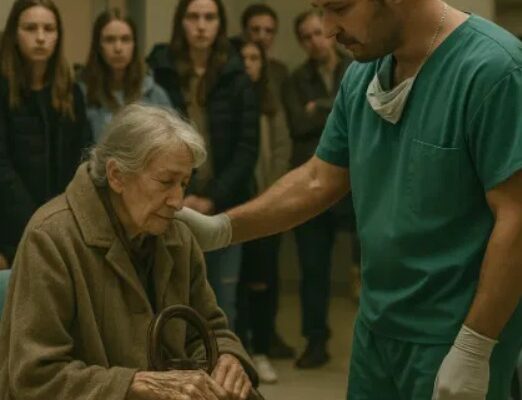
A surgeon walked out — still in his green scrubs, with a mask hanging from one ear. He looked exhausted: dark circles under his eyes, hair tousled from sweat. But in his eyes was determination.
He didn’t stop by any of the families, didn’t look at any worried relatives. He walked straight to the elderly woman.
He bent slightly, touched her shoulder with his gloved hand, and with a warm smile said loudly enough for everyone to hear:
— Are you ready to tell them who you are?
Silence fell over the waiting room.

The woman slowly stood up from the chair, and the surgeon reached out his hand to her. She looked around — at the surprised, shocked, and ashamed faces.
— My name is Margaret Green — she said quietly. — You probably don’t recognize the name. Few remember it now. But I used to run a bakery two blocks from here.
Some older patients nodded. Maybe someone remembered.
— I was never married. I had no children of my own. But there was one boy… He lived in the apartment above my bakery. He had no father, and his mother worked two jobs and still couldn’t afford heating in the winter.
She glanced at the surgeon for a moment. He smiled.
— He was always hungry. I started giving him leftover pastries. Then I let him wash dishes for a small pay. When I found out he had trouble reading, I helped him after hours. And when his mother fell ill, I helped take care of her. After she died, I did everything I could to help him continue his education.
The surgeon stepped forward.
— I was that boy — he said with a trembling voice. — And I wouldn’t be here if it weren’t for her.
He spread his arms, gesturing to everything around him.

— My name is Dr. Nathaniel Lewis, head of the cardiothoracic surgery department in this hospital. And this woman — the one you laughed at, the one you dismissed — she’s the one who gave me a chance. She’s the one who taught me what kindness is.
He took her hand.
— Today, I performed my one-thousandth heart surgery. It was an important day. And I knew I wanted to share it with just one person. The one who gave me my first chance. The one who showed me what it means to be human.
The room was completely silent.
Margaret looked at those gathered — her gaze was gentle, but firm.
— I didn’t come here for coffee — she said with a soft smile. — I came for my boy.
After a few seconds, the nurse was the first to start clapping. Then someone else joined. And soon, the entire room erupted in applause — sincere, warm, real.
The woman who had earlier whispered a mean comment to her husband was now staring at the floor. The teenagers were silent, unsure what to do. And the young nurse wiped away the tears that had welled up in her eyes.
Dr. Lewis looked at Margaret:
— I reserved a table at the café near the hospital. Would you allow me to invite you for a piece of cake to celebrate, Miss Margaret?
— Only if it’s chocolate — she replied with a playful twinkle in her eye.
They left the room to a standing ovation — not out of politeness, but out of respect.

Later, on the hospital’s official social media, a photo appeared: Dr. Lewis and Ms. Green sitting at a table, a chocolate cake between them, and wide, radiant smiles on their faces.
The caption read:
“Behind every great doctor is someone who first believed in them. Today, we honor Ms. Margaret Green — mentor, teacher, and a heart that healed thousands of others.”
The post quickly spread across the internet.
People began sharing stories about their own mentors, about unexpected kindness, and about how important it is not to judge others by appearances.
And maybe — at least for a moment — everyone became a little more mindful of those who sit quietly and alone beside them.
Because, as Dr. Lewis said in an interview:
“Each of us had someone who lifted us when we couldn’t move forward on our own. In my case, it was a woman who baked the best blueberry buns in town.”