
I never thought I would find myself in a situation where I would talk about myself so openly. But with age, many things lose meaning: appearance, status, even wealth. All that remains is the desire to speak the truth while you still breathe. Seventy years of my life were devoted to one work — the stores I built from scratch. In five states, signs bore my name. People called me the “Bread King.”
But in the enormous house, full of silence, I realized: the name means nothing if there is no one to share the joy with. My wife had passed away decades ago, and we had no children. One day, looking at rows of photographs and stacks of contracts, I asked myself: who will inherit all of this? I knew one thing — who certainly does not deserve it: lawyers, managers, relatives who only appeared when money was involved. I needed someone who values kindness for its own sake.
I came up with a test.
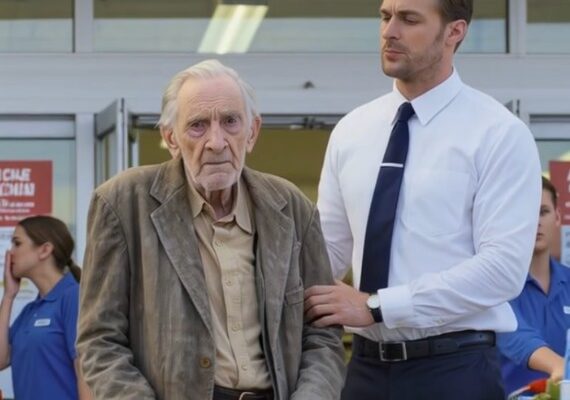
I took an old jacket, rubbed dirt on my face, and didn’t shave for several days. In the mirror, I saw a stranger — a graying old man forgotten by everyone. That’s how I entered my store, like a homeless person.
From the very first steps, I felt the gazes. In the aisle, a pair of teenagers whispered.
— Ugh, he surely hasn’t washed in a long time — said the girl.
— And what is he doing here? — replied the boy.
At the register, a young employee, barely hiding her grimace, whispered to her colleague:
— He smells like rotten meat.
— Don’t say that so loudly! — laughed the other, but not any quieter.
I heard every word. In the line, a man pulled his son close.
— Don’t look, Tommy.
— But, Dad, he…
— I said, don’t look!

My chest felt heavy. This was my store, my work, my pride — and suddenly it had turned into a courtroom where a verdict was passed against me.
Then the manager approached me. Kyle Ransom. I had once trusted him, promoted him, thanked him for his loyalty. Now he stood straight and coldly said:
— Sir, you will have to leave. Customers are complaining. People like you are not needed here.
I wanted to respond, but the words got stuck in my throat. I almost walked out the door when I felt a light touch on my shoulder. I turned — a young cashier stood before me. His name was Lewis.
— Sir… — he said quietly. — Please wait. You must be hungry.
He handed me a sandwich, bought with his own money. I didn’t know what to say. I just nodded and walked out.
Late that evening, the phone rang.
— Mr. Hutchins? — his voice trembled. — This is Lewis. I… I recognized you.
— From where? — I asked.
— From your voice. But at that moment, I didn’t know who you were. And it didn’t matter. I saw that you were hungry.
I was silent. His words were sincere. He passed the test, though he didn’t even know it.
The next day I came to the store with the lawyers. In front of the entire staff I said:
— This man — I pointed to Lewis — is your new manager. In the future, he will become the owner of the chain.
A murmur ran through the room, someone couldn’t believe their ears. Lewis went pale.
— Mr. Hutchins… I… is this a mistake? — he whispered.
— No, son — I replied. — This is the only right decision.

Soon a letter arrived. No return address. Inside were only a few words: “Don’t trust Lewis. Check Huntsville prison, year 2012.”
My heart tightened. I told my lawyer to check. In the evening he brought documents: at nineteen, Lewis had stolen a car. He was arrested and served eighteen months.
I summoned him. We sat in my office, among old photographs and books.
“Why didn’t you tell me the truth?” I asked.
“I didn’t want the past to close every door,” he replied calmly. “It was a stupid thing I paid for. But it was there I understood who I do not want to be. That is why I try to treat people with respect.”
I looked at him and did not see a criminal, but a man who had learned to value what many take for granted.
Soon the relatives found out. My brother’s daughter, Denise, rushed into the house in an expensive suit.
“Uncle, is this a joke? Some cashier? And family?”
“Family?” I repeated quietly. “You didn’t call me for twenty years. You came only for the money.”
“And him? He’s using you!” she exploded.
“Blood does not make a family. Compassion makes a family,” I said firmly.
Family games
That same night I caught her at my safe. She turned and hissed coldly:
“If you do that, we’ll destroy him.”
For the first time I was afraid — not for myself, but for Lewis.

The next morning, I summoned him and told him everything: about the disguise, the sandwich, the letter, the relatives. He listened in silence.
“Lewis, I don’t know what to do,” I admitted.
He stared out the window for a long time, then quietly said:
“Mr. Hutchins, I don’t want your money. I only needed one thing — to know that I did the right thing. If you rewrite your will, your relatives won’t leave me alone. I don’t want to live off someone else’s money.”
“So what should I do?” I asked almost in a whisper.
“Please create a fund. Help those who have lost hope. Feed the hungry, give a second chance to people like me. Let this be your true legacy.”
I realized he was right.
I invested everything I had into the Fund for Human Dignity. We opened cafeterias, shelters, and scholarships. And Lewis became the director of the fund — not for money, but to prove that goodness always matters.
When I handed him the documents, he said:
“My father used to say: character is who you are when no one is watching. Today you proved it.”
Now I am ninety years old. I don’t know how much time I have left. But I am at peace. Because I understood: legacy is not wealth. True legacy is kindness that lives longer than we do.
And if you ask whether it matters, I will answer with Lewis’s words:
“It’s not important who they are. What matters is who you are.”