
Jenny Miller was twenty-nine years old. She worked as a waitress in a small roadside diner between a hardware store and a laundromat in a quiet town on the outskirts of Kansas. Her days were all the same: early wake-up, commute to work, blue apron, and polite words to regular customers. No one knew that behind that smile hid a lonely heart.
She rented a tiny room above a pharmacy. Her parents had long been gone, and the aunt who raised her had moved to Arizona. Rare calls on holidays were her only connection to the past.
One autumn morning, Jenny noticed a boy about ten years old. He always sat in the farthest corner, opened a book, and silently stared at the pages. His backpack was too big, and his gaze—too mature for his age.
On the first day, he ordered only a glass of water. The next day—again. By the end of the week, Jenny realized he came every day precisely at 7:15, sat for about forty minutes, and left without ordering anything.
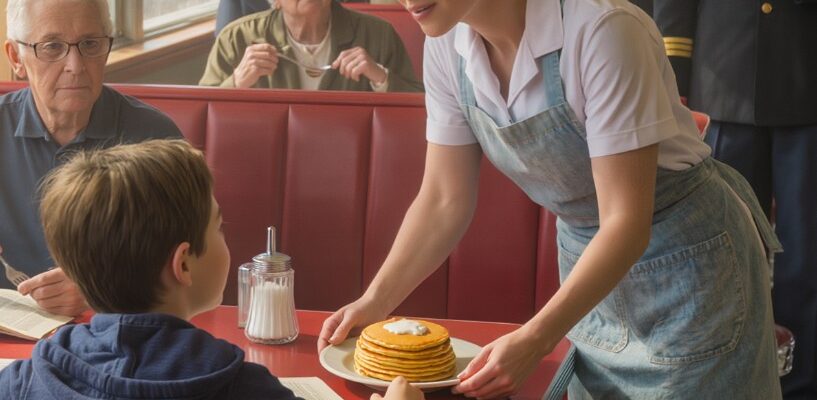
On the fifteenth day, she placed a plate of pancakes in front of him, pretending it was a mistake.
“Sorry, they mixed up the orders in the kitchen. Eat it so it doesn’t go to waste.”
The boy lifted his eyes, a mix of hunger and distrust. Jenny smiled and walked away. In a moment, the plate was empty.
“Thank you,” he whispered.
Thus began their quiet tradition. Sometimes she brought pancakes, sometimes oatmeal or scrambled eggs. He never spoke about himself, but always thanked her with a look.
Jenny’s coworkers began to notice.
“Who is this boy?” asked Harold, the former mailman. “I’ve never seen his parents.”

“I don’t know,” Jenny replied. “But he’s hungry.”
“Be careful,” sighed the cook, Katy. “He’ll get used to it, and then he’ll disappear.”
“Let it be,” Jenny answered gently. “I know what it’s like to be hungry.”
She didn’t ask his name, afraid of scaring him. She simply left food and water.
When customers began talking about the boy, mockery appeared:
“Here comes the savior!”
“Now everyone wants to be fed for free!”
Jenny remained silent. She knew kindness doesn’t need explanations.
One day the manager, Mark, called her over.
“We can’t give food away for free,” he said.
“I pay for it,” she replied calmly.
“With tips? You don’t get many.”
“It’s my decision.”
From that day on, she truly paid for the boy’s breakfast from her own tips.
But one day he didn’t come. The next day, neither. Jenny kept watching the door, waiting for him to enter. The plate of pancakes remained untouched. A week, two, three—the boy did not appear.
Someone posted a photo of the empty table online with the caption:
“At Rosie’s Diner, they feed invisible children.”

The comments were cruel—people laughed, mocked, and blamed.
In the evening, Jenny took out her father’s diary from a box—he had been a military medic. On one of the pages, she read:
“Today I shared my rations with a boy. Perhaps unnecessarily, but hunger is the same for everyone. No one becomes poorer by sharing bread.”
These words warmed her heart.
More than three weeks passed when, at 9:17 a.m., four black SUVs stopped in front of the diner. Men in uniforms stepped out. One of them—a tall officer with decorations—entered and asked:
“Who here is Miss Jenny Miller?”
“That’s me,” she said, putting down the coffee pot.
“Colonel David Reeves, U.S. Army,” he introduced himself. “I have an order from one of my soldiers.”
He took out an envelope and added:
“The boy you were feeding is named Adam Thompson. His father, Staff Sergeant James Thompson, was under my command. For several months, Adam lived alone. His mother had left him, his father was on a mission, and the boy was afraid to tell anyone.”
The colonel lowered his gaze:
“Two months ago, Sergeant Thompson was killed in Afghanistan. In his last letter, he wrote: ‘If anything happens to me, find the woman from the diner who fed my son. Tell her she gave him not only food—she gave him faith in people.’”
Jenny took the envelope with trembling hands. The soldiers stood silently. The colonel saluted. The customers stood up. Silence filled the diner.
A few days later, the story spread throughout the county. People who had previously mocked her now thanked Jenny. At the spot where the boy usually sat, a plaque was placed:
“Reserved for those who serve and for those who wait.”
Rosie’s Diner became a gathering place for veterans and their families. People left notes of thanks, coins, and little flags. On the counter now lay tips with a note: “Thank you for reminding us what humanity is.”

One day, Jenny received a letter, carefully written in a child’s handwriting:
Dear Miss Jenny,
I didn’t know your name until that day. But every morning, you were the only person who looked at me as if you really saw me.
Dad used to say that heroes wear uniforms. But I think sometimes heroes wear aprons.
Thank you for your kindness. I miss my dad. And your pancakes.
Your friend,
Adam Thompson
She placed the letter in a frame behind the counter.
From that moment on, Jenny and her diner became a symbol of simple, human kindness. Mark established a charity fund supporting military families, and a sign appeared in the window:
“Whoever you are. Whatever you can pay. No one leaves here hungry.”
One morning, Jenny found a military dog tag on the counter engraved with:
Semper Memor — Always in memory.
She smiled, thinking that perhaps the boy and his father somehow knew she remembered them.
Not every good deed is noticed,
but every one leaves a mark.