
After my wife’s death, I sent her son away — but ten years later, the truth hit me so hard that it almost destroyed me.
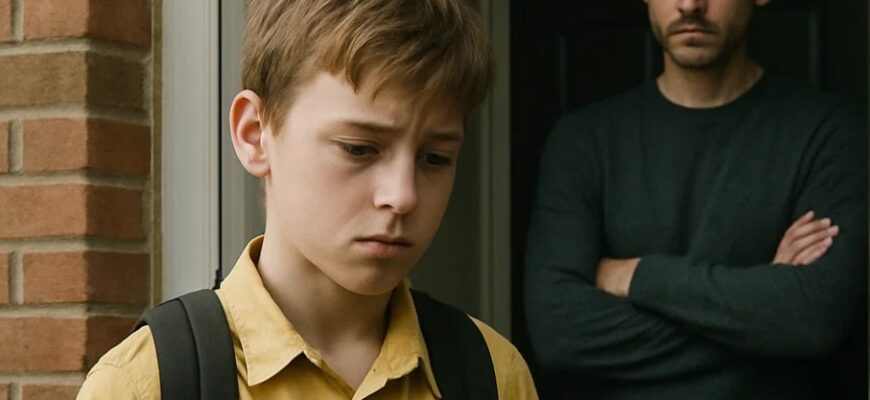
— Go away. You’re not my son. My wife is dead, and I owe you nothing. Go wherever you want.
He didn’t shed a single tear.
He didn’t ask to stay.
He didn’t even look back.
He simply took his worn-out backpack and left — quiet, small, and foreign.
I didn’t stop him.
At the time, I thought I was doing the right thing. That I had to move on, that I didn’t need anyone, that a stranger’s child was none of my concern.
But ten years later, the truth struck me in a way that no loss could compare.
My name is Alexander. I was 36 years old when my wife Elizabeth died. A sudden stroke. I didn’t even have time to understand what was happening. She was gone within a few hours.
She left me a twelve-year-old boy — her son Luis.
He wasn’t my child by blood.
That’s what I was told.
That’s what I kept telling myself.
Elizabeth had him before we met. I always considered myself generous: “I took responsibility,” “I took in a stranger’s child.” Only now do I understand — it was arrogance, not kindness.

As long as Elizabeth lived, I endured it. I pretended that Luis needed me. And when she was gone — the last thread connecting me to that boy disappeared.
He was quiet, polite, didn’t bother anyone. Maybe he sensed everything — my coldness, fatigue, reluctance to be a father.
A month after the funeral, I told him what I had kept inside for so long:
— Go. I don’t care what happens to you. If you survive — fine. If not — fine too.
I expected hysteria, tears, pleas.
But he simply nodded.
Picked up his backpack.
Left.
And I… felt nothing.
I sold the house. Moved away. Started a new life. Opened a business, met a woman without children — everything seemed easier, simpler.
Sometimes I thought of Luis. Not with anxiety — just as a distant episode.
Is he alive?
Where is he?
No one knew.
But time erases even curiosity.
Ten years later, an unknown number called:
— Mr. Alexander? We invite you to the opening of a gallery on Main Street. One person really wants you to come.
I was about to refuse when I heard:
— Don’t you want to find out what happened to Luis?
I froze. The name I hadn’t spoken aloud for ten years.
I went.
The gallery was modern, full of people.
Huge paintings on the walls. Cold, deep, as if breathing history.
I looked closely — felt a strange unease.
— Good day, Mr. Alexander.
In front of me stood a tall young man, slim, with thoughtful eyes. Calm, confident, foreign and… familiar.
I recognized him.
Luis.
Not a boy — a man.
Not broken — fulfilled.
— You… — it caught in my throat. — How…?
He didn’t let me finish.
— I wanted you to see what my mother left to the world. And what you once threw out of your life.
He led me to a painting covered with a red cloth.
— This work is called “Mother.” I never exhibited it. Today — for the first time.
I lifted the cloth.

I saw Elizabeth.
Pale, lying in a hospital.
In her hands — our photo. The three of us. From the only trip she had wanted to take us on.
My legs gave way.
— Before she died, she kept a journal — Luis said calmly. — She knew you didn’t like me. But she still believed that one day you would understand.
I raised my eyes.
— What… are you talking about?
His voice grew softer — but every word pierced me like a burning needle.
— I am not a stranger to you. I am your son.
I couldn’t breathe.
— She… what?
— Mom was pregnant when she met you. But she said the child was from another man. She wanted to see if you could accept us unconditionally. And then… it was too late to tell the truth.
The world around me collapsed.
I had thrown my own son away.
Left him alone.
Turned away.
Forgot.
And he… stood before me, alive, strong, talented — and all without me.
— My father… — I whispered. — I… your…?
— Yes — he answered calmly. — But you didn’t want to be a father. And I accepted that.
I tried to speak, to explain — but Luis stepped back.
— I don’t need anything from you. I only invited you so that you would know: Mom never lied out of malice. She believed that one day you would be able to love truly.
He handed me an envelope — a copy of her journal.
On the first page — her handwriting:
“If you ever open this — forgive me. I was afraid. Afraid that you would stay only for the child. And I wanted you to stay for love.”
I cried.
Quietly, almost silently.
I cried for the lost years, the forgotten love, the son I had rejected myself.
I didn’t give up.
For weeks I tried to meet him.
I stood by the gallery.
I sent short messages:
“How are you?”
“Do you need anything?”
“I’m nearby.”
He avoided me — but not harshly. Simply… without need.
And one day he said:
— You don’t have to atone for your guilt. I hold no grudge against you. But I don’t need a father. Because the one who was one when I was a child… chose to leave.
Those words were fair.
And sincere.
I offered him my savings. Everything I had.
— I don’t need your money — he said. — But I will accept it. Because Mom believed that you could become a good man.
And that was mercy.
His and Elizabeth’s.
Years passed.
Quietly, I supported his gallery:
helped with contacts, invited collectors, promoted his name.
Not as a father. As a man trying not to lose the last thread.
Every year I went to the temple on Elizabeth’s death anniversary and whispered:
— Forgive me. I realized too late. But I try to live well… for both of you.
When Luis turned 22, he was invited to an international exhibition.
On his profile he wrote:
“For you, Mom. I did it.”
And then — for the first time in ten years — he sent me a message:
“If you’re free… the vernissage is on Saturday.
— Luis”
I read it several times.
There was no word “son.” No word “dad.”
But in those lines was the most important thing: he allowed me to be close.
It wasn’t the end.
But a beginning.
Sometimes mistakes cannot be undone.
But sincere remorse can still reach the heart.
Happiness is not in perfection.
But in the courage to admit the pain we once caused,
and in the willingness to quietly, without expectation, do good.