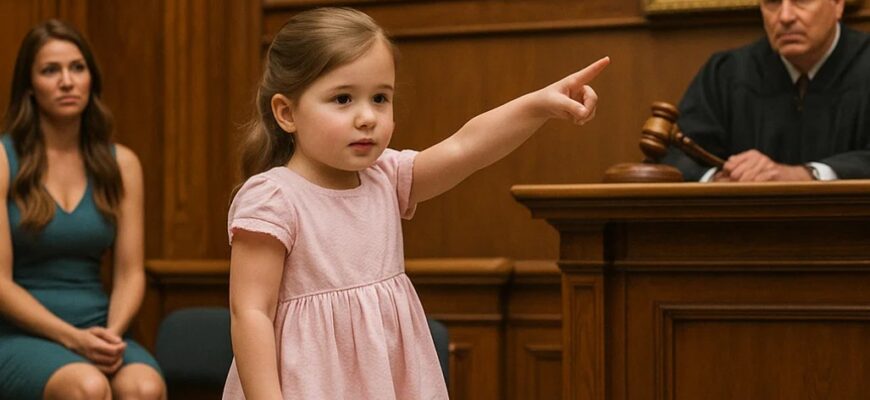

The doors burst open with such a bang that the sound echoed throughout the courtroom. Down the central aisle ran a four-year-old girl in a pink dress, smeared with mud. She had no shoes — she had lost them somewhere on the way.
“Kasia didn’t do anything!” she shouted as loudly as her small lungs allowed.
The judge raised his gavel but froze. The whispering in the room stopped. Every gaze turned to the small, trembling figure with messy hair and cheeks red from running.
Kasia sat on the defendants’ bench and felt her heart stop. Tears — the same ones that had been falling for weeks — ran down her face again. She couldn’t believe her eyes.
“Zosia…” she whispered.
The girl turned toward her. Their eyes met for a moment. Then, with a determination no one expected from a child, Zosia lifted her trembling finger and pointed to the first row.
“It was her,” she said quietly but clearly. “She’s my stepmother.”
Weronika, dressed in black, sat motionless with her hands folded on her knees. Her face still carried the mask of controlled sadness she’d worn through the whole trial. But something changed in her eyes — deep inside them, panic flickered.
The judge struck the gavel three times:
“Order! Order in the courtroom!”
His voice rose above the growing chaos. He announced a thirty-minute break.
Before anyone could react, Zosia was already running to Kasia. Security moved to stop her, but the lawyer raised his hand.
“She’s the victim’s daughter,” he said quietly to the judge.
Kasia leaned down as far as the handcuffs allowed. Zosia grabbed her hands and whispered something only she could hear:
“It wasn’t you, Kasia. I saw what she did.”
Half a year earlier, the Nowak family home looked completely different.
Sunlight streamed through the large living-room window, reflecting off red-wood furniture and Persian rugs Jan brought from business trips. Zosia sat on the floor surrounded by dolls, but she wasn’t playing with them. She watched the adults on the couch like actors in a play she didn’t understand.
“Zosia, sweetheart, come here,” Jan said in the special tone he used when he wanted her to listen. “I want to introduce you to someone very important.”
The woman sitting next to him was beautiful. She had long, shiny chestnut hair like a fairy-tale princess and a blue, clearly expensive dress. When she smiled — her teeth were perfectly white.
“Hello, sweetheart,” she said, leaning forward. “I’m Weronika. Your dad and I are planning a wedding.”

Zosia looked at her father uncertainly:
“Does that mean you won’t travel so often anymore?”
Jan laughed and lifted her into his arms.
“It means Veronika will become your new mom. Isn’t that wonderful?”
Zosia didn’t know what to feel. She barely remembered her real mother — she had died when the girl was two. But Kasia had always been there: reading her stories, putting her to sleep, calming her after nightmares.
Veronika stretched out her arms:
“Come here, sweetheart. We will be happy together.”
When Zosia came closer, Veronika hugged her… but the hug felt strange. As if she were hugging a big, cold doll. Veronika smelled of expensive perfume, but underneath that scent there was something else — something that made the girl want to pull away.
Kasia stood in the kitchen doorway. She had worked in the house for three years, after Marta’s death. She had seen Zosia’s first steps, heard her first words after the trauma. To her, the girl was more than a responsibility — she was like the daughter she never had.
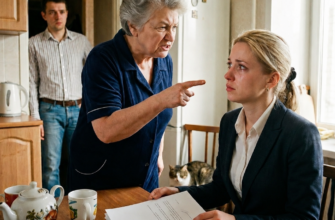
The way Veronika looked at Zosia didn’t let Kasia rest easy.
Whenever Jan turned around to take a call or check something, Veronika’s smile vanished. She looked at Zosia like an obstacle she needed to remove.
“Kasia, could you bring us some coffee? Veronika and I have a lot of plans.”
“Of course.”
While Kasia prepared the coffee, she overheard the conversation in the living room. Jan talked about the wedding, the future, how happy he was to build a family again. Veronika responded with perfectly chosen phrases, but her voice sounded memorized.
“Oh, she’s so sweet,” Veronika said when the conversation turned to Zosia. “We will become best friends.”
When Kasia came in with the tray, she saw Veronika holding Zosia by the shoulder a little too tightly. The girl stiffened and stared out the window — as if she wanted to escape.
“Coffee,” Kasia said, setting down the tray.
“Thank you, Kasia,” Jan said without looking up. “By the way, I’m leaving next week. For ten days.”
Kasia noticed something flash in Veronika’s eyes — something very different from sadness.
“So soon?” she asked. “But we just started getting to know each other — both me and Zosia.”
“That’s how it has to be, darling,” Jan replied. “You’ll get used to it. Kasia will help.”
“Of course,” Veronika said quietly, but the look she gave Kasia was far from friendly.
That evening, when Veronika went to her room and Jan worked in his study, Kasia helped Zosia bathe and change into her pajamas. It was their favorite evening ritual.
“Do you like Veronika?” Kasia asked while brushing the girl’s hair.
Zosia shrugged.
“I don’t know. She smells weird.”
“Weird? How?”
“Like… like when Dad forgets to change the water in the vase with flowers.”

Kasia frowned. The comparison was unusual, but children often sense what adults ignore.
And then Zosia hugged her tightly and whispered through tears:
“Promise you’ll always stay with me. I’m only not scared when you’re here.”
Kasia held the girl close, as if she wanted to shield her from the whole world — but even then she didn’t know how soon she would have to keep that promise.
And now, half a year later, in the crowded courtroom, her world was falling apart and coming together at the same time.
When the break ended, the room slowly quieted. The judge returned, the lawyers stood, the guards took their positions. But everyone waited for only one thing — the words of the little girl who had changed the entire trial in a single moment.
Zosia was seated on a high chair in front of the judge. To help her feel less small in the large, cold room, they placed a pillow under her feet.
“Zosia,” the judge said gently. “Do you know why you’re here today?”
The girl nodded. She was still shaking, but she spoke surprisingly clearly:
“Because I have to tell the truth.”
Kasia closed her eyes. Her lips trembled — she feared for the child, for the weight she had to carry.
“All right,” the judge said. “Please tell us what you saw that evening.”
The room fell so silent that the rustling of nervous papers could be heard. Veronika sat motionless, but her hands were clenched together so tightly they turned pale.
Zosia took a deep breath, like before jumping into cold water.
“I heard Dad and Veronika arguing,” she began softly. “And then… Dad fell. I got scared and hid behind the door. But I saw… I saw that Kasia was in the kitchen. She was washing dishes. She couldn’t… she couldn’t have done anything wrong.”
Her voice cracked, but she went on — stubbornly, with childlike honesty:
“I know it wasn’t Kasia. I saw Veronika push Dad. I thought he would get up later. But he didn’t…”
The girl covered her face with her hands. The courtroom sighed — not in judgment, but in pain. Pain for a child who had seen something no child should ever have to see.

The judge put down his pen and said calmly, with human warmth:
“Thank you, Zosia. You are very brave.”
Kasia’s defense lawyer stood up:
“Your Honor, I request the immediate acquittal of my client.”
Weronika tried to say something, stood up, but her voice was lost in the noise of the courtroom. Security stepped forward. The mask of calmness fell from her face — and it was clear she no longer had control.
Kasia sat still as the judge announced the decision. Only when the handcuffs were removed could she take her first full breath in weeks.
Zosia ran into her arms, and Kasia hugged the girl as if holding the most important thing she had ever had.
“It’s okay now, sweetheart,” she said through tears. “Everything will be fine now.”
And for the first time in a long time, she truly believed it.
Later, when they left the courthouse, the lawyer said carefully:
“Kasia, you’ll need support. After events like this, it won’t be easy. I recommend getting help from a specialist — for both you and Zosia. You must rebuild yourselves.”
Kasia nodded. She understood: the road ahead would be long, but finally it was their own road — honest, clear, and free.
Zosia squeezed her hand:
“You promised you’d always stay with me.”
Kasia smiled — tired, moved, but genuine:
“And I will keep that promise.”
Because sometimes a true family is not the one bound by blood, but the one chosen with the heart.