
The church seemed unbelievably small for a grief so immense.
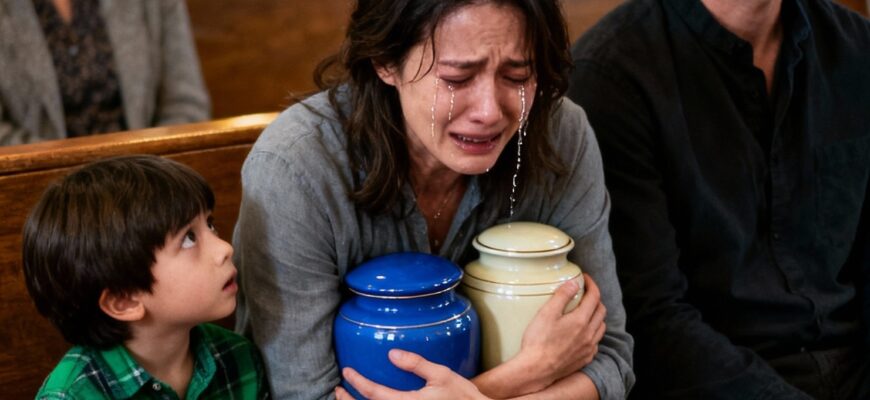
The air was saturated with the scent of lilies and old polished wood – a heavy smell that pressed on my throat and accompanied every breath, as if sorrow itself had substance. Light filtered through the stained glass, casting muted blues and warm ambers on the pews, but nothing eased the pressure weighing on my chest. Sitting in the front row, back stiff, hands trembling, I held two urns that no parent should ever have to carry – both unbearably light for the lives they contained.

My twins, Caleb and Noah, should have been six months old.
Instead, they rested in the palms of my hands. Silent. Finished.
Beside me, my husband Aaron stared into the void, motionless. His face was frozen in shock, his jaw so tight I could see the muscles contract as he swallowed. Since the hospital had called us in the dark, before dawn, he hadn’t cried. He had said almost nothing. Grief had emptied him, leaving him distant, torn between guilt and disbelief.
Behind us, family filled the pews, whispering phrases people say when words fail. God’s plan. Everything happens for a reason. These phrases floated in the air and descended on me like a silent reproach. I nodded when spoken to – because that’s what’s expected at a funeral – even though every remark, however well-meaning, seemed to erase the children I had lost.
Then Margaret cleared her throat.
My mother-in-law sat two rows ahead, back straight, hands neatly on her lap, as if attending an official ceremony rather than a mourning. She leaned toward the woman next to her, just enough to be heard, without being discreet.
“God took these babies because He knew what kind of mother they had,” she said evenly, almost kindly, as if comforting rather than judging.
Some nodded, uncomfortable. Others looked away. No one stopped her.
Those words rang louder than any scream. My vision blurred, my ears buzzed, and for a terrifying second, I thought I would stand up and collapse all at once. I waited for Aaron to speak, to protest, to defend me, but he didn’t. His shoulders slumped further, as if that sentence had drained the last of his strength.
I had never felt so alone.
Then I felt a gentle tug on my sleeve.
I looked down and saw my daughter June, barely four, her brown curls tied with a ribbon I had braided that very morning with a trembling hand. Her eyes were wide, but thoughtful rather than afraid, like children noticing far more than adults realize.