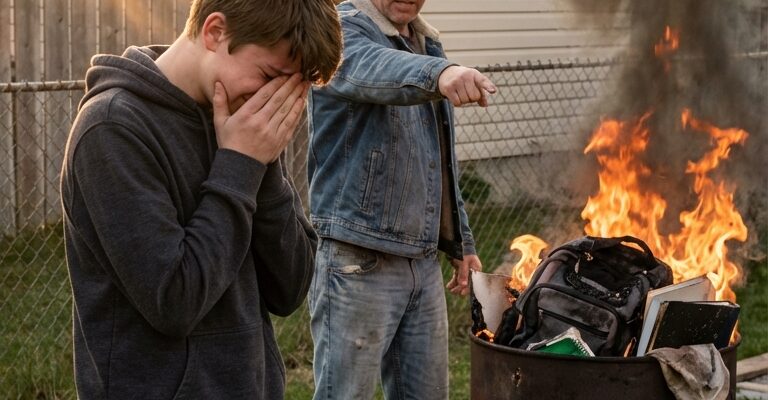

I stood there as my father threw my clothes, my books, and the last photo of my mother into the fire like my life meant nothing. Then he looked straight at me and said, “This is what happens when you disobey me.” I didn’t say a word.
Six years later, I called him and whispered, “Check your mailbox.” Inside was a photo of me standing in front of his house. The house I had just bought. And that was only the beginning.
My father burned everything I owned in the backyard when I was nineteen.
Not just a few clothes or old belongings. He brought out my clothes, notebooks, work boots, my mother’s coffee mug, my graduation photo, even my old laptop. He threw everything into a metal barrel and set it on fire behind our house in Dayton, Ohio.
“This is what happens when you disobey me,” he said.
I stayed silent as the smoke rose.
The argument started because I told him I was leaving for a trade program in Columbus. He wanted me to stay and work under him. In his mind, I wasn’t a son—I was labor under his control.
He insulted me, tried to humiliate me, but I didn’t back down.
That morning, I had already moved my important documents, savings, and acceptance letter elsewhere.
So when the fire ended, I left.
He told me never to come back.
Six years later, I called him again: “Check your mailbox.”
Inside was a photo of me in front of his house—the one I had bought at auction.
That moment wasn’t about revenge. It was about a promise I made that day: never to become like him.
I survived with almost nothing, worked construction jobs, studied at night, and slowly built my own company. Years passed of hard labor, learning, and struggle. But eventually, I earned my contractor’s license and built a business.
I learned how to fix broken houses—and broken systems.
I heard news about my father only indirectly. He lost the house over time, failed to pay taxes, and fell behind financially.
One rainy morning, I saw the auction listing: his house.
I went to the auction.
The others saw just a damaged property. I saw my past.
I won the bid.
Not out of emotion—but calculation.
When I stood in front of the house again, it felt smaller. The yard was worn down. The place where he burned my things was still there.
I took a photo and called him.
“Check your mailbox,” I said.
Inside the envelope was the photo of me standing there.
I followed the legal process. I didn’t act out of revenge.
When he finally left, I told him:
“You taught me what power looks like in the wrong hands. Thank you for teaching me what I never want to become.”
A month later, I sold the property and used the money to help support transitional housing for young people leaving foster care.
Real victory isn’t revenge. It’s building a life so strong that the past no longer controls you.