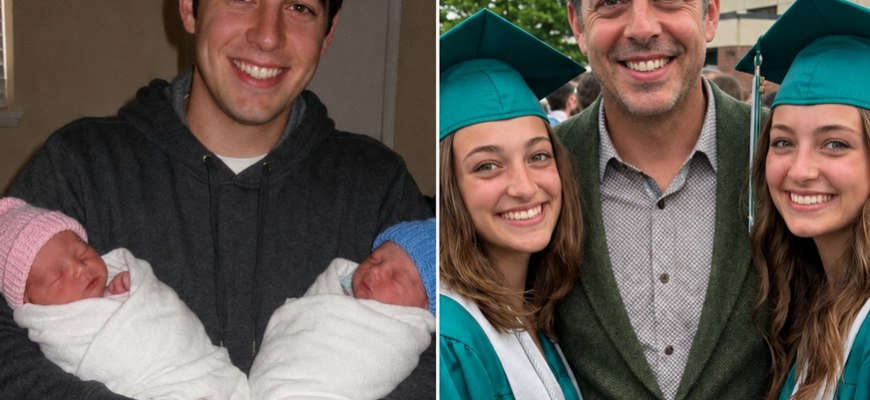


I used to say it before tests or after difficult conversations. As they got older, they started rolling their eyes like teenagers do, but I knew they were listening. I never spoke about Claire with hatred. I only told them: “Your mother made a choice she believed was right for herself. And I made a different one.”
What I never told them was that during the first years, I wrote letters to her. I put birthday photos, kindergarten pictures, copies of report cards, and notes about their small achievements into envelopes. I did it for the girls, so that one day I could tell them that I had never closed the door to their mother. At first, the letters came back unopened. Later, every single one was returned. I kept those unread messages in a box in the closet—year after year, like paper silence.
When they turned sixteen, I placed the box on the table. I showed them all the letters and photos and said, “I tried to keep the door open. She never walked through it even once. And that is not your fault.” The girls sat in a deep, grown-up silence that felt heavier than tears. At that moment, everything fell into place.
Two years later came the day of their graduation. The auditorium was full of proud parents and noise. Suddenly, the principal announced that one of the sponsors had prepared a special gift for two graduates. An elegant woman in an expensive suit stepped onto the stage.
It was Claire. I recognized her immediately. She was older, more confident, and wealthier. She took the microphone and began speaking about the mistakes of youth, regret, and how it is never too late for a second chance. Then she added:
“I would like to invite two extraordinary young women to the stage. Lily and Grace. My daughters.”
A murmur spread through the hall. The girls stood up and, holding hands, walked onto the stage. Two expensive gifts lay beside Claire. She handed them over and then turned to the audience.
“Their father spent eighteen years turning them against me. I hope that today this story finally comes to an end.”
Absolute silence fell over the room. Claire opened her arms, waiting for hugs and her moment of triumph. But the girls did not move. Grace took the microphone and spoke calmly:
“Our father never turned us against you. Quite the opposite. For years, he sent you photos, letters, and report cards. He showed us the envelopes that came back unopened. He did it not so that we would hate you, but so that we would know the truth.”
People in the audience began exchanging glances. Then Lily stepped forward.
“He never said a bad word about you. He only said that you made a choice. And then, every day, he made his own. He raised us.”
Grace finished her sister’s thought:
“You gave birth to us. But Dad stayed.”
With those words, Lily and Grace placed the gifts back on the table.
“We don’t need these gifts,” Lily added quietly. “You missed too much. Things like this cannot fill eighteen years.”
Before me no longer stood the children whose braids I used to clumsily weave. Standing there were two young, strong women who knew their worth and refused to let a beautiful speech rewrite their lives. They stepped off the stage, came to me, and sat on either side of me, taking my arms. After a moment of silence, someone in the back rows began to clap. Soon the entire hall was applauding. Claire left before the ceremony ended.
Five days later, I helped them pack for college. We carried boxes and joked about the number of books and mugs they owned. Then evening came. I got into my car and, for the first time in eighteen years, drove home completely alone. The silence in the car felt unnatural.
Halfway home, I noticed a hidden note on the passenger seat. I pulled over, opened it, and read a single sentence:
“You chose us every morning. And that meant everything to us. With love, Lily and Grace.”
And then, for the first time in a very long time, I sat in silence and cried. Not because of Claire, but because all those ordinary days—bowls of cereal, thermometers in the middle of the night, and imperfect braids—had truly meant something.
That is what real parenthood is made of. Not beautiful words spoken into a microphone or expensive boxes tied with ribbons, but staying when things are difficult and frightening. Love is rarely loud. Most often, it looks like a person who gets up every morning and chooses their children again, saying: “I’m here. I’m not going anywhere.”
That is what my daughters remembered. And in the end, that turned out to be what mattered most.