
Saturday started perfectly.
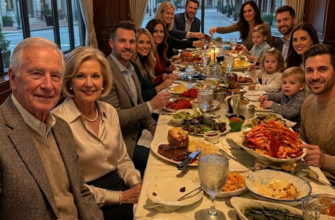
The backyard was filled with the smell of barbecue smoke, freshly cut grass, and the apple pie our neighbor had baked. The men argued about how long steaks should stay over the fire, the children ran across the lawn with water guns, and my daughter Emma wandered among the guests wearing a paper crown.
She loved that crown.
“Princesses never take off their crowns,” she declared that morning.
“Not even to sleep?”
“Especially not to sleep.”
My husband Ryan stood by the grill, trying to convince my father that he could cook meat better than he could. That argument had lasted throughout our eleven years of marriage, and I doubted it would ever have a winner.
“Five more minutes,” Ryan said as he flipped the steaks.
“You said that twenty minutes ago,” my father pointed out.
“Good meat can’t be rushed.”
“What about hungry guests?”
I smiled and went to get some lemonade.
Just then, my stepmother walked into the yard.
Her name was Margaret.
She always arrived quietly, as if she were afraid of disturbing someone else’s happiness.
Even after fifteen years of marriage to my father, she never felt like part of our family.
When I was sixteen, my mother died.
Two years later, my father met Margaret.
I hated her before I had even seen her.
It seemed unfair that someone else dared to sit at our table, use my mother’s mugs, and live in the house that still carried the scent of her perfume.
Margaret never tried to take my mother’s place.
Never.
She didn’t rearrange the furniture.
She didn’t throw away my mother’s belongings.
She never called me her daughter.
She was always too careful.
And perhaps that was exactly why a wall grew between us—a wall neither of us ever dared to tear down.
“You’re late,” my father said as he walked toward the gate.
“A little.”
“As always.”
She smiled and handed him a bag of homemade cookies.
Even now, after all these years, she looked as though she were waiting for permission to come inside.
Emma was the first to run to her.
“Grandma Maggie!”
Margaret crouched down, hugged her, and handed her a box tied with a blue ribbon.
Inside was a wooden tea set.
“Shall we have a tea party?”
“After the barbecue.”
“That’s not fair,” Emma sighed dramatically.
The next few hours passed the way all family gatherings do.
Loud.
Noisy.
Too much food.
Too many children.
Too many memories.
Margaret helped set the table, collected empty glasses, and kept straightening the tablecloth that the wind constantly tried to carry away.
“Why do you never relax?” I asked.
She shrugged.
“It’s a habit.”
“You could just sit down.”
“I feel calmer this way.”
That was typical of her too.
Margaret was always somewhere nearby, but never at the center of attention.
When the sun became unbearably hot, the children started asking for the inflatable pool.
Ryan set up the large round pool in the middle of the yard and filled it with water.
Within minutes, half the children were splashing around in it.
To my surprise, Margaret decided to join them.
She took off her light cover-up, revealing a simple navy-blue swimsuit.
And that was when everything happened.
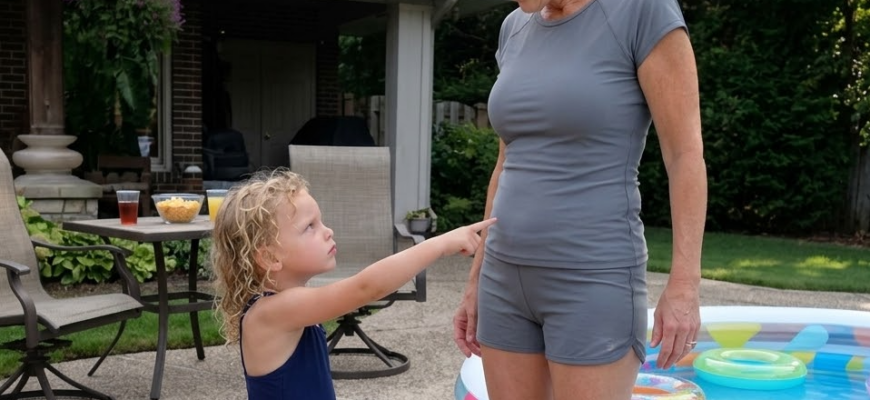
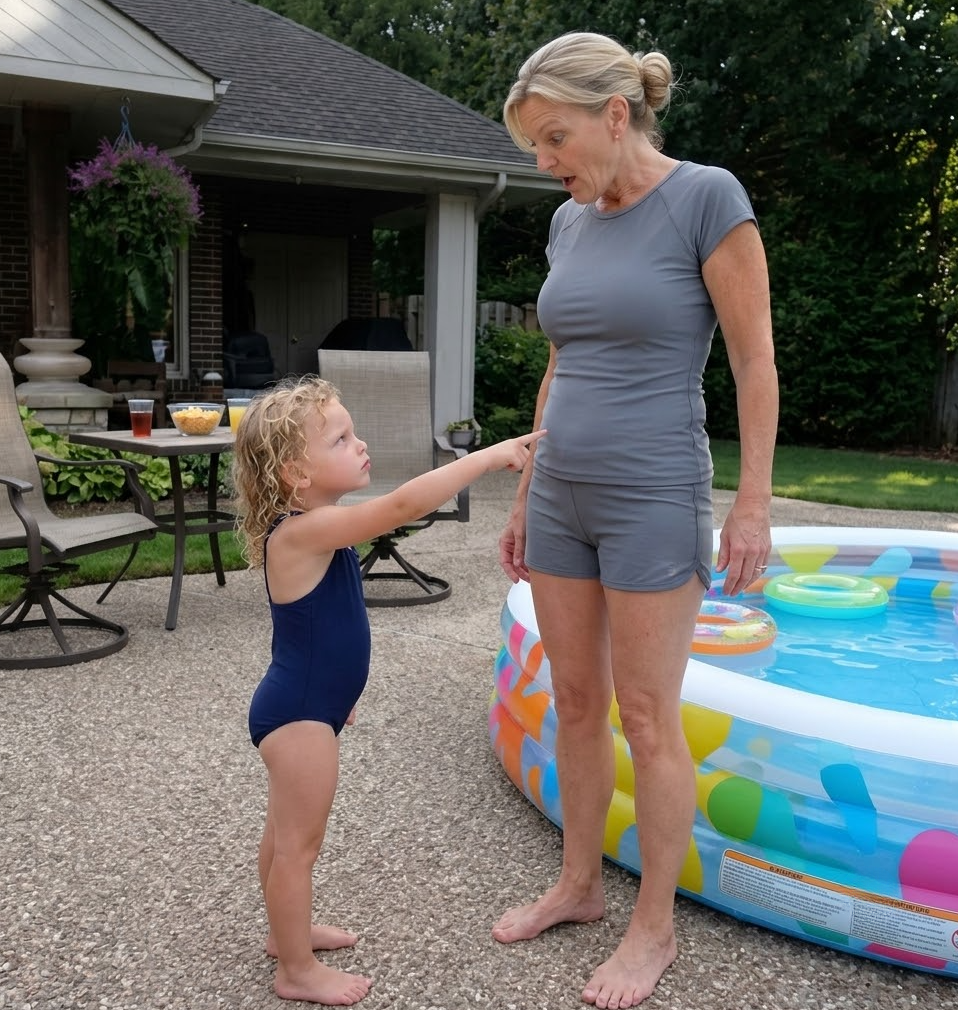
Emma suddenly stopped in the middle of the yard.
She stared at Margaret for a long moment.
Then she raised her hand and pointed at her stomach.
“Mom!”
Everyone turned around.
“What is it?”
“Dad is hiding inside Grandma’s tummy!”
Silence fell.
Then everyone burst into laughter.
My father nearly choked on his lemonade.
“I sincerely hope not,” Ryan said, raising his hands.
Even I couldn’t help smiling.
“Emma, sweetheart, it’s not polite to point.”
But she kept staring at Margaret.
“No, Mom. Dad is in there.”
“Dad is standing by the grill.”
“No!”
Suddenly she burst into tears.
Not the kind of tears children cry over a broken toy.
These were tears of fear.
She grabbed my hand.
“I’m not lying! Look!”
Margaret lowered her eyes awkwardly.
I stepped closer.
At first, I didn’t notice anything.
Then she turned slightly.
And that’s when I saw it.
Just beneath her ribs, along the edge of her swimsuit, part of an old tattoo was visible.
A small lighthouse.
And beside it, a crooked little smiling sun.
My heart stopped.
Because I knew that little sun.
Ryan drew it everywhere.
On sticky notes.
On postcards.
On Emma’s paper lunch bags.
On the bathroom mirror after a shower.
It was his drawing.
His little lucky charm.
Slowly, I looked up at my husband.
He had gone pale.
Truly pale.
“Ryan…” I said quietly. “Why is your drawing on my stepmother’s body?”
The yard fell so silent that you could hear the crackling of the glowing coals.
Ryan took a step forward.
“I can explain.”
Those were the worst words he could have said.
Always.
Because people only say them when something terrible has happened.
My father slowly rose from his chair.
Margaret pressed a towel against her chest.
“It’s not what you think.”
“Then what is it?”
Emma walked up to Ryan and said,
“Daddy always draws that little sun.”
He let out a heavy sigh.
“Yes.”
Expressions of surprise spread across the guests’ faces.
“Twenty years ago,” Ryan began, “I volunteered at a support center for people recovering from surgery.”
I frowned.
He had never told me about that.
“They held art therapy sessions there. People were encouraged to create drawings that helped them accept their bodies after serious illnesses.”
Margaret slowly sat down.
“I remember you,” she whispered.
Ryan looked at her in surprise.
“You do?”
“You always had paint all over your hands.”
He smiled without meaning to.
“Yeah… That sounds like me.”
My father looked back and forth between them.
“Wait. You two knew each other?”
“No,” they answered in unison.
Margaret ran her fingers over the tattoo.
“I had undergone a complicated operation back then. It left me with a huge scar. I couldn’t bear to look at myself in the mirror.”
My father froze.
“You never told me.”
She gave him a sad smile.
“I didn’t want people to pity me.”
Ryan continued,
“During one of the sessions, I asked everyone to draw a symbol of hope.”
“And you drew a lighthouse,” Margaret finished.
She lowered the towel.
Beneath the lighthouse were barely visible words:
‘Keep shining.’
I felt something shift inside me.
Twenty years earlier, the young man I would one day meet and fall in love with had helped the woman I had struggled to accept for so many years.
What were the chances of something like that?
“You kept the drawing?” Ryan asked.
Margaret smiled through her tears.
“It reminded me that I survived.”
No one said a word.
Even the children fell silent.
And suddenly I realized that, for the first time, I wasn’t looking at her as the woman who had married my father.
I was looking at her as a person.
Frightened.
Lonely.
Someone who had once been terrified of losing everything.
But one question still wouldn’t leave my mind.
“Then why did you never love me?”
Margaret flinched.
“What?”
“You always kept your distance. You left early. You avoided holidays. My whole life, I thought you hated me.”
She remained silent for a moment.
Then she said something I never expected.
“Because I was afraid.”
“Of me?”
“That you would never forgive me for not being your mother.”
A lump formed in my throat.
“The first time I saw you, you were sitting on the stairs wearing your mother’s green sweater. You were crying and holding her photograph. That’s when I realized I could never take her place.”
She lowered her eyes.
“That’s why I decided that, at the very least, I wouldn’t hurt you.”
I thought back over all those years.
The gifts wrapped in brown paper because that’s how my mother used to do it.
The cakes baked from my mother’s recipes.
The photos from my school graduations, where Margaret always stood off to the side.
All that time, I had mistaken her caution for indifference.
But perhaps she had simply been just as afraid as I was.
Emma walked over to Margaret and climbed onto her lap.
“Grandma, does that lighthouse still work?”
Margaret smiled through her tears.
“I think it does.”
“That’s good,” Emma nodded seriously. “Because a family needs a light.”
That evening, the guests stayed later than usual.
Ryan was once again standing by the grill.
For the first time in many years, my father was holding Margaret’s hand.
And Emma was drawing with chalk on the path in front of the house.
When I walked over, she showed me her drawing.
There was a large lighthouse.
Four adults.
And a little girl wearing a crown.
“What’s this?” I asked.
She smiled.
“Family.”
And for the first time in fifteen years, that word no longer hurt.