For five years, my father charged me rent for my room while I could barely make ends meet. Over time, I began to hate him. However, after his funeral, my father’s best friend handed me a box that changed everything I thought I knew about him.
Before Mom died, our home was always filled with music.
Almost every evening, Dad would sit on the living room couch and play the guitar while Mom sang in the kitchen.
“Come on, old man,” Dad would say, patting the spot beside him. “It’s your turn now.”
I’d climb onto the couch with my toy guitar and imagine performing in front of thousands of people.
Sometimes Mom would use a wooden spoon as a microphone and make me laugh so hard that I’d forget the lyrics to the songs.
But when I was nine, Mom died, and the music disappeared from our lives.
Dad put away his guitar and started working overtime. He came home completely exhausted and barely spoke to anyone.
There was always food in the fridge, and he signed my school papers without any trouble, but he almost never asked how my day had gone.
One day, I asked him:
“Dad, could you buy me some new shoes? These ones let water right through.”
“Put on another pair of socks,” he replied without even looking up from his plate.
I had a father, but I hardly ever felt his fatherly care.
When I turned twelve, I found some old photographs in a drawer. In the pictures, Dad stood onstage with a guitar, his long hair falling to his shoulders, while the crowd applauded enthusiastically.
“Dad, were you in a band?”
“That was a long time ago.”
“What was it called? Did you record an album?”
He suddenly snatched the photographs out of my hands.
“Stop asking questions.”
But my curiosity didn’t disappear.
One evening, I asked him if he’d ever dreamed of becoming famous.
Dad stared into his coffee cup for a long time.
See More
Gift Ideas
Improve Your Language Skills
DNA Tests
“Once, that was my dream. But my time has passed. Maybe you’ll inherit that dream.”
Back then, I didn’t understand what he meant.
When I turned sixteen, I taught myself to play the guitar and started writing songs. I dreamed of studying music production and recording my own album one day.
When I showed Dad the program I wanted to study, he barely glanced at the brochure.
“Music doesn’t pay the bills. Find yourself a proper job.”
“But you played music yourself!”
“And look where it got me.”
He turned around and walked out.
That evening, I saw him standing beside his old guitar. For a moment, I thought he was about to pick it up.
But Dad simply turned off the light and went to bed.
On my eighteenth birthday, he placed a scrap of paper on the kitchen table.
“You’ll pay $250 a month for your room. On the first day of every month.”
I stared at him in disbelief.
“You’re going to charge your own son rent?”
“You’re an adult now.”
“But it’s my birthday today!”
“Consider it your first lesson in responsibility.”
I waited for him to smile, but Dad simply continued drinking his coffee.
I was already working part-time, but now I had to take extra shifts and stock shelves at the supermarket.
After paying for my room, food, gas, and other expenses, I had almost nothing left.
Whenever I managed to save a little money, another expense came along. My car would break down, my work hours would be cut, or my work shoes would wear out.
Meanwhile, Dad would occasionally buy himself beer or new fishing gear.
“Must be nice having money for your own hobbies,” I muttered one day.
He heard me.
“Work hard enough, and you’ll have money for them too.”
When I was nineteen, I finally managed to save enough for a used microphone and an audio interface. I recorded songs in my bedroom, hanging blankets on the walls to improve the acoustics.
One evening, Dad appeared in the doorway.
“Turn that down. I’ve got work tomorrow.”
“I’m almost finished.”
“I said turn it off.”
I took off my headphones.
“You just can’t stand seeing me do something I genuinely love, can you?”
“I can’t stand watching you ruin your life the same way I once ruined mine.”
The argument ended with me slamming my bedroom door so hard that a picture fell off the wall.
Over time, I recorded music less and less. Most of the time, my guitar stayed in its case, although I still played whenever Dad wasn’t home.
His best friend, Frank, visited us from time to time. Occasionally, the two of them would leave together, carrying instruments or old equipment. I thought they were fixing something in Frank’s garage.
By the time I turned twenty-three, Dad and I had almost completely stopped talking.
We passed each other in the hallway like strangers, and every month, I left $250 on the kitchen table.
Sometimes, I noticed Dad watching me, but he never said anything.
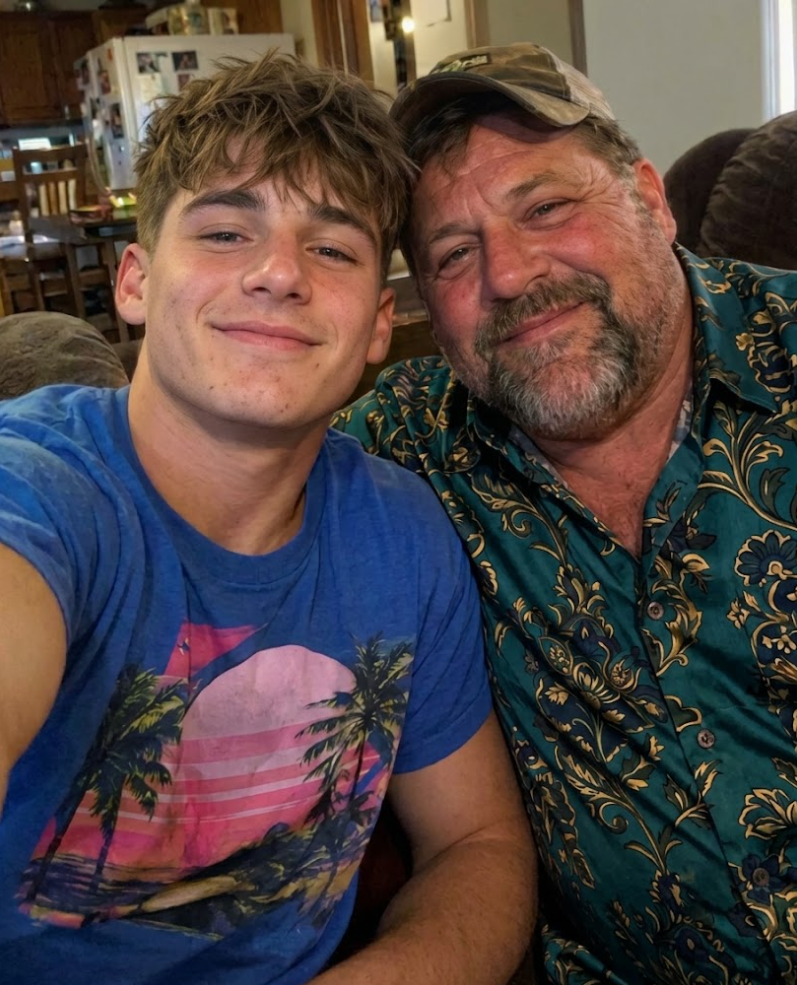
Five years after he started charging me rent for my room, Dad died of cancer.
I often imagined what it would be like when I finally had the house to myself. But after the funeral, I stood in the hallway, staring at his work boots by the door, unable to bring myself to put them away.
During the last week of his life, we barely spoke. Our final conversation was about a leaking kitchen faucet.
Now we would never exchange another word.
That evening, someone knocked on the door.
Frank, my father’s oldest friend, stood on the doorstep. He was holding a cardboard box sealed with tape.
“Your father left this with me,” he said.
He placed the box on the kitchen table.
“He wanted me to give it to you only after he died.”
I laughed bitterly.
“What, did he save every dollar from the money I paid him?”
Frank remained serious.
“Don’t jump to conclusions before you see what’s inside.”
I ripped off the tape and opened the box.
At first, I thought Frank had mixed up the packages.
Inside was an old leather vest covered in music band patches. Beside it were backstage passes, guitar picks, and photographs of Dad from his performing days.
Then I found a photograph of Mom.
She was standing beside Dad, smiling as he played the guitar. He looked happier than I had ever seen him during the last fourteen years.
Memories of those musical evenings in our living room came flooding back.
I sat in my father’s armchair and cried so hard that Frank had to hold me up.
He stayed with me until I calmed down a little, then quietly left.
As I put the photographs back into the box, I noticed something metallic beneath the vest.
It was a key with a small tag bearing an unfamiliar address.
I turned it over, trying to find some explanation.
Nothing.
There was no note or letter in the box.
I grabbed my jacket and car keys.
The address led to the outskirts of town, beyond the warehouses and an abandoned gas station.
I had lived here my entire life, but I couldn’t remember ever being in that neighborhood.
I checked the tag again. The address was correct.
“What were you doing here, Dad?” I whispered.
I walked around the building, searching for any clues. There was no sign, no parked cars, and not the slightest sign of life behind the windows.
Everything looked abandoned except for the clean doormat in front of the entrance.
I inserted the key into the lock. It turned without the slightest resistance.
I hesitated, afraid I might discover something about my father that would have been better left unknown.
Still, I opened the door, switched on the light, and stepped inside.
I froze, trying to make sense of what I was seeing.
The walls were covered with dark acoustic panels. A large mixing console stood in the corner, surrounded by speakers and computer monitors. Microphones and guitar amplifiers sat nearby, and a drum kit stood behind a glass partition.
It was a recording studio.
I stepped closer and carefully ran my fingers over the mixing console. Everything was impeccably clean, as if someone had been taking regular care of the equipment.
“Dad?” I whispered, almost expecting to hear an answer.
Then I noticed a wall covered with photographs, concert posters, and newspaper clippings.
In one photograph, Dad was much younger, holding his guitar high above his head beneath the stage lights.
In another, the crowd was reaching toward the stage.
I walked over to a newspaper clipping.
“Local Rock Band Sells Out Riverside Theater for the Third Consecutive Time.”
I read the headline twice.
My father had performed in front of packed venues. People had paid to hear his music.
And he had never told me about any of it.
“Why did you hide all this?” I muttered.
I approached the instruments.
Electric guitars, keyboards, and professional recording equipment filled almost the entire room. I recognized an audio interface that had once cost more than three of my monthly paychecks.
Then I noticed something beside the keyboard.
An old black guitar with a small silver star near the neck.
My guitar.
I had bought it secondhand when I was sixteen and played it almost every day until my arguments with Dad became unbearable.
Later, while tidying my room, the guitar had disappeared. I assumed I had accidentally thrown it away.
But now it was standing here, fitted with brand-new strings.
I picked it up and examined it carefully.
Someone had even repaired the crack near the bridge.
My throat tightened.
For the first time, I wondered whether Dad had built this studio not for himself, but for me.
Maybe he had built it for me.
But why? And why had he always pretended to hate music?
I carefully returned the guitar to its stand.
A small USB flash drive lay beside the mixing console.
I picked it up. Two words had been written on a piece of tape in familiar handwriting:
“Our Band.”
I plugged the drive into the nearest computer. There was one video file on it.
I clicked “Play.”
The screen flickered, revealing grainy footage of four young men rehearsing in a cramped garage.
Dad was among them, with long hair falling below his shoulders and a guitar in his hands. A cigarette was tucked behind his ear.
“Come on, Frank!” he shouted at the drummer. “My grandma keeps better time than you!”
“Then invite her to join the band!”
They all burst out laughing.
The footage changed quickly: performances, backstage moments, and funny incidents during rehearsals.
In one scene, Dad tried to make a dramatic jump off a speaker cabinet but landed flat on his backside.
In another, the bass player knocked over a tray of drinks.
I laughed until tears filled my eyes.
I had never known this man. He was energetic, cheerful, and talkative—completely different from the silent man I had shared breakfast with at the same table.
Suddenly, the video cut off.
The screen went black.
A few seconds later, Dad appeared.
Not the young musician from the old recordings, but the same man we had buried that morning.
He was sitting in the same studio. His face was gaunt, and most of his hair had fallen out because of the cancer.
“Hi, son.”
I stopped breathing.
Dad looked down at his hands before speaking again.
“You know, I’ve never been good at talking about things like this. About feelings. You know that better than anyone.”
He tried to smile.
“First of all, I want to say… I’m sorry.”
I gripped the edge of the table more tightly.
“I worried so much about making sure you had a normal life that I forgot something truly important. Life should bring you joy. It shouldn’t be only about paying bills.”
He shook his head.
“When your mother died, I was scared. I thought that if I worked hard enough, provided you with a roof over your head, and taught you to be independent, I would be fulfilling my duty as a father.”
He fell silent.
“But somewhere along the way, I forgot how to be your dad.”
I swallowed hard, feeling my eyes fill with tears.
“A while ago, I started watching old recordings. I think I just missed the old days. I remembered how much I loved music. How happy it made me. Then I remembered what you were like when you played.”
Dad let out a heavy sigh.
“And then I realized that for years, I’d been trying to protect you from something that had once made my own life truly beautiful.”
He wiped his eyes.
“By then, we’d barely spoken to each other for years. I wanted to explain everything to you, but I knew how it would look. Like I was trying to buy your forgiveness with an expensive gift.”
He gestured toward the studio.
“So I made a decision. I asked Frank to give you the box only after I died. I don’t want you to feel that you owe me anything. Not forgiveness. Not gratitude. Not even a phone call.”
He took a deep, uneven breath.
“This place belongs to you now. You can make music here, sell the equipment, or turn the studio into something completely different. Do whatever makes you happy. And I won’t be around anymore to tell you that you’re doing everything wrong.”
He looked directly into the camera for a few moments.
Then Frank appeared in the frame.
He placed a hand on Dad’s shoulder.
“We’re with you, old man.”
Two other men joined them. I recognized them from the photographs hanging on the walls.
The bass player gave a crooked smile.
“Besides, when you’re gone, we’re going to need a new guitarist.”
“And a singer,” the drummer added. “Preferably someone who can hit the high notes at least once in a while.”
Dad laughed, wiping his face.
“You hear that, son? They’re already planning to replace me.”
He looked at his old bandmates, then turned back to the camera.
“But seriously, these idiots have been my friends for almost my entire life. If you want to give music a try, they’ll help you. And if you don’t, they’ll understand that too.”
The men stepped aside, leaving Dad alone.
“One more thing. Open the drawer beneath the mixing console. You’ll find something there to help you get started.”
His voice trembled.
“I wish I’d been a better father. I wish we’d had more time. But what I regret most is never telling you how proud I am of you.”
A tear rolled down his cheek.
“I love you, son. I’ve always loved you.”
He reached toward the camera.
“Goodbye, old man.”
The screen went dark.
I sat motionless in front of the computer, then doubled over and cried even harder than I had at my father’s funeral.
Finally, I opened the drawer beneath the mixing console.
Inside was a wooden box containing neatly arranged envelopes.
Each one was labeled with a month and a year.
I opened one.
Two hundred-dollar bills and one fifty-dollar bill.
The next contained exactly the same amount.
All sixty envelopes held $250 each.
Every rent payment I had given my father over five years.
Fifteen thousand dollars.
On top lay a note written in his familiar handwriting.
“You earned every one of these dollars. Don’t waste them the way I once wasted my chance.”
I pressed the note against my chest.
For five years, I had been convinced that Dad was taking away my future—$250 at a time.
And all that time, in his stubborn and completely misguided way, he had been trying to express his love and help me reclaim that future.
I looked at the dark computer screen.
“Thank you, Dad,” I whispered. “I just wish you’d told me while you were still alive.”