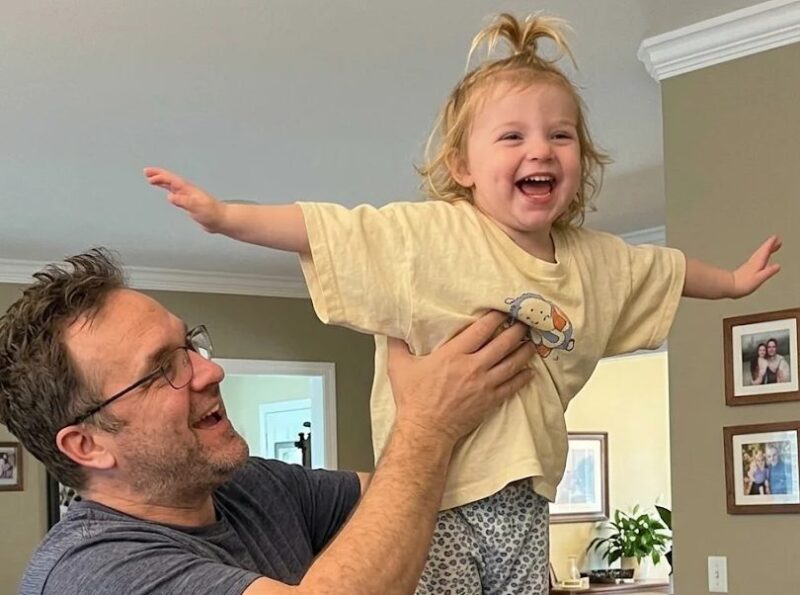
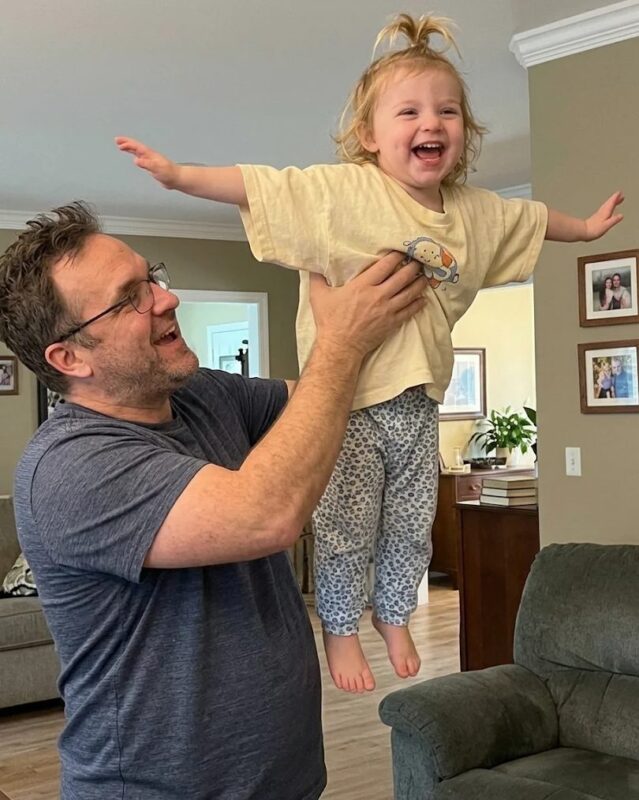
I was playing airplane with my three-year-old daughter Ellie when she suddenly froze and screamed:
— Daddy, put me down! Right now!
I immediately lowered her to the floor and crouched beside her.
— What happened, sweetheart?
Ellie was staring fearfully toward the enormous wardrobe in our living room.
— There’s a little girl there! On top! She’s watching me!
I looked in the direction she was pointing, but I couldn’t see anything unusual. Still, my daughter looked so terrified that I decided to investigate.
I brought over a chair, carefully climbed onto it, and looked behind the top edge of the wardrobe. What I saw nearly made me lose my balance.
Every evening, Ellie and I had a little family ritual. We played airplane: I lifted her above my head, and she spread her arms like wings, loudly announcing where we were flying.
She usually chose the Moon, distant islands, or magical fairy-tale lands.
That evening, my wife Anna was working late, so my daughter and I decided to spend some time playing together. Ellie asked for one more flight, and of course, I couldn’t say no.
We “flew” through the hallway, passed the sofa, and headed toward the living room. But as we approached the old wardrobe, my daughter suddenly stopped laughing.
— Daddy, put me down!
— What’s wrong, sweetheart?
She stretched out her arm and pointed toward the wardrobe.
— There’s a little girl there! She’s watching me!
I tried to calm her down, explaining that she might have seen a toy or a shadow. But Ellie kept pointing to exactly the same spot.
So I pulled over a chair and climbed onto it.
At first, I saw nothing but a layer of dust and a few old objects. But when I leaned a little farther forward, a pair of eyes suddenly appeared right in front of me.
I flinched and nearly fell off the chair.
A moment later, I realized that the eyes belonged to an old photograph hidden behind the top edge of the wardrobe.
The photograph showed a little girl with chestnut curls, wearing a yellow dress. She was smiling at the camera, her head tilted slightly to one side.
But something else surprised me even more.
The little girl looked remarkably like Ellie. She had the same eyes, a similar smile, and even a small crescent-shaped birthmark above her left eyebrow. Our daughter had exactly the same mark.
For a long moment, I stared at the photograph, trying to understand who the little girl was and why her picture had been hidden in such an unusual place.
Behind the photograph, I found an old, dusty box. I pulled it out and opened it.
Inside were a carefully folded yellow dress, a stuffed rabbit with worn-out ears, and a small envelope bearing Anna’s name.
I turned the photograph over. On the back, in uneven handwriting, there were just three words and a date:
“Our wonderful Lucy. June 1994.”
I climbed down, holding the box and photograph in my hands.
— Daddy, has that little girl disappeared now? Ellie asked cautiously.
— She’s only in the photograph, sweetheart. Don’t be afraid.
I showed her the picture. My daughter studied it carefully and then gently ran her finger across the glass.
— That’s me!
— No, sweetheart. That’s another little girl.
Ellie frowned and looked at the photograph again.
— But why does she have the same face as me? And the same birthmark?
I didn’t know what to say. The resemblance was far too extraordinary to dismiss as a coincidence.
All evening, I couldn’t stop thinking about the photograph, and I waited for my wife to come home.
When Anna finally returned, I immediately noticed how tired she was. She took off her coat, put down her handbag, and went into the kitchen.
I approached her with the photograph in my hand.
The moment she saw it, her expression changed completely. She turned pale, and the fingers holding her cup began to tremble noticeably.
— Where did you find this? she asked quietly.
— On top of the wardrobe. There was also a box with a dress, a toy, and a letter. Anna, who is this little girl?
My wife remained silent for several seconds. Then her eyes filled with tears.
— That’s Lucy. My younger sister.
I was in shock.
We had been married for eight years, but throughout all that time, Anna had never once mentioned having a sister. I hadn’t even known that something like this had happened in her family.
— She died when we were children, my wife finally whispered. — I was nine, and she was only four.
I gently took Anna’s hand and asked her to tell me what had happened.
For a long moment, she stared at the photograph, as if trying to gather the strength to speak.
It turned out that one day, the girls had been playing at home. Lucy ran toward the stairs leading down to the basement, tripped, and fell down them.
Anna had been entrusted with looking after her younger sister. After the tragedy, their parents, especially their mother, constantly reminded her that she should have been more careful.
Anna was still a child herself, but for many years, she believed that her carelessness had caused Lucy’s death.
—I should have protected her, she repeated through her tears. — She was so little. I was older. I should have been watching her.
I hugged my wife and tried to explain that a nine-year-old child couldn’t possibly be expected to carry such responsibility. But Anna seemed unable to hear me.
She asked me not to talk about it any further for the time being and went to the bedroom.
The next morning, Ellie mentioned the photograph again.
During breakfast, she approached her mother and asked:
— Mommy, does that little girl really look like me?
Anna looked at her daughter, remained silent for a moment, and then replied:
— Her name was Lucy. She was my little sister.
— And where is she now?
Anna knelt beside Ellie and gently stroked her hair.
— She passed away a long time ago, sweetheart. But we can keep her photographs and remember her.
Ellie wrapped her arms around her mother’s neck, as if sensing that her mother especially needed affection at that very moment.
After our daughter left for preschool, I took out the old box again and carried it into the kitchen.
Anna immediately recognized the little dress and the stuffed rabbit.
— Mom must have kept all her things, she said quietly. — I thought they had been lost a long time ago.
Then I showed her the envelope.
Her name was written on it. The handwriting belonged to Anna’s mother, but my wife had never seen this letter before.
For a long moment, she held the envelope in her hands, as if she were afraid of discovering what was inside. Finally, she carefully opened it.
The letter began:
“Dear Anna,
There is something I should have told you many years ago. I have remained silent for far too long, and now I’m afraid I may never be able to make up for my mistake.”
Anna began reading aloud. With every sentence, her voice grew quieter.
Her mother wrote that Anna had been only nine years old when Lucy died. She admitted that after the tragedy, she had been so overwhelmed with grief that she couldn’t cope with her own emotions.
Instead of supporting her older daughter, she had placed the responsibility for what happened on her shoulders.
But further down were the words Anna had apparently been waiting to hear her entire life, even if she hadn’t realized it herself.
“After the accident, I said something to you in the hospital that you should never have had to hear. I was terrified, devastated, and didn’t know how to cope with losing my daughter. I needed someone to blame for my guilt, and I did that at the expense of my own child.
The basement door had been broken for several weeks. The lock wasn’t working properly, and I knew perfectly well that it needed to be repaired. I kept putting it off. That day, I thought the door was securely closed, but it wasn’t.
You were just a little girl. You couldn’t possibly have been responsible for the safety of the entire house or protected your sister from a danger that I myself knew about.
I failed Lucy because I didn’t take care of her safety. And then I failed you, too, by allowing you to believe that you were responsible for her death.
I watched you grow up carrying that guilt. I watched you avoid conversations about your sister and saw how afraid you were to remember that day. Every time, I lacked the courage to admit that I was the one who had done something wrong.”
Anna covered her mouth with her hand. Tears were already streaming down her cheeks.
For more than thirty years, she had lived believing that she was responsible for her sister’s death. For years, she had replayed that day in her mind, wondering what she could have done differently and returning again and again to the moment when she had left Lucy alone.
And now, her mother had finally confessed the truth that Anna should have heard back when she was still a child.
She had been just a child herself. The responsibility for her younger sister’s safety should never have rested on her shoulders.
Anna read the final passages of the letter:
“That day, you lost your sister. But you should never have lost your childhood as well because of guilt.
I cannot give you back the years you spent believing you were to blame. I cannot erase the words I spoke in the hospital or undo my silence.
But I want you to finally know the truth. You are not to blame, Anna. You never were.
Please forgive yourself for something you should never have been held responsible for.
With love, Mom.”
Anna placed the letter on the table, covered her face with her hands, and burst into tears.
— She knew everything, my wife whispered. — She knew that I had been blaming myself all these years, and yet she remained silent.
I sat beside her and held her tightly.
— Maybe it was difficult for her to admit it, too. But that doesn’t change the most important thing: you were just a little girl back then. You couldn’t have been responsible for what happened.
Anna cried on my shoulder for a long time.
The letter couldn’t change the past or bring Lucy back. But it finally freed my wife from the guilt she had carried inside her for almost her entire life.
Over the following weeks, Anna slowly began to change. She had previously avoided any conversations about her sister, but now she increasingly began telling me stories from their childhood.
She showed me old family albums and recalled Lucy’s favorite games, her habits, and the funny little words she used when she was learning to speak.
It turned out that Lucy had been a very cheerful little girl who loved pretending she could fly.
Anna even scheduled an appointment with a psychologist to work through the emotions she had been carrying for so many years.
One evening, Ellie noticed Lucy’s photograph, which we had placed on the bookshelf.
She ran up to her mother and called out happily:
— Mommy, look! It’s the little girl from the wardrobe!
Anna smiled.
— Yes, sweetheart. That’s your Aunt Lucy.
Ellie studied the photograph carefully and then asked an unexpected question:
— Did she like playing airplane, too?
Anna chuckled softly, wiping away her tears.
— Very much! She loved pretending to fly. Sometimes she even asked me to pick her up and carry her.
Ellie excitedly turned toward me.
— Daddy, let’s fly! Right now!
I looked at Anna.
— Do you mind if I lift her up for a little while?
My wife smiled through her tears.
— Just don’t hurt your back.
I lifted Ellie above my head, and she immediately spread her arms, pretending they were wings.
— Daddy, we’re flying all the way to the Moon and back!
We walked through the living room, passing the bookshelf. Ellie noticed the photograph, waved her little hand at it, and shouted:
— Bye, Aunt Lucy! We’ll fly again soon!
Anna watched us with tears in her eyes, but this time, the old pain was no longer present in her smile.
Later, when Ellie had already fallen asleep, my wife rested her head on my shoulder and whispered softly:
— For so many years, I tried not to think about her. I thought that if I stopped blaming myself, I would be betraying her memory.
— You’re not betraying her by allowing yourself to stop suffering, I replied. — You can remember your sister and still be happy.
Anna took my hand and remained silent for a long time.
I often find myself thinking back to that evening. At the time, I thought I had simply discovered something frightening on top of an old wardrobe, something that had accidentally caught our daughter’s attention.
In reality, I had uncovered a family secret that had tormented my wife for most of her life.
Sometimes, a photograph discovered by chance can open the door to memories that people have tried to hide for years.
We couldn’t change what had happened to Lucy. We couldn’t give Anna her childhood back or undo the mistakes of the past.
But now she could remember her sister with love, tell our daughter stories about her, and stop blaming herself for the tragedy.
And most importantly, she no longer had to carry that pain alone.