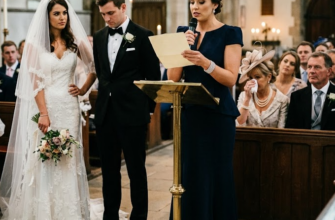

To the happy couple who always loved playing in the mud!”
The sound of champagne glasses was clear and ringing, but it was immediately swallowed by a wave of laughter. My sister Tamara’s voice, filled with that particular sweetness that could cut glass, echoed throughout the hall.
The laughter hit me like a slap. My cheeks burned, and two hundred pairs of eyes were fixed on me and Peyton. My name is Bethany — and this day was supposed to be the happiest of my life.
I should have known that Tamara wouldn’t hold back and would remind everyone of my place in the family hierarchy. She stood there — shining in a designer bridesmaid dress, with a “scepter” in her hand at the head table. And I — in our grandmother’s inherited and slightly altered wedding gown — tried to keep a calm smile while the world around me crumbled.
“Bethany, honey, smile” — hissed my mother Rosie, squeezing my hand with her perfectly manicured fingers. “People are watching.”
Of course, they were watching. They had watched me my whole life, waiting to see which sister would stumble first. And as usual, it was me.
Peyton’s rough, calloused hand found mine under the table. His large thumb traced gentle circles on my palm. When I met his gaze, his eyes were warm and confident — a true haven of calm amidst the storm of mockery. “Let them laugh,” he whispered, his breath brushing my ear. “We know we have each other.”
God, how I loved this man. I loved him even when he was covered in morning dust from the fields — yes, on our wedding day he was still checking the irrigation system. He was real, reliable, a true man in this room full of pressed suits and fake smiles.
“I can’t believe you married a farmer” — my younger sister Erin said quietly, sitting next to me. She was twenty-seven, the family diplomat, trying to smooth the sharp edges. “It seems romantic to me, but Mom has been taking antacids all week.”
“Thanks for the support” — I muttered, glancing at Tamara, who skillfully drew the guests’ attention. She was thirty-one, had a beautiful car, a Manhattan office with a panoramic view, a husband in thousand-dollar suits, talking about market fluctuations like poetry.

“Ladies and gentlemen” — my father Donald said loudly from the podium, with perfectly styled gray hair and a carefully balanced expression between disappointment and confidence. “I want to say a few words about my daughter Bethany.”
My stomach dropped. I saw Tamara smiling behind her champagne glass.
“Bethany has always been… special” — he began. “While her sisters built careers and achieved success, Bethany chose a different path. A more… simple one.”
The word “simple” hung in the air, almost an innocent mockery. I felt Peyton’s grip on my hand tighten.
“She chose Peyton, a man who works with his hands and values effort” — Donald continued with a pause. “We wish them happiness in their… modest life together.”
The applause was polite, but cold. I saw Mom rubbing her eyes, unsure if they were tears of joy or sadness. My family, the people who were supposed to support me, were praising my “lost” future. Every award, every achievement was overshadowed by the fact that I chose to love a man who values the land more than stocks.
“You know what?” — I said, standing so abruptly that the chair creaked. Silence fell over the room. I raised a glass of water and looked directly at Tamara.
“Family” — I said in a clear voice. “And understanding who is truly beside you when it matters.”
Tamara’s smile disappeared for a fraction of a second before she raised her glass with the others. Peyton leaned toward me: “She’s my girl” — he whispered. And then I didn’t yet know how prophetic those words would be.
Three years later, I stood in Tamara’s marble foyer with a casserole of green beans that cost less than her doormat. The annual family barbecue was in full swing.
“Oh, you brought food” — Tamara said in a white summer dress more expensive than my monthly mortgage. “How… thoughtful.”
“From our garden” — I said, placing the dish next to the professionally prepared appetizers.

“Organic?” — her husband Elijah continued, martini in hand. “Is it just… well, just like that?”
I felt warmth on my neck. “Homegrown” — Peyton said quietly, standing beside me. His simple clothing sharply contrasted with Elijah’s suit.
“Yes, yes, farming” — Elijah nodded with exaggerated interest. “How’s it going? Still playing in the mud?”
“The farm has been profitable for two years” — I replied calmly.
Tamara laughed like a bell in a storm. “Profit? Oh, darling, that’s sweet. Elijah just signed a contract worth as much as your little farm in ten years.”
“But we sleep peacefully at night” — I said involuntarily. Laughter died. Elijah’s smile became thin.
“What does that mean?” — Tamara asked sharply.
“Nothing” — I answered quickly. “Physical work is tiring.” But the line had already been crossed.
Six months later, the cracks in my family’s perfect façade became apparent. Weekly conversations between my parents, once long stories of Tamara’s triumphs, became tense. At Erin’s birthday, the truth came out:
“Elijah’s company is in trouble” — Erin whispered, avoiding eye contact. “Something went wrong with the investments. They had to sell the house in the Hamptons.”
A small, strange satisfaction crept into my heart. “Are they asking you for money?” — Peyton asked.
“Not yet” — Erin said. “But I think only because I don’t have it.”
A week later, the phone rang. Mom, thin trembling voice: “Bethany, a family meeting is needed.”
At my parents’ house, everything looked like a courtroom; Peyton and I sat in the accused seats.
“We need your help” — Tamara said, and it cost her effort.
“Your land” — my father said bluntly. “The farm. You have to sell it.”
I stared at them, the air gone. “You want us to sell our home to fix your unfair behavior?”
“It’s not about unfairness!” — Elijah shouted. “It’s about family! About doing what’s right!”

“What do you mean by ‘right’?” — I stood, my hands shaking. “Where was your family loyalty when you spent years mocking everything we built?”
“It’s just mud!” — Elijah burst out. “Mud and weeds! You can buy another farm!”
Peyton stood calmly. “I think” — he said quietly — “it would be better if we left.”
“We need an answer by Monday” — my father shouted. I turned and looked at their desperate, haughty faces. “I’ll think about it” — I said. “But you need to think too. Who are the people who demand a family destroy a life to save their own greed?”
The drive home was tense and silent. “I won’t sell” — I said as we entered our farm.
“I know” — Peyton replied with a somber expression. “But there’s something you need to see.”
In his small office in the barn, he opened a locked folder and spread out documents: patents, accounting reports, complex schematics.
“What is this?” — I whispered.
“Irrigation system I assembled from parts. Patented, approved for use in twelve states” — he said.
He laid out more documents. “Soil condition forecasting software. Also patented. Also approved.”
I felt dizzy. “Peyton… why didn’t you tell me?”
“I wanted to be sure” — he said. “I wanted to build something real before I told you. Our farm isn’t just a farm. It’s now valued at 50 million dollars.”
I sank into the chair, stunned by the words. My ‘simple’ farmer turned out to be the CEO of a tech company.
“Why did he hide this?” — I asked. “Why did he let my family treat us like poor people?”
“I wanted to see who they really are” — he said calmly. “I wanted to see how they’d treat us if they thought we had nothing. I let them show their true face.”
He pulled out the last folder. “Even more. Elijah’s company. Failed investments. He bet against us. He lost your parents’ retirement savings, putting everything on the company’s collapse.”
At that moment, my phone rang. A text from Erin: they’re coming tomorrow. All of them. Dad said ‘no’ doesn’t exist.
I showed Peyton. He smiled slowly: “Good. Let them come. Time for their lesson.”
They arrived, three expensive cars raising dust at the driveway. Father held a folder with the sale documents. They had already found a buyer.
“We need your signature” — he said, leaving no choice.
“You’re right” — Peyton said calmly. “Family should take care of family.” My mother’s smile disappeared. “Then it’s time to speak honestly.”
She placed the folder on the table. “Elijah, how much do you think this farm is worth?”

“Around 300 thousand, if we’re lucky,” he answered mockingly.
“Interesting,” Peyton said. “And what if I tell you that this ‘dirty patch’ is the center of a tech company worth 50 million?”
Silence fell. He showed patents, a PhD in agrotechnics from MIT, proving the truth of the ‘simple’ farming life.
Turning to Elijah: “You bet against us,” he said coldly. “You lost the retirement savings of seventeen families. Ironic? All the money you lost doubled our capital.”
At that moment a man in an expensive suit entered the house. “Sorry for being late,” he said.
“Everyone,” Peyton said with a stern smile. “Allow me to introduce Leonard Weisz, our lawyer.”
The next hour became a demonstration of the collapse of the family’s pride and greed. Leonard secured the company’s protection and grants.
“What do you want?” Tamara asked, her voice trembling.
I looked at them all: parents who forced me to feel small, the sister who thought I was nobody, her husband who tried to destroy us.
“I want you to leave,” I said quietly. “And never come back.”
They left, leaving emptiness behind. The next day Erin called, crying and apologizing; I realized — something could still be saved. But the rest? They had made their choice long ago. They bet against us and lost.
We stood with Peyton on the porch, watching the sunset paint the fields in golden shades.
“Do you regret anything?” he asked.
I recalled the years of humiliation, the quiet pain, the constant sense of worthlessness. I looked at my husband, wise and patient, who had suffered and then won.
“No,” I said. “I regret nothing.”