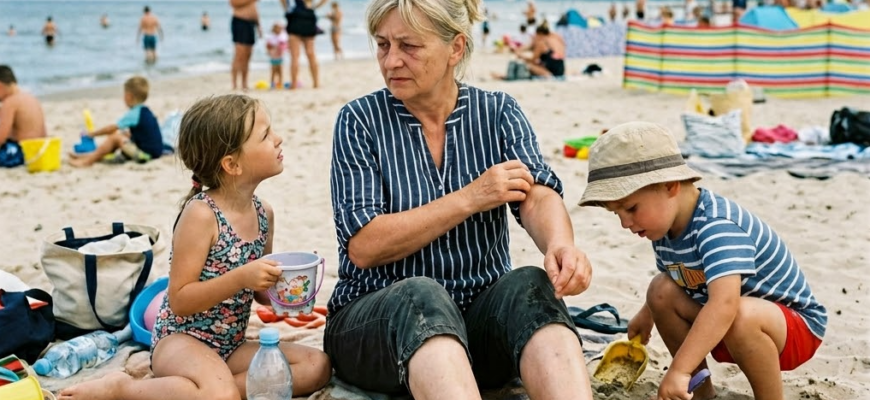

They brought us to the seaside for two weeks, and I truly thought it would be a gift. A family vacation, the sound of waves, grandchildren, laughter, rare evening conversations on the balcony. That was how it sounded in my daughter’s words when she called in the spring and almost joyfully persuaded me: “Mom, come with us, you deserve some rest, you’ll be with the children, and Paweł and I will finally get a chance to breathe a little.” Back then, I had no doubts at all. After thirty years of working at a school and five years of retirement, it seemed to me that this was exactly the moment when family finally comes together not out of obligation, but out of love.
The first thing that greeted me in the apartment by the sea was a sheet of paper. Printed out, carefully arranged, with an hourly schedule. My daughter handed it to me almost ceremoniously, as if it were something perfectly normal, even caring. Seven in the morning — breakfast for the grandchildren. Nine — beach with the kids. One in the afternoon — lunch. Then again children, food, supervision, nap time, bathing, dinner, putting them to bed. And in this tight schedule everyone had one invisible word: “freedom.” Everyone except me.
At first I even smiled, thinking it was a joke. But the joke did not end on the first day or the second. It simply became my reality. At seven in the morning I was already standing in the kitchen, hearing children crying behind the wall, doors slamming, my daughter and son-in-law getting ready to “just go out for a little while,” only to return long after midnight. And during that time I washed sand off my grandchildren’s knees, made cocoa, treated scratches, read fairy tales, picked up toys, and kept going in a circle that did not end even in the evening.
The strangest thing was not that I was tired. I had known exhaustion all my life. What was strange was something else — the feeling that someone had simply assigned me a role automatically, without asking whether I agreed to it. As if I were not a guest on vacation, but a function. A grandmother according to schedule. A nanny without relief. And the more days passed, the less it seemed like an accident.
On the third day I caught myself thinking that I had not seen the sea peacefully even once. It existed somewhere nearby, beyond the umbrella, beyond the shouting, beyond the plates and towels, but not for me. In the morning I asked to go out alone for just half an hour. Simply to walk to the water before the children woke up. My daughter did not even get upset — she only looked at me as if I had suggested something impossible. “Mom, but he wakes up at six… who will stay with him?” And that was all. The conversation was over.

On the fourth day, a small incident happened — my grandson cut his leg on a seashell. Nothing serious, but there were lots of tears, panic, blood on the sand, which I tried to cover as quickly as possible with myself, with my hands, with words, with attention. I carried him in my arms while also calming the older granddaughter, who had become frightened too. When my daughter returned from a walk, during which she and my son-in-law had been riding a motorboat — something I found out by accident — she only glanced briefly and said, “Well, everything’s fine now.” Then she went to change her clothes. At that moment, something inside me quietly shifted, though I still did not know what it was.
On the fifth day, I realized that I was standing in the kitchen automatically peeling potatoes, even though we were supposedly “on a seaside vacation.” That same evening I accidentally overheard a conversation: the apartment had been expensive, the trip had been planned as their vacation, their rest, their freedom. And suddenly I saw clearly that in this arrangement I was not part of the отдых. I was the condition that made their vacation possible.
I called my friend, the only person to whom I could tell the truth without explanations or excuses. And she said one sentence that struck harder than all my own thoughts: “You are not on vacation. You are on duty.” After that, everything inside me became quiet. Not lighter — just more honest.
On the seventh day, I asked them to sit down. Not with shouting, not with a fight — calmly, like someone who had stayed silent for too long. I told them that I loved them, loved the grandchildren, but I had not come there to work nonstop while they lived their own lives. I watched my daughter’s face change — from surprise to defensiveness, from defensiveness to explanations. She spoke about exhaustion, about how they needed time together, about a year without rest. I listened and understood that all of it was true — but not the whole truth.

Because the truth was also that I am a human being. And that “grandma nearby” does not mean “grandma always available.” And that a vacation where one person takes care of everyone stops being a vacation.
After that, nothing suddenly changed. Miracles do not exist. They still went out in the evenings, and I still stayed with the children. But for the first time, a crack appeared in the automatism. My daughter sometimes began coming back earlier. Sometimes she would bring ice cream or waffles and sit beside me in silence, as if she were relearning how to be not only a mother, but also a daughter.
And one morning I simply went to the sea alone. Very early. The sand was cool, the water almost gray, there was not a single shout, not a single demand. I sat right at the shoreline and understood that this was exactly the kind of rest no one can take away from you once you are finally truly present in it.
We drove home in silence. In the car, the grandchildren were asleep, my daughter stared ahead, and I held the warm head of the little child on my lap, and for the first time in a long while I did not feel absent from my own life.
And when, near the end of the journey, she quietly said, “Mom, thank you,” I simply replied, “It’s good that we understood this.”