
My name is Lara, and I’m not going to tell you a story about being abandoned. I’m going to tell you a story about finding myself.
He said it in the kitchen. Not in the bedroom, not over a candlelit dinner, not in any special setting — just in the kitchen, between the coffee machine and the refrigerator, leaning against the counter as if a conversation about the end of twenty-five years together needed some kind of support.
“I’ve fallen in love. I have to give it a chance.”
Seven words. Later, I counted them over and over, trying to find something hidden between them that would explain everything. I found nothing.
I remember carefully placing my spoon on the table. I didn’t throw it, I didn’t drop it — I simply set it down. As if, by doing it quietly enough, everything else might become quieter too.
I sat down. My legs simply stopped holding me up. And something inside me said very clearly: don’t scream. Don’t beg. Don’t ask questions, because the answers will be worse than the silence.
He left with a sports bag. The same one he used to take fishing. I watched him zip it up and thought about how it had once held fishing rods and rubber boots, and now it was holding our life together.
The next day, I learned from a friend—not from him, but from a friend—that he had moved in with Ania from marketing. Twenty-eight years old, colorful dresses, a loud laugh. I had seen her at company parties. I never imagined I would know her name so well that it would start appearing in my dreams.
For the first few weeks, I lived on autopilot. I answered “I’m fine” whenever someone asked how I was, went grocery shopping, cooked soup for one person, and was surprised that I still made too much.
In the evenings, I sat by the window trying to understand what hurt more — that he had left, or the way he had left. No argument, no tears, no fight. As if I weren’t a person being abandoned, but merely a circumstance he was walking away from.
That was the strangest discovery of those first weeks: that you can spend twenty-five years beside someone and eventually become nothing more than background to them. Familiar, comfortable, warm background — but background nonetheless.
And over there, with Ania, everything was bright, loud, and alive. Every evening was an event. Nobody went to bed at ten, nobody made shopping lists, nobody said, “Turn off the TV, we have to get up early tomorrow.”
Back then, I wasn’t angry with him. I was angry with myself for not feeling angry.
A month passed. Exactly one month. I wasn’t counting on purpose; I simply remembered the date he left and the date I saw his shoes on my doormat.
I came home from shopping, opened the door, and saw them. Old brown shoes, slightly worn at the heel. I knew them by heart.
I had bought them three years earlier in a shopping mall while he stood beside me saying he didn’t care what they looked like, as long as they were comfortable.

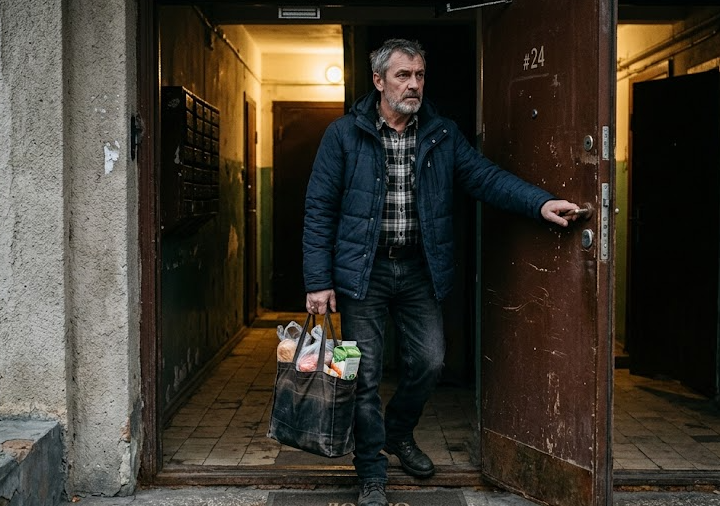
He stood in the hallway. Unshaven, exhausted, holding his jacket in his hands — as if he still hadn’t decided whether he was staying or leaving and kept it just in case. He looked at me the way people do when they want to apologize but don’t know what word to begin with.
I didn’t rush toward him. I set the grocery bags on the floor and simply looked at him. I tried to connect, in my mind, the man who had packed his fishing bag a month ago with the one standing before me now, looking as though life had given him a thorough beating. I wasn’t very successful.
We sat down at the table. The same table where we had eaten breakfast thousands of times. He placed his jacket on the chair beside him and began to speak.
He said he had thought it would be different. Easy. Free. As if life could be started over from scratch and immediately become more exciting.
He said that life with Ania had turned into an endless celebration where no one cleaned, no one cooked, and no one simply sat beside him in silence. He said that for the first time in a month, he realized how much he loved silence. Our silence. Our kitchen. Me.
I listened and waited for something inside me to stir.
Nothing did.
Not because I had become cold or cruel — but because during that month, I had quietly stopped waiting. Waiting for him. Waiting for explanations. Waiting for someone to come and tell me that everything would be okay.
I had started telling myself that instead, and it turned out to work.
“So what now?” I asked.
No drama. No anger. I simply asked.
“I want to try to come back,” he said. “I know I have no right to ask. I know what I did. But if there’s even the slightest chance…”
I looked at him and thought: here is a man who left lightly, believing in another life.
And he returned heavier, having realized that another life is still just life — only without familiar walls. Without me.
And without me, it wasn’t better.
Just different.
Loud and empty.
I didn’t tell him about all the nights I had spent by the window. I didn’t tell him how afraid I had been to fall asleep in the silence I once loved. I didn’t tell him that one night, at three in the morning, I realized that if he had come back during the first week, I would have opened the door without hesitation.
I kept all of that to myself.
Because now, it no longer mattered.
I made some tea. I sat down across from him. And I said exactly what I was thinking — no tears, no drama, just words:
“I’m not going to pretend that nothing happened. I’m not going back to what we had before. If you want to stay, it can’t be because things didn’t work out there. It has to be because you choose to be here. Not me instead of her. Us — as a decision you make every day. Consciously. Without a backup plan.”
He cried.
I didn’t expect that.
I looked at him and thought: here is my husband, the man I’ve known for twenty-five years, sitting at this table and crying, and I have no idea what it means.
Maybe remorse. Maybe relief. Maybe just exhaustion from the past month.
He stayed.
I didn’t invite him into the bedroom — I made up the couch for him. Not as a punishment. I simply needed to understand what it felt like to have him here again while knowing that everything had changed.
To look at him and see two people at once: the man with whom I spent the best years of my life, and the man who one day decided that those years were no longer enough.
That evening, I sat by the window.
I turned on a lamp — not for him, but for myself.
So there would be light.
So I could remind myself that I am capable of creating light on my own.
That in this apartment, at this table, by this window, I exist not as someone’s wife, not as part of someone else’s story, but as Lara.
Simply Lara, who makes tea, looks up at the dark sky, and holds her own life in her hands.
I don’t know what comes next.
I don’t know whether we will make it — or whether anything that could still be called “us” will survive.
I don’t know whether a second chance is worth the price it will demand.
But I know one thing:
That night, I fell asleep peacefully.
Not because he came back.
But because I had finally stopped waiting for someone to return in order to feel whole.