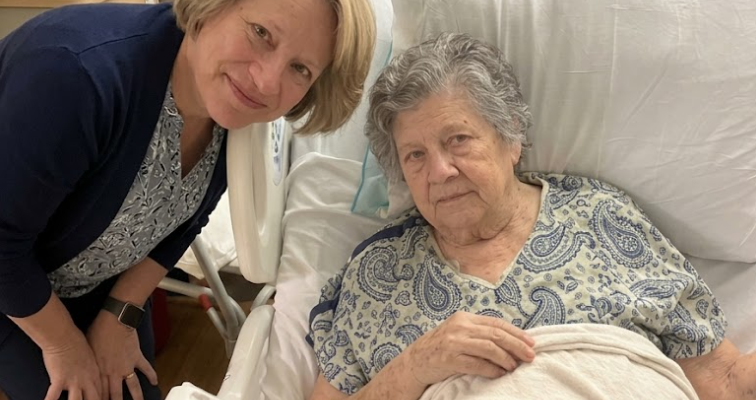

My name is Emily, and I’m 43 years old. I never imagined that caring for my dying mother-in-law would uncover a secret that could destroy my marriage.
Last autumn, my husband, Daniel, brought his 76-year-old mother, Margaret, into our home. She had terminal cancer, and the doctors warned us that she had very little time left.
She could barely walk, and even a short conversation drained what little strength she had remaining.
That very evening, Daniel announced that he had received a job offer abroad.
“I’ll be gone for several months, maybe even almost a whole year,” he said.
I couldn’t believe my ears.
“Daniel, your mother is dying! How can you leave at a time like this?”
He shrugged.
“Someone has to earn money. You’ll manage.”
Two days later, he left.
From that moment on, all the responsibility fell on my shoulders.
Every morning, I got up before dawn, helped Margaret wash and change, prepared her meals, and fed her with a spoon. At night, I barely slept. Sometimes my mother-in-law would cry quietly from the pain, while other times she would simply squeeze my hand because she was afraid of dying alone.
Daniel rarely called. He talked about work, money, and how tired he was, almost never asking how his mother was feeling.
The money he sent me barely covered the cost of her medication. Soon, I had exhausted my savings, so I had to sell my jewelry and borrow money from a friend.
Still, I couldn’t bring myself to leave Margaret alone.
One evening, she looked at me with tear-filled eyes.
“Emily, why are you doing all this for me?”
“Because you’re my family, Mom.”
She turned her head and began to cry. At the time, I didn’t understand why.
A few weeks later, on a freezing December night, Margaret asked me to come closer to her bed. Snow was falling outside, and an unusual silence filled the house.
Suddenly, she grabbed my hand tightly.
“Promise me you’ll do what I’m about to ask you.”
“Of course, Mom.”
“When I’m gone, go to my old house in the village. Find the summer kitchen. There’s an old wooden cabinet against the far wall. Move it and dig beneath the floor.”
I stared at her in confusion.
“What am I supposed to look for?”
Her eyes filled with tears.
“What I hid thirty-two years ago. And Emily, don’t tell Daniel anything until you’ve read everything.”
I wanted to ask more questions, but Margaret closed her eyes. She was too weak to continue the conversation.
Three days later, she died.
Daniel didn’t even come to the funeral. He simply texted me that the company couldn’t release him from his work obligations.
With the help of relatives and neighbors, I buried my mother-in-law. A week later, remembering her final words, I set off for the village.
The old house stood at the end of a narrow road. Everything inside was covered in dust, but I found the summer kitchen without difficulty. The wooden cabinet stood exactly where Margaret had described it.
With considerable effort, I moved it and noticed several loose floorboards. Beneath them was bare earth.
I picked up an old shovel and began to dig.
After a few minutes, the shovel struck something hard. A metallic sound echoed through the empty kitchen.
I knelt down and brushed away the dirt. A rusty metal box appeared before me.
It was surprisingly heavy. When I finally lifted the lid, I froze.
Inside were bundles of banknotes carefully wrapped in paper, old photographs, legal documents, and two sealed envelopes.
One of them had my name on it.
With trembling hands, I opened the envelope.
“Dear Emily,
If you’re reading these words, it means my end is near.
For thirty-two years, I secretly put money aside, trying to save even a small amount every month. I never told Daniel because I knew what would happen if he found out.
After his father died, Daniel inherited money, but he spent almost all of it. Then he began demanding that I sell my house and hand over the money I received.
When I refused, he flew into a rage and told me that one day I would bitterly regret my decision.
When the doctors informed me that I was dying, Daniel came to me again and demanded my savings. I refused.
That was when he declared that he had no intention of sacrificing his life to care for a sick old woman. He said he would leave me in your care.
Emily, I want you to know the truth. Your husband did not go abroad for work. He simply didn’t want to care for his own mother.
I watched you spend your own money on my medication. I watched you sit beside my bed, so exhausted that you could barely keep your eyes open. I heard you crying in the kitchen, thinking I was asleep.
And every day, I thanked God for bringing someone like you into my life.
I know I can never repay you for the months of sleepless nights or all the money you spent caring for me. But at least I can make sure your future is secure.
I arranged everything through a lawyer. The house, the land, and my savings belong to you.
Not because you ever asked me for anything, but because you gave me something money cannot buy. You gave me love, while my own son offered me nothing but excuses.
Please don’t let him take away what I am leaving to you of my own free will.
With love,
Margaret.”

I froze. Tears dripped onto the yellowed paper.
Beneath the letter were documents concerning the house and land, along with a will confirming Margaret’s final wishes.
But there was another envelope inside the box.
It contained a letter from a lawyer. From it, I learned that Daniel had previously tried to gain legal control over his mother’s estate, claiming that she was no longer capable of making decisions about her own affairs.
Margaret had discovered his plan and taken steps in advance to protect herself.
I sat on the dusty floor for almost an hour. I wasn’t thinking about the money, but about the woman who, despite her own suffering, had continued to worry about me.
Now I understood why she had cried when I called her my family.
Two weeks later, Daniel finally returned home.
He walked into the living room, tossed his suitcase onto the floor, and asked:
“Well? Did Mother leave anything behind?”
I stared at him in disbelief.
“Is that really the first thing you want to ask?”
“What do you mean?”
I placed a copy of Margaret’s letter in front of him.
“Read it.”
As he read, his expression gradually changed. First, he looked confused, then disbelieving, and when he reached the part about the inheritance, he flew into a rage.
“SHE LEFT EVERYTHING TO YOU?!”
I didn’t answer.
“Emily, she was MY mother! That money BELONGS TO ME!”
I looked him straight in the eyes.
“She was your mother when she lay helpless in bed, too. But you left her alone to die in solitude.”
He opened his mouth, but he couldn’t find a single word to say.
“You abandoned her when she needed you most. And you abandoned me along with her,” I added.
I had never imagined that one day I would say those words to the man I had loved for eighteen years.
Over the following days, Daniel demanded that I hand over the inheritance, started arguments, and threatened to contest the will. But I no longer allowed his anger to control my life.
I contacted Margaret’s lawyer. He confirmed that the will had been properly drawn up and was legally binding.
I used part of the inheritance to pay off the debts that had accumulated while I was caring for my mother-in-law.
After several months of difficult conversations, I decided to end our marriage.
It wasn’t easy. Eighteen years of life together cannot be erased with a single decision. But I finally understood that love should not mean endless sacrifices for someone who isn’t willing to support you when you need it most.
A few months later, I moved into Margaret’s renovated house.
Now, flowers bloom beneath the kitchen window. The old wooden cabinet still stands in its place. I have never been able to bring myself to throw it away.
A photograph of Margaret, smiling, hangs on the living room wall.
Sometimes I sit beneath that photograph and remember her final words. I thought I was simply helping an elderly woman live out her final days with dignity.
But all that time, she had been preparing something far more important than an inheritance for me. She was leaving me a chance to start my life over.
At the very end of her letter, Margaret had written:
“Dear Emily, I couldn’t choose what kind of man my son would become. But I could decide who deserved the love and security I had spent my entire life building through my own hard work.”
Every time I read those words, tears fill my eyes.
Because the woman everyone considered helpless gave me the most precious gift of my life.
Not money. Not a house.
But the courage to finally choose myself.