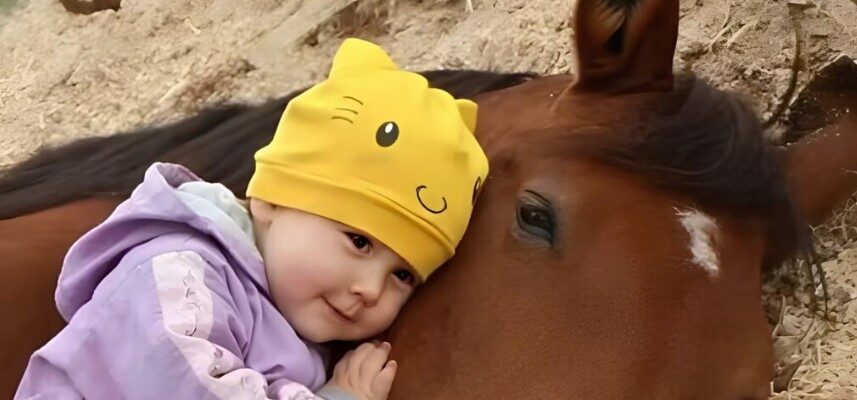

My little daughter was only two years old when she first met our neighbors’ horse. For such a small child, everything around seems huge, mysterious, and extraordinary, but this animal immediately became a source of joy and wonder for her.
At first, she stood shyly behind the gate, only watching as the horse lazily nibbled on the grass in the sunny meadow. Its smooth, dark coat shone in the sunlight, and its thick mane fell softly along its neck. There was something calm and kind in the animal’s eyes, and that is probably what drew the child in.
With each passing day, my daughter grew braver. She would stretch out her little hand through the fence and laugh when the horse carefully brought its muzzle close, as if it understood that a little one was standing before it. Soon, they became true friends.
She could sit by his side for hours, stroking his neck and whispering to him her childish secrets, of which even the youngest have quite a few. Sometimes, she pressed her face into his soft mane and fell asleep right there in the hay. For us, the parents, it was both touching and a little worrying — after all, a horse is a large animal. But from the very first encounters, it was clear: this horse possessed an unusual calmness. He behaved with surprising gentleness, as if he understood that beside him was someone who needed special care.

My husband and I often joked that our daughter had found a “second nanny.” Because when she was with the horse, we didn’t need to entertain her or pull her away from other activities — she completely immersed herself in her own childhood world, where it was just her and her big friend.
Months passed this way. Our daughter literally radiated happiness whenever she ran into the neighbors’ yard. But one day, everything changed.
One evening, the neighbor — the horse’s owner — knocked on our door. He was usually a cheerful man with a slight smile, but that day he looked very serious.
— We need to talk — he said quietly.
There was tension in his voice, and my heart tightened with worry.
— Did something happen? — I asked. — Did our daughter do something wrong?
— No, no — he hurried to explain. — It’s not about her behavior. It’s about her health.

Those words sounded unexpected and strange. I looked at him, confused.
Then he explained that his horse was no ordinary animal. It had undergone special training — it could sense changes in a person’s condition and react to them. According to the neighbor, in recent days the horse had started behaving differently around our daughter. It was no longer just a calm play companion. Now it would often neigh nervously, sniff the girl, and stand between her and other people, as if trying to protect her.
At first, we were skeptical. It seemed that the neighbor was exaggerating — after all, animals have their quirks. But his insistence made us think. That very evening, we decided to go to a doctor and make sure that our daughter was truly okay.
The tests turned our world upside down. The doctors confirmed that the child had serious health problems we had no idea about. Hearing something like that is an experience for parents that cannot be put into words. Yet, alongside the fear, we also felt gratitude: thanks to swift action, the illness was detected at an early stage when effective treatment was possible.

A difficult period of treatment began, with doctor visits, waiting, and hope. In such moments, support is especially appreciated. We felt it not only from family and friends but also from the neighbors and their extraordinary animal. Every time our daughter appeared near the horse, her eyes lit up with joy, and her smile grew wider. It was her source of strength, her quiet and faithful friend, who seemed to offer comfort without words.
Months passed. Our daughter’s condition gradually improved. We often think back to the day the neighbor knocked on our door and said, “You need to go to the doctor.” Those words changed our lives.
Today, our little girl is healthy and full of energy again. She runs, plays, and laughs, and her friendship with the horse has grown even stronger. Every time we see them together, our hearts are filled with gratitude. For it was this animal that first gave the signal that we should pay attention to the child’s health.
We now look at him with special respect. He is no longer just the neighbors’ horse. He is a true family friend who once helped save what is most precious to us.
And when I see my daughter hugging his neck again, pressing her cheek against his mane, and laughing with happiness, I understand: sometimes fate sends help in the most unexpected form.