
At the age of 18, I passed the university entrance exam. It was the happiest day of my life… and at the same time the day that left the deepest wound in my heart — a scar I carried inside for fifteen years.
To this day I clearly remember that fateful evening. From the window of a small house on the outskirts of Guadalajara, the rays of the setting sun fell on my acceptance letter: a prestigious engineering school in Mexico I had dreamed about for so long! My hands were trembling, I was crying with joy. For the first time I felt that, despite my poor childhood, I had done something valuable for my mother. But a few hours later that letter turned to ashes in the hands of my stepfather.
He — Raúl — didn’t say a word, looked at me with cold eyes and set the letter on fire. I screamed, jumped to save it, but it was already too late. He turned and walked out, leaving me lying on the floor with the smell of burnt paper on my hands.
That was the moment my hatred for him was born. I hated him so much that for fifteen years I didn’t call him “dad,” didn’t look him in the eye, didn’t come to family dinners if he was there. Soon I moved out of the house. My mother — Teresa — called, cried, but I had forever closed the door to the past.
Because I had no money, I put my dream of university aside and went to work in a textile factory in Monterrey. A year later I passed the exam again and entered another university — not as prestigious as the first one, but still a university.
I finished it, found a job and fought for my life in the big city of Mexico. When life stabilized and I could buy a small apartment, I never once returned to my hometown. My mother called from time to time and said my stepfather was weak, barely eating… but I remained silent.
For me, he was the man who killed my dreams, who stole my path.
A month ago. My mother called, her voice trembling:
— He… passed away, sweetheart. He had a heart attack while sweeping the yard. Can you come home?

I didn’t answer. I just hung up the phone. That night I drank alone. I didn’t cry; I felt neither sadness nor joy — only emptiness. The hatred I had carried inside me all those years was dissolving in the smoke of alcohol.
A few days later I returned home. The house looked even more run-down. My mother had aged, her hair was almost completely gray. She hugged me and burst into tears. For the first time in many years, I let her hug me.
After dinner my mother invited me into her room and said she wanted to show me something. Reluctantly, I followed her. Then she handed me an old wooden box and said:
— There is something important here. Open it.
Saying that, she turned and left, leaving me alone in the room. I opened the box and froze in surprise. Inside there were lots of newspapers and magazines with clippings from my school years, some documents about my acceptance at 18, and a yellowed notebook.
I opened it. On the first page it said:
“Diary — written for the one who will never call me dad.”
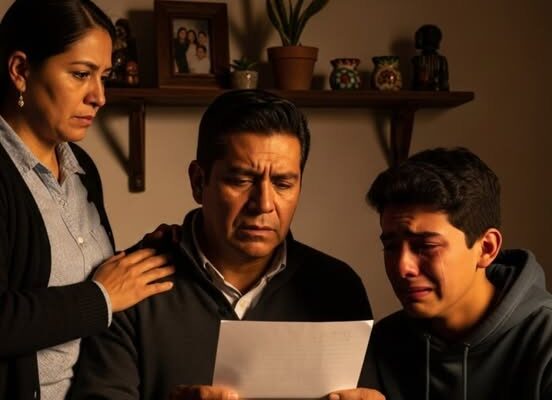
I was shaken; my hands trembled as I turned the pages and read every crooked line.
“Today the acceptance letter arrived. She smiled. For the first time I saw such a smile on her face…”
“I burned that letter. I am a scoundrel. But studying at that university is very expensive. I calculated: even if we sold all our cows — it wouldn’t be enough. If she went there, her mother would have to go into debt for a lifetime. I’m afraid. I don’t want them stuck in debt forever. I chose the worst solution — to kill her dream so we could live peacefully.”
“She hates me. I understand that. But if I had a second chance… I would do the same. Better that she hates me than that she or my wife suffers. I am a worthless man, I cannot take care of my family. If only that year I had been more careful, hadn’t fallen from the roof and gotten sick… everything would be different.”
Those words clenched my chest. I knew my stepfather had once fallen from scaffolding and that his health had worsened, but I didn’t know he was ill. That’s why he often didn’t go to work and stayed at home; I judged him in silence, thinking he was simply lazy and leaving all the burden to my mother. I was wrong: I had misunderstood a man who was rough on the outside but silently bore his sacrifices.
I pressed the notebook to my chest and went to the kitchen. My mother was washing the dishes. I put the notebook on the table and quietly asked:
— When did you find out about this?

She froze, looked at me for a long time, and then said:
— Only now. I also thought he did it out of hatred for me. After you left, he was silent. We hardly spoke. I only understood everything when I went through his things.
My throat tightened:
— If only… he had said anything.
My mother shook her head, her eyes filling with tears:
— If only… but he was always like that: even exhausted to the limit, he never complained; he bore everything alone.
That night I sat in front of the little altar in the house. For the first time in my life I spoke the word I had avoided for so many years:
— Dad…
“Dad.” Those two syllables came out of my mouth and stuck in my throat. After all the years of restraint, I burst into tears.
I once thought that some people come into our lives only to cause pain. But I realized that sometimes wounds arise not from a lack of love, but from an inability to express it. My stepfather was just like that: harsh in words but sacrificial in deeds. And that night I called him with the most precious word.
After I sat before his memory and said “dad,” I felt great relief. But also a resolve appeared: not to let what happened to me happen to other children.
I asked for a transfer at work and returned to Guadalajara — the place where my pain and childhood memories lived. My mother’s house stood on a quiet street: the roof covered with moss, the walls peeling. My mother was aging and weakening, so I decided to stay and take care of her in her last years.
Every morning I got up early and swept the yard — what my stepfather once did. Sometimes, while sweeping, I imagined he was still there — working silently, without complaint.
The image of that day, when he burned the letter, haunted me for fifteen years; it was my greatest nightmare. But over time that wound turned into a light, showing the way: no child should lose their dreams because of poverty.
I started small: I gave free lessons to local children — children of workers, builders, poor families. In the evenings my mother’s old living room turned into a classroom. When the children solved an equation or managed fractions, their eyes sparkled, and I couldn’t hold back my tears.
With my savings from working in Mexico, I set up a small fund called the “Satyama Scholarship Fund.” This fund helped pay for the education of poor students dreaming of university.

At first I could help only a few. But after a year the fund spread across Guadalajara and the surrounding districts. Many children entered engineering, medical and teaching programs. On the day I received the first trembling letters of thanks, I remembered the notebook my stepfather had secretly written — the diary in which he called me “the one who will never call me dad.”
I cried bitterly and whispered:
— Dad, I’m doing this for you. So that no one will lose their dream just because someone couldn’t say what they felt.
In the last days of my mother’s life, I cared for her with all my heart. She often sat at the entrance to the house, watched the children running in the yard, and smiled, saying:
— If he were alive and could see you now, he would be so proud…
I believe that. My stepfather did not leave me wealth or honors; he left a mark, a wound. But over time that scar became a beacon.
For fifteen years I lived in hatred, thinking my life had been destroyed. In the end I understood that this pain had taught me the meaning of sacrifice: love can sometimes be clumsy, dry, and show itself only in silent renunciations.
Today, when I see a child holding an acceptance letter, I again become that eighteen-year-old girl. But this time my tears are not bitter, but full of pride.
And I know with all my heart: my stepfather, in his own way, always protected me and silently smiled.
And now, calling him by the most precious word, I say it with tenderness: