
I am 38 years old, married, with two children, and we live in a quiet Midwestern town where everyone waves from the porch, and news about you spreads faster than you can even hear it. After ten years, it seems like you know everyone on your street. But the truth is, you never really get to know your neighbors. Never completely.
About a year ago, we moved to Maple Street when my husband, Nathan, got a job at a local auto repair shop. He is 41, handy with everything, and thinks I worry too much about other people’s problems. We lead a normal, peaceful life: parent meetings on Tuesdays, soccer games on Saturdays, and Sunday afternoon garden parties that anyone can drop by.
All the neighbors were friendly from day one. Mrs. Peterson brought us cookies, the Johnsons invited us to the Fourth of July celebration, and the Martinez family let our kids play while they watered the garden on hot summer days.
Everyone was kind, except the woman in the Victorian house at the end of the street. Mrs. Halloway. No one knew her name, and no one was invited over. A few times a day, she would go to the mailbox in old pink slippers and a worn robe, her hair always in a messy bun, as if she hadn’t brushed it for weeks. She never noticed anyone. She didn’t wave, she didn’t smile.
“Many years ago, she lost her husband,” Mrs. Peterson once said, watching children ride their bikes. “A tragic story. Some people never recover.”
But Mrs. Johnson had a different version: “I heard her only child died young,” she said. “In a car accident or something. That’s why she talks to no one.”
The stories changed depending on who told them, but one thing remained constant: Mrs. Halloway had no visitors. Ever. No family, no friends. Even on holidays, no one came. The mailman left packages on the porch, and they could sit there for days before she picked them up.
But sometimes, late at night, when I walked our golden retriever around the neighborhood, faint music would drift through the walls of her house. Sad, haunting piano melodies that gripped your heart. And always, every time, a shadow of a cat sat on the windowsill, watching the world.

Two months ago, on a Tuesday, just after midnight, red and blue lights flickered on the wall of my bedroom, like a strobe. I jumped out of bed, my heart racing, even though I was still half-asleep. I looked out the window and saw an ambulance in front of Mrs. Halloway’s house.
Barefoot and in my pajamas, I ran outside, not caring how I looked. The house doors were wide open. The paramedics moved quickly back and forth, and the radio buzzed with terms I didn’t understand.
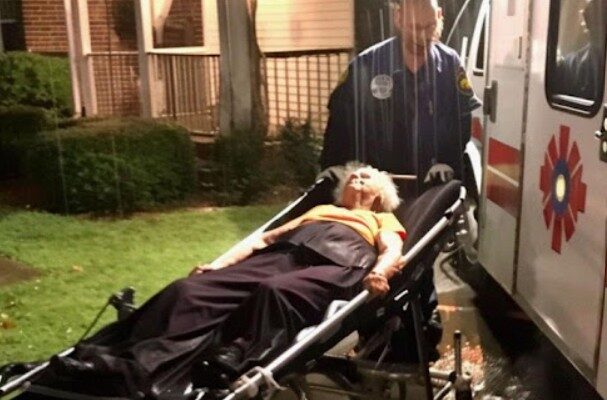
When they carried Mrs. Halloway out on a stretcher, she looked tiny and fragile under a white sheet. Her face was paper-thin, an oxygen mask on her nose and mouth. But when she looked at me, our eyes met. She raised a trembling hand and, with surprising strength, squeezed my wrist. She removed the mask to speak:
— Please… my cat… don’t leave her hungry.
I quickly nodded: — Okay, I’ll take care of her. I promise.
The paramedics gently released my hand and drove off. A few minutes later, they were gone, leaving only the reflections of flashing lights and the fading wail of the siren.
And there I stood, barefoot on the sidewalk, staring at Mrs. Halloway’s door. The door, closed for over twenty years, was now open, like an invitation.
I’ll never forget stepping across the threshold. The house smelled of dust and damp wood. The cat – thin, red-and-white striped – leapt at me, loudly meowing, clearly hungry.
I followed it into the kitchen, barefoot on the linoleum. The room was small and cluttered, with unopened letters everywhere, but the interior was functional. I found cat food in the pantry and poured it into a bowl, filling a dish with water.
At that moment, I should have left. Fed the cat, closed the door, returned to bed. But curiosity pushed me further into the house.
In the living room, everything was covered with white sheets, as if I’d entered a haunted house. I lifted one – beneath it stood a magnificent, old piano, its keys yellowed with age. Scattered across its surface were sheet music, manuscripts, song lyrics written in pale blue ink.
Then I noticed a black-and-white photo above the fireplace. A young woman in an evening gown, in front of a microphone, eyes closed, as if immersed in music. I froze – I knew that face.

Since childhood, I loved jazz. My father raised me on old, scratched vinyl records; every Sunday we listened to Ella Fitzgerald or Billie Holiday at breakfast.
And that woman in the photo? She was a singer from the ’60s, known for her melancholy melodies, and then she disappeared. My father always said of her: “A great mystery of music history.”
She had one album, about six months of tour dates, and that was it. “No one knew what happened to her,” my father said. “One day her songs were heard across America, the next – as if she never existed.”
And now she was here, on my street, at my neighbor’s house. Cat, music, solitude.
The next day, I brought flowers to the hospital. Mrs. Halloway lay in room 314, fragile but conscious, with an oxygen tube.
— Mrs. Halloway — I whispered, sitting beside her — I know who you are.
Her eyes narrowed, her voice sharp. — No, you don’t.
I leaned closer, even quieter: — My father had your album. I recognized the photo above the fireplace.
She froze. Only the rhythmic beeping of the heart monitor and the quiet hiss of oxygen. Finally, as if after an eternity, she whispered: — Close the door.
When we were alone, she said: — I vowed to take this secret to the grave.
Through tears, she told the whole story. She was that singer. She had an album, a tour, a dream she had carried since childhood.
But her husband Richard, also her manager, controlled her harshly and cruelly. He took all the money, told her what to sing, how to dress, what to say in interviews.
When she tried to defend herself, no one listened. When she wanted to leave, they threatened her daughter. — “The record label declared me unreliable,” she whispered. — “They said I was an alcoholic and mentally ill. Not a word was true. Who will they believe – him or a frightened girl from a small town in Ohio?”
She gathered courage and left with her daughter. Richard said she would never see her child again. He had money and influence, she had nothing.
That’s how she disappeared. The star became Mrs. Halloway, living in the shadows, on our quiet street.

— Then her daughter died in a car accident — she continued. — Richard died shortly after. Only the music no one heard and the damn cat remained.
Since then, I visited her every day. I brought soup, helped with exercises, fed the cat Melody. At first, she resisted, shy and stubborn.
But gradually, like spring ice, she began to open up. The children called her “Grandma.” Sometimes she played the piano for them, her hands trembling, but the sound was magical.
One day, I anonymously wrote about her on an old music forum. Replies came within hours: “The lost voice of the ’60s,” “Album now worth thousands of dollars,” “I’ve always searched for her traces.” People had never forgotten. For decades.
But I didn’t tell her about the forum. Too fragile, I was afraid they would find her. Yet somewhere inside, I knew — the world had to hear her story.
On a rainy Thursday, Mrs. Halloway asked me to sit beside her in the hospital. Her voice was barely audible.
— Dori, I lied to you about something important.
My heart stopped in my chest.
— About what?
Tears ran down her face:
— My daughter didn’t die in an accident. She left. She blamed me because I stayed silent… because I let him control us. She changed her name, started a new life. I never saw her again.
I couldn’t breathe.
— Do you know where she is now?
Mrs. Halloway’s hands trembled as she pulled a folded piece of paper from a drawer:
— This is the last address I found. Five years ago. I was too cowardly to go there.
With trembling hands, I unfolded the sheet. The address was in our town, twenty minutes from home. For three weeks I hesitated: was this my task? Did her daughter even want to be found after all these years? What if I opened old wounds?

But something in that fragile woman, in her eyes full of sorrow, pushed me forward.
Finally, on a sunny Saturday morning, I went to that address. A modest house in the suburbs, a tidy garden, children’s bicycles in the driveway. My heart pounded as I pressed the doorbell.
After a few seconds, a woman opened the door, around fifty, sharp green eyes, facial features like Mrs. Halloway. The family resemblance was obvious.
— Can I help you with something? — she asked cautiously.
— H-hi. I’m Dori — I stammered. — I think I know your mother.
Her face went pale. She closed the door without a word, the frame shaking.
As I walked back to my car, I heard a young voice inside:
— Mom? Who was at the door?
Mrs. Halloway’s granddaughter, of whom she knew nothing, had heard me.
I returned to the hospital and told her everything. Before I finished, Mrs. Halloway was already crying:
— I have a daughter — she whispered. — I’m a grandmother, and I never knew.
— Would you like to try meeting them? — I asked carefully.
Mrs. Halloway nodded, tears still flowing.
— I’m dying. The doctors told me yesterday. Maybe I have only weeks left. The past cannot be fixed, but maybe… at least I can say I’m sorry.
The next week, I brought Mrs. Halloway in a wheelchair to her daughter. She trembled; I feared she would fall before we reached the door.
— How could you dare bring her here? — Susan said coldly.
But then the daughter came out — a teenager, eyes like Mrs. Halloway, strong chin like Susan.
— Mom, who is this? — she asked.
And in that moment, three generations of women met face to face, after 26 years of silence and pain.
Susan was a little angry, but then she saw her daughter’s goodness, and her face softened.
— I’ve been waiting for you to save me — Susan said through tears. — I’ve waited years for you to be brave enough to leave him.
— It was awful — whispered Mrs. Halloway. — I thought we were lost forever. I thought if I stayed, I could protect you.
— Not like that — Susan said simply. — But I understand why you thought that.
As we left, Mrs. Halloway whispered in the car:
— Now I can die in peace. They know I never stopped loving them. They know I tried.
Two weeks later, Mrs. Halloway passed away peacefully in her sleep, and the cat Melody curled up beside her on the hospital bed.
At the funeral, Susan and Emma sat in the front rows. My husband played Mrs. Halloway’s piece on the piano, and my children cried as if they had lost a real grandmother. Emma sang softly; her voice was incredibly beautiful, like her grandmother’s.