
When I was lying in the hospital after hip surgery, every day I dreamed only of one thing — to return home.
It seemed that nothing was more precious than the silence of familiar walls, the scent of jasmine in the garden, and the old armchair by the window where my late husband, Andrés, used to enjoy reading.
Ten days felt like an eternity. I counted the hours while the doctors prepared the discharge papers, thinking that surely my son Daniel and daughter-in-law Valeria were waiting for me outside the hospital room. They knew how hard it was for me.
But no one came. No one called.
I handled the paperwork myself, ordered a taxi, and holding my bandaged leg, I kept telling myself:
“They must just be busy. They’re definitely waiting for me at home.”
When the car turned onto Jacaranda Street, my heart began to beat faster. That was our home — white, with a blue gate, the home where Andrés and I spent our whole lives, raised our son, planted trees, and dreamed of growing old together.
But at the gate, I felt a strange uneasiness.
There was a black SUV I had never seen before. The gate was slightly open.
I knocked.
Daniel opened the door — my son, the one I once carried in my arms, nursed through colds, and walked to his exams.
But his look was cold, unfamiliar.
“Mom,” he said dryly, “you can’t come in.”
I froze.
“What did you say, son? This is our home…”
Behind him appeared Valeria, holding my granddaughter Camila in her arms.
“From today, my parents live here,” she said calmly, as if announcing something completely ordinary. “We’ve already moved your things out.”

I couldn’t believe it.
“Valeria, you must be joking? I just came back from the hospital…”
But there was no compassion or regret in her eyes.
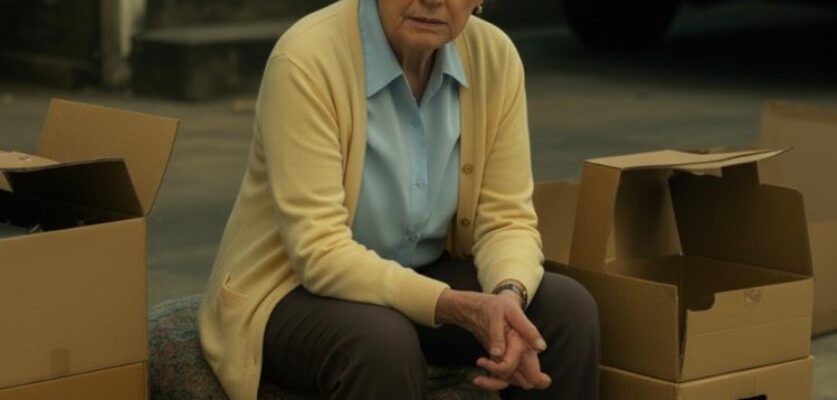
There were boxes on the stairs — my things, neatly packed, labeled with black marker: “C.M.”
I recognized the old wool blanket that Andrés gave me, the photographs, the porcelain cup that belonged to my mother — my whole life packed up like useless trash.
“You have no right to do this!” I whispered, feeling my legs give out under me.
“Everything is legal,” my son replied, throwing some papers onto the ground. “You signed it yourself.”
I fell to my knees. They were some kind of authorization forms, with my signature.
And suddenly I remembered: Valeria used to come to the hospital, smiling and saying they were “insurance documents.”
I signed them without even reading, not wanting to hold up the nurse.
That’s how I gave away everything: the house, the accounts, even the savings I had collected for years after Andrés passed away.
From that evening, a new life began — without a roof over my head, without a family, but with one goal: to regain not only my property but also my dignity.
I rented a small room in a cheap hotel in the center of Querétaro. The room smelled of disinfectant, the walls were pale, but I turned on the lamp, took out a wedding photo — Andrés was holding my hand in it — and quietly cried.
After an hour, my friend Marta arrived. She had known me all her life.
“Clara,” she said, opening a folder, “while you were in the hospital, your accounts were emptied. The money was transferred to a company registered in Valeria’s father’s name.”
I sat down, feeling the ground slip from under my feet. It wasn’t just fraud — it was betrayal.
“But why?” was all I managed to whisper. “I trusted them.”
Marta took my hand.
“Because you are kind, Clara. But now is not the time for tears — we have to act.”
We filed a report and began gathering evidence. It turned out that similar things had happened to other elderly neighbors — tricked in the same way.

With each passing day, my determination grew. I remembered Andrés’s words:
“You are strong, Clara. Never let anyone humiliate you.”
I knew I wasn’t alone. I had Marta, several neighbors, and the belief in justice that survived despite the pain.
The investigation took a long time. Court, documents, testimonies — it all seemed endless.
But in the end, the truth won.
It was proven that the documents had been signed as a result of fraud, the accounts were emptied illegally, and the authorization had been forged.
The house was returned to me.
When I crossed its threshold again for the first time, the walls seemed to whisper:
“Welcome home, hostess.”
I cried — with relief, with sorrow, with everything at once.
Neighbors came with cakes, flowers, and helped me clean.
Even little Camila, now without Valeria, one day ran into the garden and hugged me.
“Grandma, is everything okay now?” she asked.
“Yes, now it is,” I replied, stroking her hair.
Life slowly returned to the house.
But I was no longer the same. I learned not to trust blindly, to read every document, and not to be afraid to fight for myself.
With Marta’s help, I started a small charity project — the Andrés Montiel Foundation.
We help elderly people check documents and advise them before signing anything.
Sometimes in the evening, I go out to the garden, where the jacarandas bloom, and I light a candle by Andrés’s portrait.
“I did it, my dear,” I whisper. “I survived betrayal, and I found the strength to carry on.”
And when the wind moves the purple petals, I feel no pain anymore, but gratitude.
For friends, for a second chance, and for the fact that life allowed me to prove: even after the greatest betrayal, you can regain your home, your dignity, and your faith in people.
Because true strength is not about never falling — but about always being able to rise again.