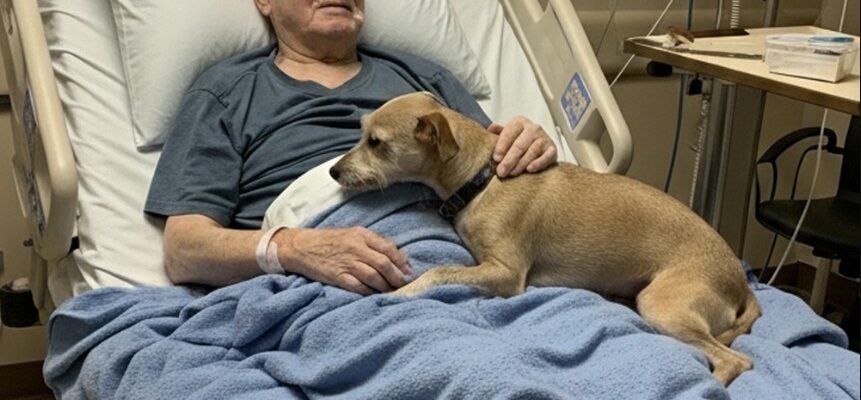

The room was warm and quiet; only the steady sound of the machines reminded of the passing time. Alden Pierce lay on white pillows, staring at the ceiling as if he could see an endless sky beyond it. He was eighty-two years old. He had been through a lot — lost his wife, endured hard times, and raised a son who now lived far away. But what he feared most was not pain or death — it was saying goodbye. Not to the world, not to his home, but to the one who had been by his side for nearly fifteen years — a small gray dog named Richie, who once saved his life simply by being there.
Every day Alden looked out the window and whispered, “Where are you, my old friend?” Sometimes he thought he could hear the gentle tapping of claws on the floor, as if Richie was running through the house again. Since the illness had forced him to move into the hospital, he missed that sound more than anything else.
When nurse Elena entered the room to change his IV, he squeezed her hand. His fingers were light, almost transparent, but there was strength in that gesture. “Please,” he whispered, “let me see Richie. He’s waiting for me. I can’t leave without saying goodbye.”
Elena knew the rules. Animals weren’t allowed in the ward. But something inside her stirred — maybe because she remembered her own dog, whom she had lost a few years earlier. She nodded softly and promised to try.
That day she spoke to everyone — the head nurse, the ward director, even the doctor who never allowed any rules to be broken. When she explained, her voice didn’t sound like a request but like certainty. The doctor sighed, rubbed his face, and said, “If that’s his last wish, let the dog come. We’ll make sure it’s safe.”
Two hours later, a quiet sound echoed in the hallway: the tapping of claws on tiles, the jingle of a collar, a soft, restrained “woof.” Richie walked carefully, his old legs trembling slightly, but his eyes sparkled. A volunteer from the nearby shelter, where the dog had stayed since Alden was hospitalized, had brought him.
When the door opened, Richie didn’t hesitate for a second. He ran to the bed, jumped up, curled into a ball on his owner’s chest, and laid his head on his shoulder. Alden laughed softly — like a man who had just been given his breath back. “Forgive me, my friend, for not always being there for you. Thank you for everything.”
Richie gave a quiet growl, as if to say, “I was always here.”

That day, time in the room seemed to stop.
Elena dimmed the lights and hung a sign on the door: “Do not disturb.” She turned off the sound of the machines. She covered the dog with a soft blanket so he wouldn’t get cold.
Alden spoke slowly, remembering his life as if leafing through an old album. He told how, one rainy evening, he found Richie under a bridge — soaked and frightened. How he brought him home, bathed him, and gave him a name. How the dog saved him from loneliness after his wife’s death. How every morning he waited for Alden to brew coffee, and every evening lay beside him, resting his head on his knees.
Elena listened, trying not to cry. At some point, Alden stopped speaking; he just stroked Richie, and their breaths blended into one rhythm — calm, gentle, like an old metronome.
When dusk fell, the nurse returned with a new IV. She quietly opened the door — and the folder with papers slipped from her hands. Alden was lying peacefully, a slight smile on his face. Richie — beside him, his head on Alden’s chest. The monitor showed a straight line.
Elena froze. She approached, checked his pulse — and immediately knew he was gone. Her heart seemed to stop along with his. She looked at Richie, expecting he too had stopped breathing. But she felt it — a weak but steady heartbeat. He was still here.
“You did well, old man,” she whispered. “You made it.”
Alden left quietly — between his last story and the first glow of the streetlights. And Richie stayed by his side, guarding his peace until someone told him he could rest.
A few minutes later, doctors entered the room. No one said a word. They straightened the blankets, dimmed the lights, and allowed those two old souls to leave in a silence worthy of music. Elena gently took Richie in her arms. The dog snuggled against her and sighed deeply.
At the end of the corridor was a small courtyard with strings of lights. There, a volunteer sat with Richie on a bench. Someone brought water, another a blanket. Around them, hospital life went on as usual, but in that place, for a moment, there was an extraordinary peace.
The next morning, Elena called the number Alden had left on the back of his phone. A woman answered — Mrs. Reyes, a neighbor and family friend. She came quickly, holding in her hands the old leash she had kept since the day Alden first brought Richie home.
The woman knelt, pressed her forehead to the dog’s head, and said: “Come, my dear. Now we’ll take care of each other.”
Elena filled out the papers. They were simple words — confirmation of the patient’s last wish fulfilled, the transfer of the animal to a new guardian. But at that moment, those signatures felt like a blessing.

A few weeks later, the story spread throughout the hospital.
At first, it was whispered, then it was written into the report. Soon a new rule appeared.
From then on, animals were allowed to come to say their final goodbyes.
On the doors of such rooms, a blue sign was hung: “Family farewell — do not disturb.”
Even the cleaners, who were always in a hurry, left that room empty for an extra hour.
The security guards helped welcome guests with their four-legged friends.
And the head doctor, the same strict man, signed the order and said:
“We treat pain, but we have no right to forbid love.”
Since then, Elena has kept a letter in her locker — the one Alden wrote just before the end.
Yellowed, with a coffee stain, but the words are still clear:
“Thank you for your mercy — for breaking the rules when you needed to keep a promise.”
Sometimes, when her shift is too long, she takes out the letter and reads it.
Then it seems she hears Richie’s quiet breathing nearby,
and her heart fills with that special warmth that comes only from true kindness.
Richie now lives with Mrs. Reyes.
In the morning, he sleeps on a soft rug by the window,
and in the evening he gets up and looks at the sky.
When the wind moves the curtains, it feels as if he’s still waiting for the old man with the gentle face to come.
If dogs could pray, their prayers would sound just like that —
without words, in their breath, in gratitude.
And perhaps somewhere, beyond the edge of the ordinary,
Alden is once again stroking his faithful friend,
and the dog lies peacefully beside him, knowing that everything has happened just as it should.
Sometimes Elena remembers the cry that escaped her when she opened the door and saw them together.
People often ask if she was afraid.
She smiles and says:
“No. It wasn’t fear. It was awe. I thought I saw an ending, but really I saw a fulfilled promise.”
There is no tragedy in this story.
There is silence — the kind where love lives.
An ordinary man wanted only one thing — to say goodbye to the one who was always with him.
And the hospital allowed him to do that.
Maybe that’s what makes us human:
to stay when others leave, and to let go when it’s time.
And if someone asks what happened that night,
you can answer simply: the door opened — and love stayed in the room.