
On Thanksgiving, I gave my coat to a homeless woman.
Two years later, she stood at my door — with a black backpack and a smile you could never forget.
Thanksgiving hadn’t meant much to me for a long time. Everything changed when, at forty-nine, I lost my wife, Marla. She had been ill for a long time, and we both knew the road ahead would be difficult. In the last months, her strength slowly faded. For three months I slept in a chair beside her bed in the hospice. Sometimes it felt like I had forgotten what it meant to breathe calmly.
After she passed, my world shrank to one person — our daughter Sarah. She was the only reason I placed my feet on the floor every morning. I stopped paying attention to holidays, birthdays, ordinary family traditions. Only one thing mattered — to protect her and keep us both afloat while I learned to live with the emptiness.
When Sarah left to work abroad, I told her I was proud of her — and that was true. But when the door closed behind her, silence filled the house like water leaking into the cracked hull of a ship. It was everywhere. Music lost its melody, food became a duty, and the walls seemed to move further away, making the house feel even more empty.
The year I turned fifty-one, Sarah was in Scotland and couldn’t fly home. We planned to talk in the evening, but the morning felt like a long corridor full of closed doors and memories that hurt.
A strange silence filled the house — as if the air itself was waiting for something. Counters too clean, plates in their places, and the steady hum of the fridge louder than usual.
I stood at the sink with a cup of coffee I didn’t want to drink, but forced myself to make — because I heard Marla’s voice in my head:
“If I’m ever gone, Eric… stick to your routine. It will protect you. Promise.”
I trusted her. With all my heart.
After a few minutes, I set the cup aside, grabbed my keys, and reached for the coat hanging by the door — the brown one Sarah had given me once for Father’s Day. Warm, heavy, reminding me that someone loved me, even if I felt unbearably lonely.

The coat was too elegant for a quick trip to the store, but I didn’t care. I just needed to get out, breathe some cold air.
I slowly walked toward the supermarket. I bought a roasted chicken, rolls, cranberry sauce, and pumpkin pie. The truth was, I didn’t need any of it. I told myself I would make a normal dinner. But I knew — I’d probably eat only a piece of pie, and the rest would remain untouched.
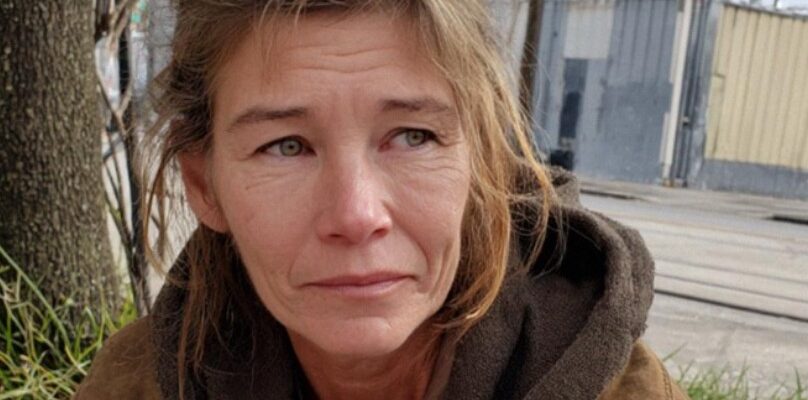
When I left the store, I saw her. She sat alone under a bare maple tree, next to the shopping carts. Her hands trembled, and she had no coat on her shoulders. She looked at the ground as if she wanted to disappear among the passersby. People walked past her without noticing anything.
But something drew me to her. I approached carefully. And again, I heard Marla’s voice:
“Do something good, Eric.”
I came closer. She stiffened when she saw me.
“I don’t want to bother you,” I said quietly. “I won’t ask anything. It’s just… you must be cold.”
She didn’t answer. She only narrowed her eyes — she looked as if she carried an invisible weight on her shoulders.
I unbuttoned my coat and handed it to her.
“Here. You need it more than I do.”
She lifted her gaze — as if she couldn’t believe it was really happening. Her cracked fingers barely brushed mine as she took the coat.
She didn’t say “thank you” for a long time; she simply held the coat against herself, looking as if, for the first time in a long while, she felt safe.
I gave her the bag with food as well. I pulled out a pen and wrote my address on the pie box.
“Only if you really need help,” I said. “My name is Eric.”
She nodded slightly and whispered almost silently:
“Thank you.”
That evening I spoke with Sarah. She was in Scotland, sitting by the fireplace in a huge hoodie.
“Did you eat something, Dad?”
“Of course!” I lied a bit. “I had a piece of pumpkin pie. Too sweet.”
“Thanksgiving without pie isn’t Thanksgiving,” she smiled. “Remember how Mom used to bake three kinds?”
We talked about everything — except that quiet sadness we both carried.
After the call, I thought about that woman. Did she eat? Did she find shelter? Was she wearing my coat?
Two years passed like a moment. I didn’t forget, but I learned to move forward.
On the next Thanksgiving, in the afternoon, the doorbell rang. Sarah and her husband Jake were already home — arguing over a board game.
When I opened the door, I lost my breath. It was her.
Different — neat, confident, calm. In her hands she held a black backpack, pressed to her chest.
“I hoped you still lived here,” she said with a warm smile.
“Did something happen? Is everything alright?” I asked.
She nodded.
“Yes. It’s just… I think the time has come to return something that belongs to you.”
She handed me the backpack.
Inside was my brown coat — carefully folded. And on top of it — a wooden box.
Inside were:
— a gold watch with a worn strap,
— and a check for twenty thousand dollars — made out in my name.
I was speechless.
“What… what is this? I can’t accept this…”
She smiled softly.
“My name is Charlotte. And I will explain everything to you.”
We sat at the table. Charlotte held the backpack on her knees.
“Eric… you changed the course of my life.”
She told me everything.
About a difficult marriage.
About the manipulation that made her lose her confidence and much more.
About an unfair dismissal.
About the long period when she could barely find the strength to move forward.
That day at the supermarket she was exhausted and saw no way out.
But the fact that someone noticed her, fed her, and gave her warmth became the beginning of change.
She turned to an old acquaintance — a lawyer, a friend of her father.
Together they analyzed the situation, gathered documents, evidence, and brought justice.
“I kept your coat,” she said. “And your address. And I promised myself that when I got back on my feet — I would return everything. And add something from me.”
She pointed at the watch and the check.
“The watch belonged to my father. And the check… is a thank-you. Please use it to help someone else. Just like you helped me.”
I wanted to protest, but she said quietly:
“Just live, Eric. Allow yourself joy.”
We laughed — through tears.
A year passed. Charlotte spent Thanksgiving with us.
Sarah insisted she try cranberry sauce for the first time.
When everyone said what they were grateful for, I stayed silent for a long time. I looked at my daughter, at Jake… and at Charlotte — a new part of our family.
And I felt something I hadn’t allowed myself in a long time: hope.
Between me and Charlotte, something quiet, calm, healing began to grow.
And deep inside I felt that this too was part of the path Marla and I once began.
Only now — new, warm, unexpected.
The coat lies today in the wooden box in the hallway.
It is something more than fabric and thread.
It is a reminder of kindness, of second chances, and of a moment that changed two lives — each in its own way.