I was visiting my fiancé’s parents when my future mother-in-law, Mrs. Loran, leaned toward him and said something in French, certain that I wouldn’t understand. But by the end of the evening, I approached them and said it back in flawless French…
The day before the wedding, as I stood in the kitchen reviewing lists, trying not to forget anything, my phone quietly vibrated in my pocket.
The message was brief: Honeymoon
“Mom wants to see you at dinner. Better today. It’s important.”
I stared at the screen for a few seconds. The thought of meeting his parents always gave me a slight chill under my skin—not fear, but a feeling as if you were entering a house where everything is measured not by warmth but by rules.
My fiancé’s family, the Lorans, was wealthy and influential. The house—old, familial. Traditions—strict, almost ritualistic.
And I, a girl raised in an ordinary family of teachers, didn’t fit into their world.
But I loved Etien.
And I was ready to endure a lot.
In the evening, as I walked up the marble stairs, polished so that the chandelier’s light reflected off them, it felt like every step was too loud. Etien greeted me at the door. He looked calm, but I knew him well enough to notice the tension in his shoulders.
— Thank you for coming — he whispered. — Let’s go. Everything will be fine.
Those words, spoken in an almost childlike voice, warmed me more than all the lamps in their formal living room.
Inside, it was beautiful, luxurious, even refined—but not cozy.
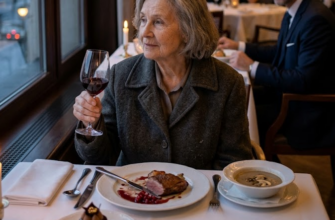
The table was set as for a diplomatic reception: crystal, porcelain, thin knives, caviar dishes, and miniature tartlets. The air carried the scent of expensive candles.
Mrs. Loran sat at the head of the table—graceful, composed, in a burgundy dress that emphasized her status more than any words. Beside her, a calm and collected husband, observing everything carefully.
— We’re glad you could come — Etien’s mother said with irony that could be felt even in the gentlest phrase.

I smiled politely.
Such a smile was a shield for those accustomed to living in harmony and without conflict.
Dinner began.
Conversations were calm, but every question touched boundaries: my background, work, family, plans. The questions didn’t sound harsh, but there was an undertone—a hidden test, as if I had to prove I deserved to be part of their world.
When I said that my parents were ordinary people, Etien’s mother slightly nodded, as if she had heard something obvious.
I constantly felt as if an invisible wall stood between me and this house.
But I endured. For Etien.
By the end of the evening, the tension was evident. Etien stepped out to take a phone call, and the three of us remained. Mrs. Loran leaned slightly toward her husband and, calmly, gently—almost tenderly—said something in French.
The phrase was short, but every word—like a needle:
“She’s charming. Too simple for our son, unfortunately. But she tries—that’s obvious.”
They were sure I didn’t understand.
And perhaps it would have been easier—hear nothing, know nothing.
But life often gives us knowledge to finally set boundaries.
I understood everything.
French was my second language.
I took a deep breath. Not in resentment—calmly. For the first time in a long while, I felt not pain but a strange clarity.
As if a puzzle had fallen into place: their expectations, my fears, his growing tension.
Indeed, we were from different worlds.
But that didn’t give them the right to speak to me that way.
As the evening drew to a close, I thanked them for dinner and approached Etien’s mother. At that moment, Etien was returning to the room, but hadn’t yet said anything.
I took her hand—gently, respectfully—and spoke quietly, but clearly.
In perfect, pure French:
— “Je suis ravie d’avoir une famille si exquise, et j’espère que nos futurs enfants ne vous ressembleront pas.”
I am very pleased to have such an exquisite family… and I sincerely hope that our future children will not resemble you

The world in the room seemed to stop.
Mrs. Loran went pale—not with anger, but with surprise.
Etien froze mid-step, unable to believe what he had heard.
For several seconds, no one breathed.
— You… speak French? — Etien’s mother whispered now, without her usual haughtiness, as if seeing me for the first time as a person, not a category.
I smiled gently.
— Yes. And for a long time. My grandfather lived in France; he taught me from childhood.
And… I always try to respect people, even if they are not like me.
I sighed and added:
— But today, I felt unnecessary here. Not because of wealth or the residence. Simply because I was not valued, even without being known.
I gently draped my coat over my shoulders, thanked them for the evening, and headed toward the door.
Behind me, I heard Etien’s mother’s quiet voice:
— I didn’t know… I didn’t mean to offend…
But I was already closing the door.
Not in anger.
Not in resentment.
But with the feeling that for the first time in my life, I had said what I should have said many years ago—not only to them, but to myself.
Sometimes one finds their strength not in a loud argument, not in scandal, and not in proofs.
But in quiet honesty—calm, strong, full of respect.
And that evening, I found myself.