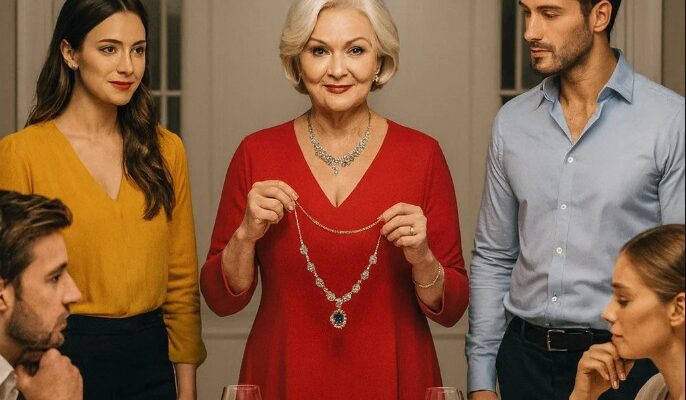

That night, when my mother was celebrating her seventieth birthday, the house was filled with warm light, the soft glow of lamps, laughter, and the clinking of glasses. Neighbors and friends she had loved her entire life came to celebrate.
Teachers still called her “Mrs. Parrish,” and my younger brother Landon, who was only twenty-two, sat beside her with such confidence, as if he had organized the entire party himself.
And I stood there with a box in my hands. I had been saving money for this gift for five years. Every extra dollar, every canceled trip, every small sacrifice — all so I could buy my mother the necklace she had dreamed of since her youth. It was special — “for real ladies,” as she used to say.
When I handed her the box, a quiet but powerful hope flared inside me. Adults rarely admit to themselves that they still have hope, but I did. I hoped that maybe now my mother would finally see me — not just as the daughter who always remained in the background, but as a grown woman who had spent her entire life trying to be good enough.
But when my mother opened the box and lifted the necklace, her smile seemed to falter. Not completely, but enough for me to feel a chill pass through the room.
She stood up, holding her glass, and said:
— Friends, today Marta made a very dramatic gesture.

The room fell into silence. At that moment, I understood: the sharpest words of my life had been spoken in front of everyone. My mother talked about my “great achievements,” about how I always try to prove something instead of seeking real closeness.
She said that Landon truly understands her because he simply comes to her, without trying to prove anything.
I went outside. The cool evening air touched my face, and suddenly I felt like a teenager again — small, defenseless, always standing in the background of her world.
I was compared to Landon from childhood. If I got a good grade, I would hear, “Landon would have done better.” If I cleaned the house — “well, at least you tried.” Even when I earned scholarships or achieved success, my mother would say, “Landon thinks more broadly.”
Her words were never harsh, but they left deep marks. Love showed itself in small gestures, while recognition came rarely. I grew up believing that if I worked even harder, one day my mother would truly see me. But that moment never came.
I saved for the necklace for five years not to show off, but in the hope of being noticed. Yet at the party, my mother put it back into the box without saying a single word of thanks. I left and didn’t answer her call.

The next day, my mother was already creating her own version of events. She called my workplace, “concerned about my emotional state,” and sent a photo of the empty velvet box with the caption:
“A mother’s heart can break in silence. I pray that my daughter finds peace.”
I understood then: it was time to live for myself. I sold my apartment, packed my things, and moved to a quiet little town by a river in Ohio. The air there was different — light, as if the whole world had exhaled along with me.
I adopted an old female dog named Rusty from a shelter, who seemed to understand the art of starting over. Every morning we walked slowly along the river — without expectations, without comparisons, just life.
At the local community center, I began teaching simple financial education classes. People listened, asked questions, and thanked me — sincerely. And that was enough.
For the first time, I felt that my life belonged to me. Quiet, peaceful, unconditional, without comparisons. A life in which I was finally good enough — exactly as I wanted to be.
Sometimes the path to healing does not lead backward. Sometimes it begins when we stop waiting for others’ approval and start living for ourselves.