
After twenty years spent abroad, I returned to my sister’s house, which I had once given her. And what I saw at the entrance stopped my heart.
— “Do you really want me to drop you here?” the taxi driver asked cautiously, stopping in front of the tall gates. “The house looks very expensive. Are you sure someone is expecting you here?”
I nodded. I was wearing a simple gray coat and worn shoes, holding a small bag in my hands. Twenty years of living abroad had taught me to cherish every opportunity to spend time with family, but at that moment, the feeling of being at home seemed particularly fragile.
The house stood deep in the garden — large, well-kept, with a wide porch. The path I walked on was clean and carefully maintained. The front door was open. Music and guests’ conversations could be heard — clearly, a celebration was taking place inside.
I entered quietly. The spacious hall was full of people in expensive suits and elegant dresses, glasses in their hands. No one paid attention to me. I stood by the wall, almost invisible.
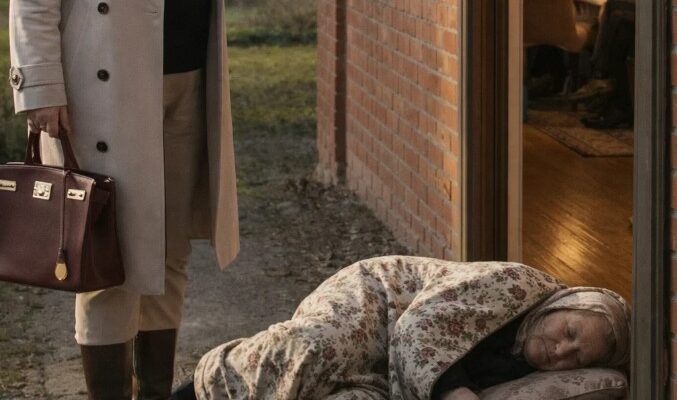
It was only when I looked down that I saw her.
On the doormat right by the door, wrapped in a thin blanket, a woman was sleeping. In old, worn-out clothes, she lay as if this cold corner had always been her place. With horror, I recognized my sister in her — the same one I had once given this house to. My heart trembled with pain.

At that moment, a man came out from the depths of the house, holding a glass. My son. He was laughing loudly, talking to the guests, and walking past without paying any attention to my sister.
— “Don’t mind her,” he said in a slightly mocking tone. “She’s our maid.”
The guests laughed awkwardly, and for a moment, the whole world around me froze. I understood: in this house, my sister was treated in a way that no family should ever allow.
I went to my sister and quietly said, “Get up.” She opened her eyes and looked at me — there was no surprise in her gaze, only a slight weariness and expectation. As if she knew I would return today.
— “You can end the party,” I said in a calm but firm voice. “This house no longer belongs to you.”
I placed a thin folder of documents on the table in front of everyone.
— “Twenty years ago, I gave this house as a gift on the condition that whoever lived here would be treated with dignity and care. That condition has been broken,” I said without looking away. “From this moment on, you are here without legal title.”
Silence fell in the hall. The guests froze, stopped smiling, stopped holding their glasses. My son turned pale and froze, as if seeing me for the first time and realizing this was no longer a joke.

— “You have time to pack your things and leave the house,” I added. “From this moment on, the house returns to its rightful owner.”
My sister slowly got up. I helped her sit in a comfortable chair next to me. Her gaze met mine — and I saw gratitude that could not be expressed in words.
— “Twenty years,” I said quietly, “I built a life abroad for the family so that everyone would have a home, warmth, and care. Today, everything returns to its place.”
The guests understood that the party was over. Glasses fell, the music stopped, and true silence filled the house — a silence that spoke of justice and a new life.
My sister took my hand. We didn’t speak a word, but everything was clear: after long years of neglect and pain, justice had been restored. And no one would ever dare to forget the dignity and respect owed to the person who owns this house.