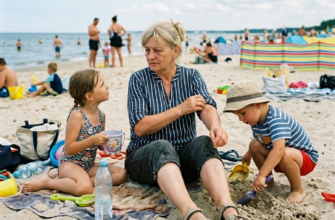

My husband and my mother-in-law left for the seaside early in the morning.
I was awakened by silence — the kind that exists only when there are no хозяins left in the house. On the kitchen table lay a note, written in my mother-in-law’s familiar, sharp handwriting:
“We’ve left. Deal with Grandma on your own.”
No signature. No explanation.
I read those words several times, hoping I was mistaken. But no — everything was painfully clear. They had gone to rest, leaving me to care for the elderly relative they had preferred not to remember in recent years.
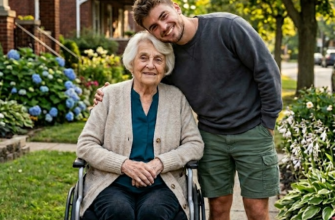
My husband’s grandmother lived in the back room. Quiet, almost invisible, like a shadow. Once she had been a strict, wise woman who kept the whole household in order, but with age her strength had faded. My husband and his mother spoke of her more and more often as a “problem,” as something unnecessary and burdensome.
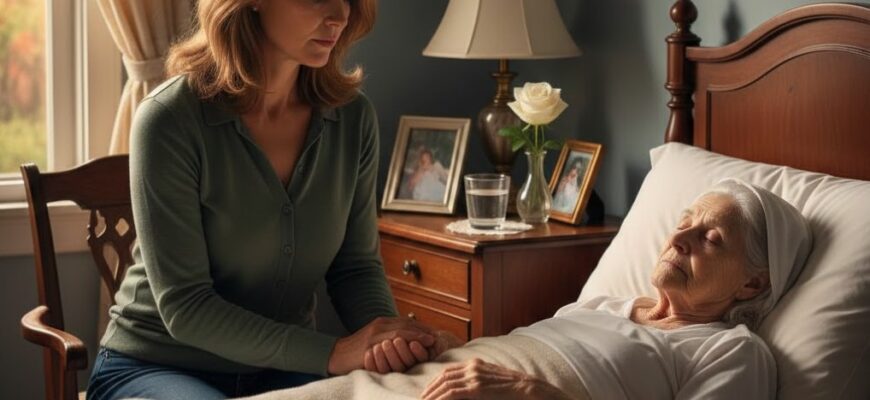
I entered the room and immediately felt uneasy. The air was heavy, the window closed. Grandma was lying on the bed, hardly moving. Her eyes were open, but her gaze was absent.
“Grandma…” I said softly.
She slowly turned her head. I realized that she had not been receiving proper care for a long time. There was no concern or attention — only the expectation that everything would “sort itself out.”
Something tightened inside me. I reached for my phone to call the doctors. In moments like these, one must not take risks — an elderly person’s health is more important than any family conflicts.
And then Grandma carefully raised her hand and touched my wrist. She gripped it with surprising strength.
“Wait…” she whispered. “Listen to me first.”

I leaned closer.
“Look under the dresser,” she said barely audibly. “That’s where the truth lies. Then you will understand why they were in such a hurry to leave.”
There was no fear in her voice. On the contrary — calm and clarity. That struck me the most. For the first time I saw not weakness in her eyes, but awareness.
The dresser had stood in the corner of the room for so many years that I had stopped noticing it. Old, heavy, with worn handles. I pushed it aside with effort and saw a small hatch hidden beneath the fabric.
Under it was a hidden compartment.
Inside were neatly arranged documents. Bank statements, contracts, letters. Everything sorted, as if Grandma had been preparing for this moment for a long time. I slowly went through the papers, and with each page it became harder and harder to breathe.
The documents showed that the house was registered in Grandma’s name. That she had never lost her legal capacity. That attempts to declare her “incapable of making decisions” had been made without her consent. There were also letters — calm, factual, without accusations, but full of evidence.
And at the very end — a will. Recent. Fully legal. Notarized.
According to it, all the property — the house, the accounts, the land — was to pass to me.
I sat down right on the floor.
At that moment everything became clear. They had left expecting that in a few days, without proper care, the situation would worsen on its own. They did not expect that someone would stay with Grandma — someone who truly would.

I returned to the bed. Grandma was looking at me attentively and smiling faintly.
“I watched for a long time,” she said quietly. “And I waited. Not for the one who talks the loudest about family, but for the one who will not leave.”
That same day I called an ambulance. The doctors examined Grandma, prescribed treatment, and confirmed that help had arrived in time. Her condition stabilized.
And after that, everything unfolded not under the influence of emotions, but according to the law.
When my husband and my mother-in-law returned from the seaside, they expected to see a familiar scene. Instead, documents, officials, and facts that could not be ignored were waiting for them at the house.
No shouting. No arguments.
Just the consequences of the decisions they themselves had made.
I watched it all calmly.
Because in that moment I understood one thing: family is not words and not formalities. It is the choice we make when someone weak and in need of support is beside us.
And sometimes that very choice changes an entire life.