
Light at the End of the Snowstorm: Why That Meeting on a Winter Road Became My Salvation
That night, the road seemed endless. The snow was falling thick and heavy, as if someone up above were covering the world with a heavy blanket, trying to muffle all sound. The headlights pulled only a narrow strip of asphalt out of the darkness; beyond it began a cold, impenetrable emptiness.
I was driving slowly, gripping the steering wheel so tightly that my fingers hurt. My thoughts kept returning to my parents’ house, where my children were waiting for me. Emma and Jake were probably already exhausting Grandma with questions: “Where is Mom? Will she make it in time for the presents?” This Christmas Eve was special for us — and painful. The first year after their father had left. He had simply closed the door behind him, leaving me with two children and an empty silence I had to learn to fill on my own. I was managing. But on nights like this, the exhaustion fell so heavily that I wanted to stop in the middle of the forest and scream.
I saw him on a bend.
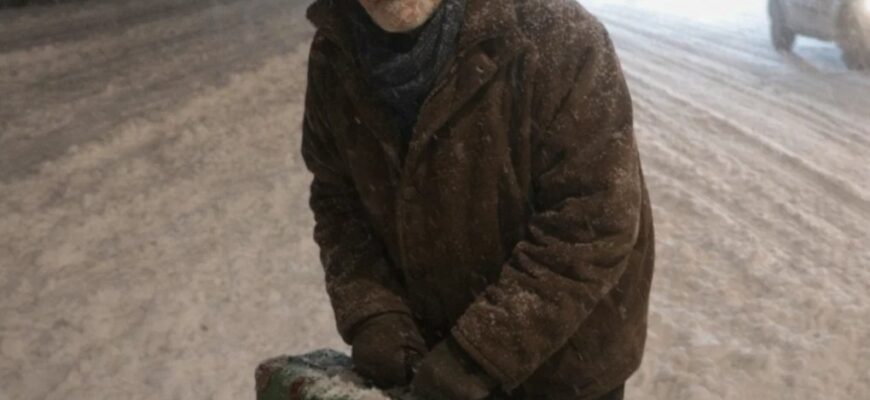
At first he was only a shadow. Then the headlights revealed a hunched figure. An old man in a worn coat was walking slowly along the roadside. In his hand he carried an old leather suitcase with a cracked handle. He walked as if every step were a small victory over death.
My mind screamed, “Drive past! It’s dangerous!” But I hit the brakes. The window slid down with a heavy creak, and icy air immediately filled the car.
“Excuse me!” I called out. “Do you need help? It’s almost thirty degrees below zero out here!”
The man flinched and slowly turned his head. His face was covered in wrinkles, frost clung to his eyelashes, but there was no aggression in his eyes — only a bottomless, frozen confusion.
“I need to get to Milltown,” he rasped. “My family… my family is waiting for me there. They’re waiting for dinner.”
I knew the town. It was at least a five-hour drive along an icy mountain road. “You won’t make it there today,” I said gently. “The roads are closed. Get in — I’ll take you to our house. It’s warm there.”
He stood motionless, staring at his snow-dusted boots. “But today is Christmas,” he whispered, and there was so much despair in that whisper that my chest tightened. “They’re waiting…”
“Get in,” I urged, pushing open the passenger door. “Please.”
He sat on the very edge of the seat, as if afraid of taking up too much space. He placed the suitcase at his feet, holding the handle the whole time.
“My name is Frank,” he said when the heater had finally begun to warm his fingers.
“Maria. Have some tea — there’s still some left in the thermos.”
We drove in silence. I could see his hands — red, knotted — trembling slightly. Sometimes silence is the safest kind of conversation.

The Truth in the Kitchen
At home, Mom greeted us as if we had invited an old friend. She simply took his coat and pointed to the armchair by the fireplace. “No one should be alone on a night like this,” she said.
In the morning the house filled with the smell of cinnamon and children’s laughter. Emma immediately brought Frank her drawings, and Jake began asking: “What’s in that suitcase? Presents? Are you Santa’s helper?” Frank smiled, but in his eyes I saw something tense. He sat upright, watching the door, as if expecting someone to arrive any moment and escort him away.
When the children ran off to play, he stared into his cup for a long time. Then he took a deep breath.
“Maria… I have to tell you the truth. I lied to you on the road.”
I froze with the kettle in my hand. The worst thoughts rushed into my head.
“What do you mean, Frank?”
“There is no family in Milltown,” he said quietly, his voice breaking. “No one is waiting for me. No one at all in this world.” He had left the nursing home.
He dropped his head, hiding his tears. “Not because I’m a criminal. I just couldn’t stay there any longer. It was so cold there — not outside, but inside. Almost no one noticed us. I felt like I was disappearing, becoming an empty space, just a number in a report. I was afraid that if I told the truth, you would call the police and they would take me back to that emptiness.”
“Why did you decide to leave just now?” I asked, sitting beside him.
“At Christmas, loneliness becomes unbearable,” he smiled bitterly. “At my age, asking for help is the scariest thing. I thought I’d reach the city, sit at the station, and just watch people. Just to feel alive one more time.”
He stood up, reaching for his battered suitcase. “I’m sorry. I’ll go now. I don’t want to be a burden.”
I stepped forward and took his hand firmly. “Sit down, Frank. In this house, no one leaves anyone behind. And you are not a burden. You are our guest. And the children, it seems, really need a grandfather.”

The Gift from the Suitcase
Frank stayed. First for the holidays, then for a month. Slowly and properly, we sorted out all the documents. He became part of our life without us even noticing. He fixed old things, read to the children before bed, and taught them that patience matters more than strictness. He didn’t replace their father, but he became the foundation that had been so missing.
One evening he invited me into the living room. His suitcase was lying on the table.
“The time has come, Maria,” he said, and snapped open the clasps. “I’ve kept this for forty years. It’s all that’s left of my wife.”
He took out a canvas wrapped in old cloth. When he unwrapped it, my breath caught. The painting showed a sunrise — so bright and warm it felt as if real sunlight were flooding the room.
“It’s an original,” Frank gently ran his finger along the frame. “My wife came from a family of well-known painters. She used to say: ‘Frank, if it ever gets dark for you, the light will show you the way.’ I wanted to sell it when I left, to have money to live on. But now I know the road led me here.”
“Frank, it’s too valuable! I can’t accept this!”
He looked at me the way my grandfather used to — with boundless wisdom. “Maria, you picked up an old man on the road when an icy storm was raging in your own soul too. You didn’t ask if I had money. You simply asked, ‘Do you need help?’ This painting will help you raise your children. And for me… it’s enough that I’m a human being again, not a number.”
The painting truly changed our life. We were able to give the children an education that had once seemed like a dream. But something else was more important. Stopping on that empty winter road restored our sense of family.
Frank lived with us for five years. He passed away quietly, in his sleep, in his room that smelled of wood and warmth. Now, when I drive through a snowstorm, I always look at the roadside. Because I know that sometimes behind an ordinary door or in the oldest suitcase there is a whole world — one that simply needs a chance to warm up.