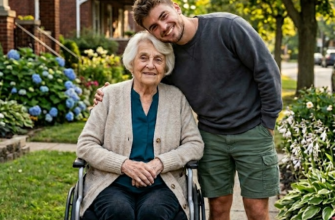

My son was sixteen when I first really realized how far apart we had grown. Formally, we were still a family, living under the same roof, eating dinner at the same table, but between us, it was as if an invisible wall had grown. Adolescence was doing its work: he became withdrawn, irritable, often answered shortly, or simply locked himself in his room, slamming the door. Every conversation could easily turn into an argument, and every question I asked became a reason for annoyance.
I felt that we were both tired. He — of school, the city, constant pressure, and expectations. I — of feeling helpless and fearing I might do something wrong. It seemed that if we continued like this, we would completely lose touch. That’s when the thought came: he needs a break. Not an escape or a punishment, but a pause. Time to catch his breath and look at himself from a distance.
I suggested he spend part of the summer out of the city, with my older sister. She lived alone, in a small house on the edge of a neighborhood, surrounded by trees and silence. Always calm and composed, she knew how to listen — without interrupting, lecturing, or imposing her opinions. In my childhood, she had been the person who made everything seem simpler. I hoped she would become such an island of calm for my son as well.
He agreed almost immediately. He said he wanted to change his environment and “be away from everything.” There was so much fatigue in his words that it made me uneasy. I felt both relief and worry: relief — because he agreed himself, and worry — because letting a child go, even a sixteen-year-old, is always difficult. Yet I decided to trust — him, my sister, and the idea that sometimes distance helps bring people closer.
The first days really went well. My sister wrote that he was helping around the house, fixing the old fence, carrying water, going to the store. Sometimes he called himself — speaking briefly, without much emotion, but the usual irritation was gone from his voice. He spoke calmly, as if a little relaxed. I noticed I was waiting for those calls and repeatedly reading my sister’s messages, seeking confirmation that we had made the right decision.

About two weeks had passed when my sister called on her own. Her voice was calm, without reproach, but in that calm tone, there was fatigue. That particular fatigue that cannot be hidden behind politeness.
— Come over — she said. — We need to talk. Better in person.
I packed immediately and set off. The drive out of the city felt longer than usual. I watched through the window as the city gradually gave way to fields and trees, while dozens of thoughts swirled in my mind. I tried not to panic prematurely, but my heart tightened anyway: something had gone wrong.
The house welcomed me with silence. Too deep, almost resonant. My sister was sitting in the kitchen with a cup of tea. She looked calm, but at the same time exhausted, as if someone had taken away her usual rhythm of life.
It turned out that my son had started inviting friends over. At first, during the day, for short periods. Then more and more — in the evenings. Music, laughter, loud conversations. As if he thought that the country house was a place where he could do everything that was impossible in the city. My sister did not complain immediately. She hoped he would sense the boundaries himself, understand that she had nothing against guests, but was not ready for constant noise. However, the solitude she was used to and the constant presence of other people became a difficult experience for her.
I went out to the yard, where my son was sitting. He immediately understood why I had come. His shoulders dropped slightly, his gaze shifted to the side.
— I thought you didn’t mind, aunt… — he said quietly. — After all, you didn’t say anything.

At that moment, I realized how easily teenagers confuse silence with consent. We talked for a long time. Without raising our voices, without accusations — calmly, step by step. I explained that silence does not always mean agreement. That adults sometimes tolerate certain things because they want to avoid conflict. That responsibility does not begin with prohibitions, but with the ability to notice another person’s state. A house someone lets you into is trust. And that trust must be treated carefully.
He listened attentively. Without the usual resistance, without sarcastic remarks. Then he said:
— I really didn’t want to upset anyone. I just thought freedom meant nobody bothering you.
There was so much sincerity in those words that it became clear: he wasn’t trying to break the rules — he simply didn’t know where they ended.
We decided he would return home earlier than planned. My sister wasn’t angry. She just wanted to have the quiet and her usual rhythm again, in which she felt calm and safe.
On the way back, we drove in silence. But it was a different kind of silence — not tense, but calm. And just below the building, my son unexpectedly said:
— Mom… thank you for coming. And for explaining instead of yelling.
Sometimes summer doesn’t give rest. But it gives a lesson. About boundaries. About mindfulness toward others. About the fact that growing up is not just a desire for freedom, but also the ability to care for those around you.