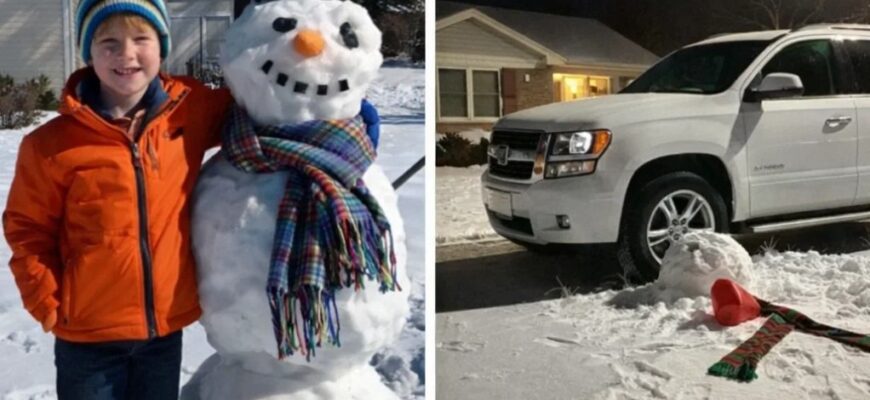

My son made snowmen all winter long.
Not “sometimes,” not “when he felt like it,” but as if it were part of his life — something important and obligatory. As if the day were wasted if he didn’t go out into the yard after school.
He was eight years old — the age when the world still seems understandable: if you don’t bother anyone, if you try and do something with your own hands, then it should be appreciated and at least not destroyed.
Every day began the same way.
I heard the front door slam, a backpack drop, Nik playing with his shoes.
“Mom, can I go out right away?” he asked, already halfway into his jacket.
Sometimes I tried to straighten his scarf or hat, but he waved his hand:
“The snowmen don’t care how I look anyway.”
He built them in the same place — in the corner of our lawn, where our yard met the street. He chose that spot himself. He said there was “the best snow” there, that it was more compact, and that the snowmen “could see people and cars.”
Each of them was not just a simple figure.
Each had a name. A personality. A role.
One “kept order.”
Another “protected.”
The third “was just kind, so others wouldn’t be afraid.”

Sometimes I could hear Nik talking to them out loud. Not like a child playing, but like someone explaining, persuading, negotiating.
I often stood by the kitchen window and watched him. His focused face, how carefully he straightened the stick arms, how he picked pebbles for the eyes. In those moments I understood: for him, it wasn’t snow. It was his space. His little world.
And every time, tire tracks appeared next to that world.
Our neighbor, Mr. Strieter, had lived next door for a long time. He was one of those people who never smile. Speak shortly. Look harsh. As if every presence of others was an obstacle.
He would drive onto his driveway, cutting through the corner of our lawn. Just a little. A few meters. But it was enough.
At first, I tried not to pay attention. Then I tried to convince myself that he didn’t do it on purpose. That maybe he just didn’t think.
But one day, Nik came home different.
He took off his gloves slowly. Snow fell onto the floor, and he kept dragging the moment, as if he didn’t know where to start.
“Mom…” he finally said. “He drove over it again.”
I didn’t answer right away. I already knew by his voice.
“He destroyed it,” Nik continued. “And he didn’t even stop.”
The first snowman lay destroyed. Head separate. Pebbles scattered. Sticks broken.
Nik didn’t cry immediately. He just stared. As if checking whether someone would notice that it was unfair.
I hugged him, and only then did he start crying. Quietly. Restrained. Like children who are beginning to understand that the world can be unfair.
That same evening, I spoke with the neighbor. Calmly. Without yelling. I said it was our lawn. That the child was trying. That it mattered to him.
The answer was indifferent:
“It’s just snow. It will melt anyway.”
But it wasn’t about the snow.
The next snowman lasted two days. Then another. And another.
Each time Nik came home a little different. Sometimes angry. Sometimes silent. Sometimes he just stared out the window for a long time.
“Why is he allowed?” he asked once. “And I’m not doing anything wrong.”
I suggested he build them closer to the house. He shook his head:
“This is my place.”

And he was right.
One day he came home unexpectedly calm. Too calm for a child.
“Mom, you don’t have to talk to him anymore,” he said.
I immediately felt concerned. I explained that he mustn’t do anything dangerous, hurt anyone, or try to solve problems in a way that could hurt someone.
He listened carefully. Very seriously.
“I don’t want to hurt anyone,” he said. “I just want him to stop.”
The next day he built especially long and carefully. A big snowman appeared closer to the edge of the yard.
It seemed strange to me, but I didn’t see any danger.
In the evening, there was a sharp sound. Then — the rush of water.
The neighbor had driven onto the lawn again. He hit the fire hydrant at the edge of the yard. Water shot up, flooding the street, the yard, and a car.
Luckily, no one was hurt.
When the authorities arrived, everything became clear: the car wasn’t on the road but on private property. The responsibility was the driver’s.
Later I talked at length with my son. We talked about boundaries, responsibility, and that even good intentions must be discussed with adults.
He worried, but he understood.
From that day on, the neighbor never drove onto our lawn again.
And Nik still built snowmen. Some melted, others were knocked over by the wind.
But none were ever destroyed by a car again.
Sometimes adults also need a reminder about boundaries. Calmly. Without yelling. But very clearly.