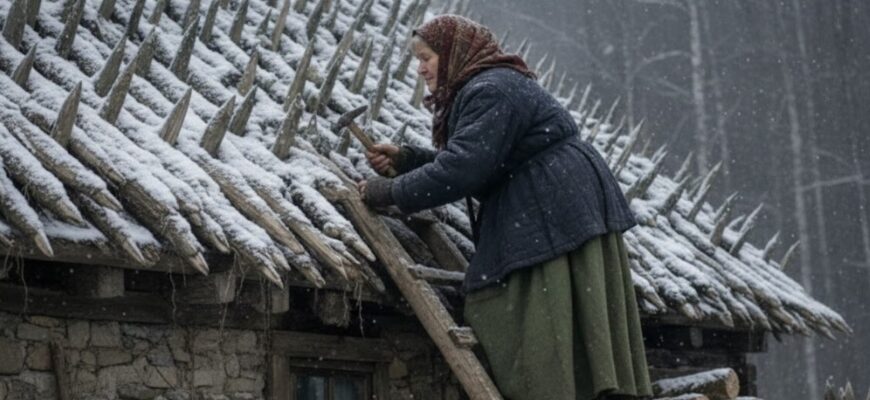

An elderly woman spent the entire summer and autumn installing sharp wooden stakes on the roof of her house. The neighbors were convinced she had gone mad — until winter came.
In the village, everyone knew each other. Strangers never stayed long, and locals were always in plain sight. That’s why, when the elderly woman — Jeanne — began climbing onto the roof of her house almost every day, it immediately drew attention.
At first, no one paid much mind to it. After all — maybe she was fixing something, patching things up. But with each passing week, more and more strange constructions appeared on the roof: sharp wooden stakes, driven in at an angle, carefully arranged in rows.
By the end of summer, the roof looked terrifying.
“Have you seen her house?” people whispered at the well.
“I have… Ever since her husband died, she hasn’t been herself.”
See more
Family games
Jeanne had been alone for a year. Her husband had died suddenly, and since then she had barely left the house. She didn’t receive guests, rarely went to the shop, and didn’t talk to anyone for long. And now — these stakes.
The rumors grew like a snowball.
Some said she was “protecting herself from evil forces.”
Others claimed it was an odd whim of old age.
And the most imaginative insisted the old woman feared people and was setting traps.
“A normal person wouldn’t do something like this,” the neighbors said.

— Everything up there is sharp. It’s scary just to look at it.
But no one saw exactly how she worked.
She chose each stake herself — only dry, solid wood.
She sharpened every one by hand, at a precise angle.
She drove them in slowly, checking whether the structure was holding firmly.
She knew that roof better than any builder: where the old boards were, where the weaker spots lay, where the wind hit the hardest. She worked without haste, as if she knew exactly why she was doing it.
Sometimes the neighbors couldn’t hold back and asked her directly:
— Why are you doing this? Are you afraid of someone?
She lifted her gaze and calmly replied:
— It’s protection.
— Protection from whom?
— From what will come.
And that was the end of the conversation.
Autumn was long and unsettling. The winds grew stronger, the nights colder. People mentioned the strange roof more and more often, laughing, yet feeling a vague unease.
And then winter came.
First, snow fell. Then the wind struck — bending trees and tearing down old fences. At night, the village didn’t sleep: roofs creaked, slate cracked, somewhere there was a pounding sound, as if a house were about to fall apart.
After one particularly strong storm, people went out to inspect the damage.

The sight was grim:
some had part of their roof torn off,
others had their roofs twisted,
from several houses the wind had literally ripped away the boards.
And only one house stood untouched.
The same one.
The elderly woman’s roof was still in place. Not a single board torn away. Not a single crack. The sharp wooden stakes took the main force upon themselves: the wind struck them, lost its strength, and rose upward without destroying the structure.
That was when the neighbors understood.
The previous winter, a storm had nearly destroyed her house. Back then, her husband was still alive. It was he who told her about an old way of protecting against hurricane winds — a method used in these parts decades ago, when there were neither modern materials nor expensive specialists.
After his death, she simply remembered his words.
And she did everything exactly the way he had once taught her.
Without haste.
Without explanations.
Without any need to prove anything to anyone.
And only in winter did it become clear: there wasn’t a trace of madness in that strange roof.
There was only memory, experience, and the ability to listen to those who knew more.