
In the intensive care unit, time passes especially slowly. Every sound, every signal from the equipment is perceived more sharply than anywhere else. It was here that, for several days, a boy stayed whose condition doctors described briefly and cautiously: “critical but stable.”
Machines were sustaining his vital functions. The lines on the monitors changed only minimally, almost imperceptibly. For the medical staff, this meant one thing — the situation was not worsening, but there were also no signs of improvement.
The parents spent as much time in the room as possible. The mother sat nearby, barely leaving the bedside. She had learned to distinguish the signals of the machines, flinching at every sound. Sometimes it seemed to her that her son’s fingers were slightly warmer than before, and she clung to that sensation like a last thread.
The father was there in silence. He listened to the doctors, nodded, asked brief questions, but most often he simply looked at his son, as if trying to memorize every detail.
The doctors did not use harsh wording. They spoke of observation, dynamics, and supporting the body. With each passing day, however, the conversations grew shorter. In such cases, words rarely change anything.
Outside the ward, near the hospital’s main entrance, the same figure appeared every day.
A German Shepherd named Riko came early in the morning. He sat by the door and waited patiently. Sometimes he stood up, took a few steps as if hoping someone would call him, then returned to his spot.
Visitors noticed him. Some stopped, some took photos, but Riko did not react. His attention was focused on one thing only — the entrance to the building.
The hospital staff quickly came to recognize him. The security guards silently nodded, and nurses sometimes brought out a bowl of water. The dog accepted the care calmly but did not leave.
One evening, a nurse noticed that Riko had been lying for a long time with his head resting on his paws and hardly moving. He looked tired but had no intention of leaving. This observation became the reason for a brief conversation with the doctor on duty.

The decision was not easy. Strict rules apply in the intensive care unit. However, it was decided to allow a short visit — without contact with the equipment and under full supervision of the staff.
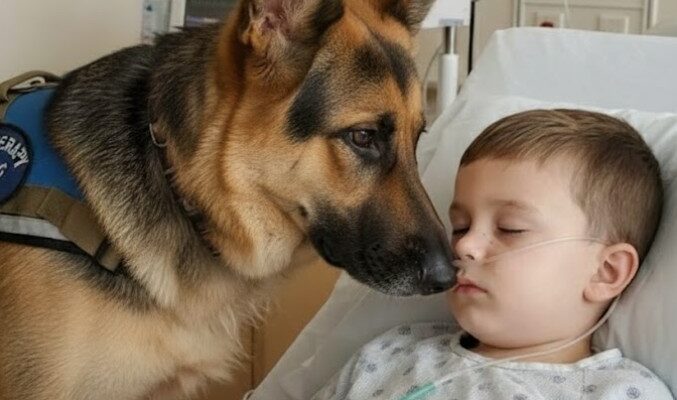
When Riko entered the room, it was as if he understood he was in an unusual place. He walked slowly, making no sound. Stopping by the bed, he stood on his hind legs and carefully placed his front paws on the edge.
He looked at the boy for a long time.
No barking.
No movement.
He just looked.
Then Riko bent down and gently touched the boy’s face with his nose. He stayed beside him for several minutes, not changing position, as if trying to be as close as possible.
It was at that moment that the equipment recorded the first changes in a long time.
At first, they were barely noticeable — slight deviations from the previous parameters. One doctor came closer, then another. The data were checked again, errors ruled out, and several monitors compared.
The changes persisted.
After a while, the mother noticed a slight movement of her son’s fingers. She said nothing at first, afraid of being mistaken. But the doctor confirmed it: there was a response.
From that day on, Riko’s visits became regular. Each time he behaved the same way — calm, focused, as if he knew why he was there. And each time, the equipment recorded small but steady changes.
The recovery process was slow. There were no sudden leaps or immediate improvement. But there was progress — and that was enough.
Over time, the boy began to respond to sounds. Then — to open his eyes. One day, he focused his gaze and held it.
Beside him, as before, was Riko.
Later, doctors discussed the case at professional meetings. They spoke about the influence of emotional factors, the importance of familiar stimuli, and the complex workings of the brain. There was no formal explanation.
Yet the fact remained: the changes began on the day the one who waited outside the hospital every day entered the room.
For the parents, it was a story of loyalty.
For the doctors — a rare clinical case.
And for Riko — simply another day beside the one he never left.