
After five years, during which I bathed him, fed him, turned him, helped him move, monitored every dose of medication, and literally lived in hospital corridors, I accidentally overheard my paralyzed husband laughing with a stranger. Casually, he called me his “free servant” and bragged that he wouldn’t leave me a single penny.
Five years… When people hear that, it seems like just a moment — a bit of time that can easily be fast-forwarded. But when those years pass not to the rhythm of holidays or changing seasons, but under the harsh glare of lamps, with the creaking of a hospital bed’s mechanisms and the smell of disinfectants seeping into your skin and hair, they become something else. They press down. They tighten. They settle on your chest like a stone that refuses to lift. Every day resembles the one before it, and the whole world narrows to the boundaries of rooms, corridors, and strangers’ glances.
My name is Marianna Cortez. I am thirty-two years old, and the woman in the mirror feels like a stranger. Her back is bent, her shoulders hunched, as if protecting something most precious that remains inside. The shadows under her eyes speak of sleepless nights. And her hands… her hands say everything. Rough from constant washing and disinfecting, calloused from lifting a body that was never meant for it. They tell a story of pain, sacrifice, and inner resistance.
Life used to be different. Bright. Certain. I met Lukas at a charity event in Boulder. He was like a magnet for people: easygoing, sincere, with an attentiveness that made everyone feel special. We married quickly, planning a house, children, travel, a shared life that seemed real. Everything felt earned and lasting.
But that future ended in a single second on a dangerous curve near Golden. Lukas was returning from a conference when a drunk driver swerved into the opposite lane. The car was shattered to pieces; his life remained, but his body was paralyzed — stripped of the ability to walk.
In the hospital, the neurologist’s words sounded like a sentence: “Spinal cord injury.” The end. Period. I didn’t cry. I held his hand and promised I would stay by his side. I believed love meant eternal presence and patience.
But the years showed that silent sacrifices slowly kill the soul.
Each day blurred into the next: the alarm before dawn, medications on schedule, pointless calls to insurance companies, sleeping on the couch to hear his breathing and his cries in the dark. I learned to lift a body without injuring myself, to smile despite exhaustion, to swallow resentment when strangers praised my strength. I became an invisible shadow, sustaining another person’s life.
On one cold, dark Tuesday, the alarm rang at half past four in the morning. The city was asleep, and the silence felt almost tangible, amplifying every thought. I dressed quickly, without pride, and mentally went through the entire day.

Lukas wanted fresh bread. “Hospital food makes me feel like a burden,” he said. I believed something warm and familiar might bring back his smile.
The bakery glowed with golden light, the smell of butter and sugar wrapped around me, and for a moment I felt again like just a woman caring for the man she loved.
— What would you like? — the saleswoman smiled.
— Two cinnamon buns, a box of plain bread, and a black coffee — I said.
I paid carefully and drove to the hospital, imagining his joy.
Inside, the familiar sharp smell of disinfectants greeted me. A volunteer said Lukas was outside with another patient. I went there, trying to look less tired.
And I heard him:
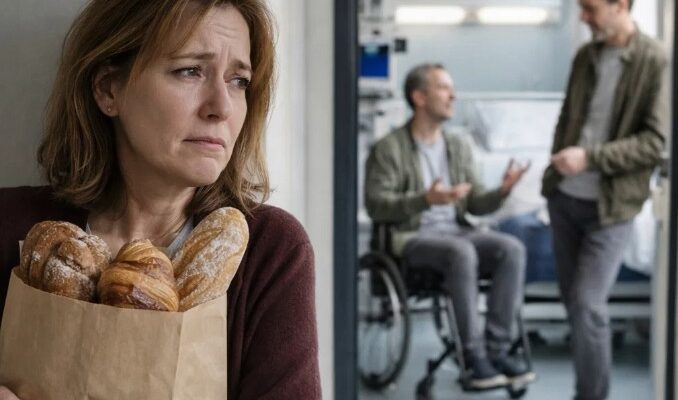
— You get used to it — Lukas said. — People think it’s a tragedy, but there are advantages too.
— Your wife does everything for you. Doesn’t it annoy you? — the man laughed.
— Why would it? — Lukas replied calmly. — Marianna is reliable. She won’t go anywhere. She has nowhere to go.
Relaxation and wellness products
Subscription to a psychology magazine
I froze, the air stuck in my chest.
— Looks like you made a good deal — the man said.
— Yes — Lukas answered. — Full care, no expenses. Just patience and hope that keeps her in place.
— And the inheritance? — another asked.
Lukas lowered his voice:
— For my son and sister. Marianna believes devotion guarantees stability.
They laughed.
I stood there with the package of bread in my hands, which suddenly felt absurd. Love had turned into convenience. My voluntary care — into control.

I didn’t scream. I didn’t cry. I turned around and threw the package into the trash.
Something inside me tightened — anger sharp as ice, but beneath it — clarity. Every impulsive reaction would have cost me everything. Patience gave me my life back.
A few minutes later, Lukas texted: “Where are you? I’m already hungry.” I replied calmly: “The car broke down, I’ll be later.”
I didn’t go home — I went to the library. I sat between the shelves, opened my laptop, and for the first time in years my hands stopped trembling.
In the following weeks, I acted methodically. I continued the care, followed the schedule, but secretly gathered evidence: financial documents, insurance policies, legal records, conversations.
I called a former colleague, Natalia. She listened and gave me the contact of a lawyer — Evelyn Porter. She didn’t pity me. She gave me a plan.
When Lukas realized what was happening, it was already too late. Accounts frozen, documents filed, the story told from the other side.
He called me cruel. The family — disloyal. But it didn’t matter.
On the day I moved out, I felt only relief. The door closed behind me — not an ending, but freedom.
Months later, the hospital called again about Lukas’s hospitalization. I refused. Now his life is in the hands of those he chose himself.
Today I sit in a bright café that I opened with Natalia. I write, I watch passersby, each with their own life — one I neither envy nor fear.
I am no longer a shadow. I am whole.
And when dignity returns, it does not ask for permission to stay.