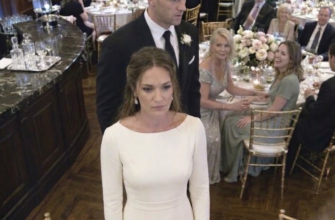

I stood in my wedding dress just minutes before I was supposed to walk down the aisle. Everything around me was perfect until that second, when the perfection suddenly disappeared.
Music was playing, the guests were quietly talking, and soft beautiful light fell across the white hall. I remember adjusting the lace on my sleeve — the same lace I had sewn myself from my mother’s fabric. It felt like it gave meaning to the day, connecting the past and the future.
I believed that today my new life would begin.
But instead, he looked at me as if I had suddenly become a stranger to him.
—I’m sorry — Adrian said. — I can’t marry you.
At first I didn’t even understand what he had said.
As if the words had not reached my mind.
Then he added:
— My parents are against it. They think you… don’t fit in. You’re too poor.
And at that moment, everything inside me froze.
Slowly, I turned my gaze toward his parents.
His mother stood straight, perfectly calm, with the expression of someone who had already made every decision for everyone else. There was neither doubt nor regret in her eyes — only cold certainty that she was right.
His father did not even look at me. He adjusted his cufflinks as if this were merely an unpleasant but insignificant episode in his workday.
And Adrian… simply stood between us.
And stayed silent.
And it was that silence that destroyed more than any words could have.
— Say something — he said quietly.
But I already understood everything.
This was not a sudden decision.
It was their choice. Their decision. Their judgment of my worth.
And his agreement.
I felt pain growing inside me — not hysterical, not loud, but heavy, deep, almost soundless.
But I did not let it come to the surface.
I straightened up.
And smiled.
— Thank you — I said calmly.
His mother frowned.
— For what?
— For telling me this before I took a step toward the altar.
I turned around.
And walked away.
Behind me, someone laughed quietly.
— At least she knows her place.
Those words should have broken me.
But instead, they became something else.
A boundary.
A point beyond which there was no turning back.
I walked down the aisle in my white dress, and every step echoed inside me like a final decision.
Behind me, I was leaving people I had considered part of my life.
Ahead of me was emptiness.
And a freedom I did not yet know existed.
Outside, my friend caught up with me.
— Klara, what happened?
I didn’t answer right away.

Because I was trying to understand it myself.
— Let’s go home — I finally said.
— Are you crying?
I stopped for a moment.
— No.
And it was true.
The tears were there.
But not on the outside.
That same evening, everything turned into a scandal.
The internet exploded with stories about the “poor bride abandoned at the altar.”
Some people sympathized.
But most judged.
“She wasn’t good enough for them.”
“She was probably hiding something.”
“Girls like that are always left behind.”
I looked at my phone screen and felt none of what people expected me to feel.
No tears.
No panic.
Only cold clarity.
They didn’t know who I was.
To them, I was just a “poor girl.”
But in reality, I was a forensic accountant.
And for almost a year, I had been working on a case involving the Veyl family.
Their business.
Their charity foundation.
And their money, which disappeared far too often into places where it should not have gone.
The most ironic part was that they had let me into their world themselves.
I sat with them at dinners.
I listened to their conversations.
I watched them talk about trust, honesty, and family.
And they never even suspected that every word they spoke was becoming part of an investigation.
They considered me their son’s “convenient” girlfriend.
Quiet.
Harmless.
Insignificant.
That was their mistake.
Two days later, I received an invitation.
A penthouse.
Of course.
They assumed I would come broken, ready to beg.
I came dressed in black.
The room smelled of expensive alcohol and power that had felt untouchable for too long.
— Name your price — Adrian’s father said.
I looked at him calmly.
— For what?
— For disappearing from this story — his mother growled. — Don’t make things complicated.
Slowly, I placed a folder on the table.
And opened it.
The silence changed.
It became thick.
Heavy.
Dangerous.
He opened the first page — and for the first time, his face twitched.
Accounts.
Transfers.
Tax havens.
Fake charity schemes.
His mother turned pale.
— This is fake — she whispered.
I looked directly into her eyes.
— No.
— This is your life.
Adrian looked at me as if he were seeing me for the first time.
— You… — he did not finish.
Because for the first time, there was no confidence in his voice.
Only fear.
I looked at him for a long time.
Too long for someone I had once loved.
— You chose your side at the altar — I said calmly. — Now live with that choice.
And I walked away.
Then they began to act.
Threats.
Attempts to destroy my reputation.
Rumors.
Lies.
But every move they made only dragged them down faster.
Because now I had no emotions.
I had evidence.
And then came the evening.
The Veyl family charity gala.
Perfect smiles.
Cameras.
Donors.
And Adrian’s mother giving a speech about “honesty and values.”
I entered the hall the moment she stood on stage.
And everything stopped.
First silence.
Then whispers.
Then recognition.
Adrian immediately turned pale.
— You shouldn’t be here… — he whispered.
I looked at him calmly.
— I’ve been here the whole time.
And I pressed the button.
The screen behind her came alive.
Voices.
Documents.
Transfers.
And the truth they had believed impossible for so long.
“No one checks the foundation.”
“The money will pass through the fund.”
“She won’t understand anything.”
And the hall exploded.
A few hours later, the arrests began.
Months later — the trials.
Their surname, which once opened doors, became a sentence.
Adrian wrote me a letter.
I never opened it.
A year later, I was sitting in my new office.
And for the first time in a long while, someone asked me:
— Are you happy?
I looked out the window.
The city was living its life.
Calmly.
Confidently.
And I realized that I was no longer living in someone else’s story.
— Yes — I said.
— Because now I’m no longer the one who can be humiliated. I’m the one who knows the truth.