
The rain had turned the city into a gray haze when we saw her beneath the overpass.
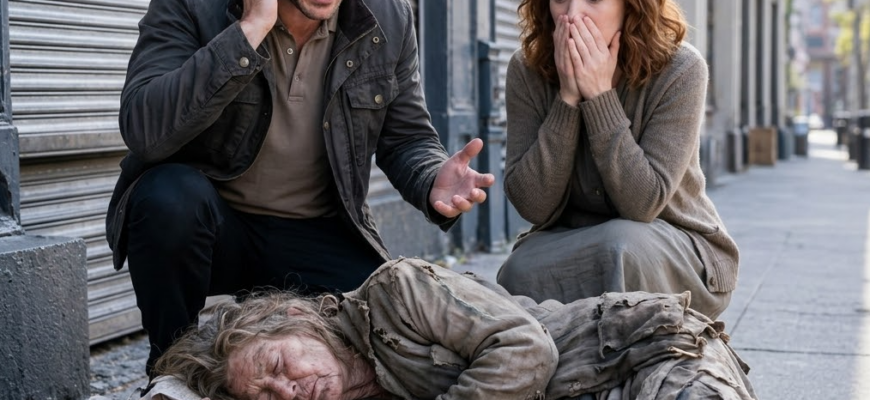
Mom was lying on a pile of old newspapers, covered with a thin blanket. Not a homeless stranger—our mother. The woman who had spent her whole life getting up at five in the morning to get us ready for school. Who worked two jobs when Dad fell ill. Who never—never—asked anyone for help.
Now she lay on the wet pavement like someone life had simply erased.
For several seconds, we couldn’t move.
“Mom?..” I whispered.
She slowly opened her eyes. First came a shadow of shame. Then recognition. Then she tried to smile, and that smile shattered me completely.
The grocery bag slipped from Daniil’s hands. Apples rolled across the wet pavement. I dropped to my knees beside her, not thinking about the mud, not thinking about anything—only that Mom was soaked, freezing, and had clearly been here for a long time.
“What happened to your house?” I asked.
She was silent for a long time, staring somewhere past me. Then she spoke so quietly I could barely hear her.
“When I was in the hospital… your brother and his wife sold it.”
Those words hit harder than any clap of thunder.
Three months earlier, Mom had undergone major heart surgery. Viktor—my brother—and his wife Regina assured everyone that they would take care of everything. They would pay the bills, collect the mail, and watch over the house.
I worked in another city. I called them every evening.
“Everything’s fine.”
“She’s recovering.”
“Don’t worry, we’re here with her.”
Every time, the same calm voice. Not the slightest hint that anything was wrong.
Now it was clear: they had been lying the entire time. Calmly, consistently, without hesitation.
Mom spoke quietly, almost without emotion—as if she had replayed the story in her mind so many times that now she was simply saying the words.
At the rehabilitation center, Viktor brought her a stack of documents. He said they were insurance papers. After the surgery, she could barely hold a pen. She signed wherever he pointed. She didn’t read them—she couldn’t concentrate, her head was heavy from the medication, and her son stood beside her saying,
“Mom, don’t worry. It’s just paperwork.”
A few weeks later, he told her the house urgently needed repairs and moved her into a cheap motel on the outskirts of town.
When the money for the room ran out, Mom called him.
“He said I was ungrateful,” she said calmly, without tears. “Then he blocked my number.”
Daniil crouched down beside us.
I knew that look in his eyes—quiet and focused.
He never raised his voice when he was truly angry.

“Did you have any documents left?” he asked calmly.
Mom took several papers out of her worn-out bag: hospital discharge records, a copy of the property deed, motel receipts, and a notary’s business card. She had kept them close to her chest beneath the blanket—the only things she had left.
Wiktor had always mocked Daniil.
“Just an ordinary accountant,” he would say with a smile.
He didn’t know—and had never cared—that my husband headed the Financial Investigations Department. That every day he handled cases exactly like this one. That he had uncovered dozens of real estate fraud schemes.
Daniil photographed every document. Then he stepped aside and made a single phone call. He spoke quietly and briefly.
When he returned, he took off his jacket and covered Mom with it.
That same night we took her to the hospital. The doctors immediately diagnosed dehydration and hypothermia—she had spent more than one night beneath that bridge.
While they were hooking up the IV drips, Daniil was working.
By one o’clock in the morning, the entire picture had become clear.
The first signature on the power of attorney had supposedly been obtained on the very day Mom was still unable to hold a pen on her own—the hospital records confirmed it. The house had been sold to an intermediary company for one-third of its market value. A few days later, the same house was resold for almost the full price. The intermediary company was registered in Regina’s cousin’s name.
The money disappeared quickly: an expensive SUV, the first payment for an apartment by the sea, and bank transfers to another region.
“They planned all of this in advance,” I whispered.
“For several months,” Daniil nodded. “Everything was carefully thought out.”
Later, the deleted messages from Mom’s tablet were recovered. One of them was a message Regina had sent to Wiktor two months before the surgery:
“Once she signs—her sister won’t be able to do anything anymore. And she won’t even live to see court.”
They had planned even for that.
Around half past two in the morning, the phone rang—Wiktor.
“So, did you find her?”
In the background—music, laughter, clinking glasses.
“You left her under a bridge,” I said.
“Don’t dramatize. She refused to go to the shelter herself.”
Then Regina took the phone.
“Be careful with accusations. We have a legal transaction, all documents are properly prepared.”
Daniil gestured: keep going.
“So you admit you sold the house?”
She laughed lightly, without concern.
“We saved the family property from an old woman who was no longer capable of rational decisions. The money is spent. No one will return the house. Let her look for a place in a shelter for people like her.”
She didn’t know the call was being recorded.
By morning, the court had issued orders.
Bank accounts were frozen. All registration procedures regarding the house were suspended. Documents were seized at the notary’s office. Security camera footage confirmed that Mom had never shown up at the office on the day of the power of attorney.
When police arrived at Wiktor’s house, they found Mom’s jewelry, passport, checkbooks, and signature stamps. And another document—a detailed plan: how to declare her legally incompetent and establish guardianship immediately after the sale, if she survived the operation.
They had planned for both outcomes.
The property was seized. The transaction was annulled. Ownership was restored.
At one of the hearings, Regina in handcuffs looked at my mother.
“After everything we did for you…”
Mom met her gaze calmly.
“You left me to die.”
Wiktor turned to me.
“We’re family. Help us.”
I remembered the wet newspapers. Mom under the bridge, empty-eyed. The faint smile she still tried to hold on to.
“No. You gave up on family before I even had a chance to act.”
Wiktor made a plea deal with the investigation.
Regina chose to fight, but the recorded phone call destroyed her defense.
She received a harsher sentence.
After the trial, Mom stayed silent for a long time, then said she didn’t want to return to the old house.
“Too many things stayed in those walls.”
She sold it legally and bought a small, bright house next to ours.
On the first morning, we ate breakfast in her new garden. The sun was rising, the air smelled like coffee and wet grass.
Mom held an old newspaper, then calmly threw it away.
“I thought I had lost everything,” she said quietly.
I squeezed her hand.
“No. They only took one night from you. Everything else—no.”