
The bride died before anyone had even finished their champagne.
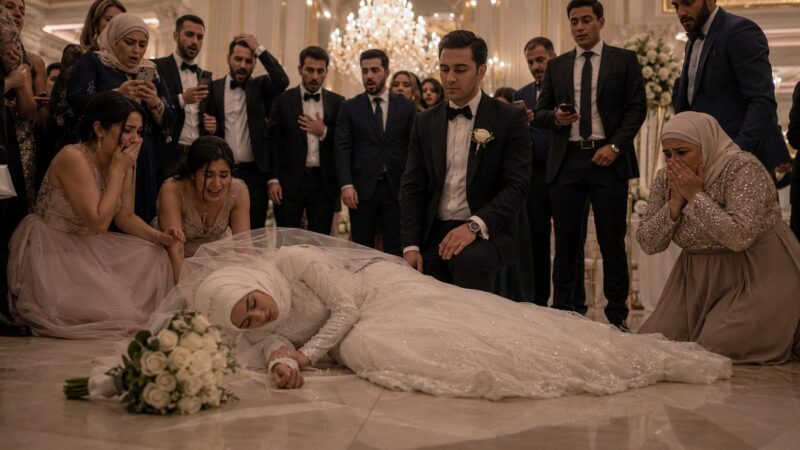
One moment, music filled the ballroom, glasses clinked beneath crystal chandeliers, and guests raised their phones to capture the newlyweds’ first dance. The next, she was lying on the floor in white silk and a white hijab, motionless beneath the lights, her bouquet crushed beside her hand.
By midnight, she had been declared dead.
By 2:00 a.m., she was in the morgue.
And by sunrise, everyone in the hospital would wish that covered face had never been touched.
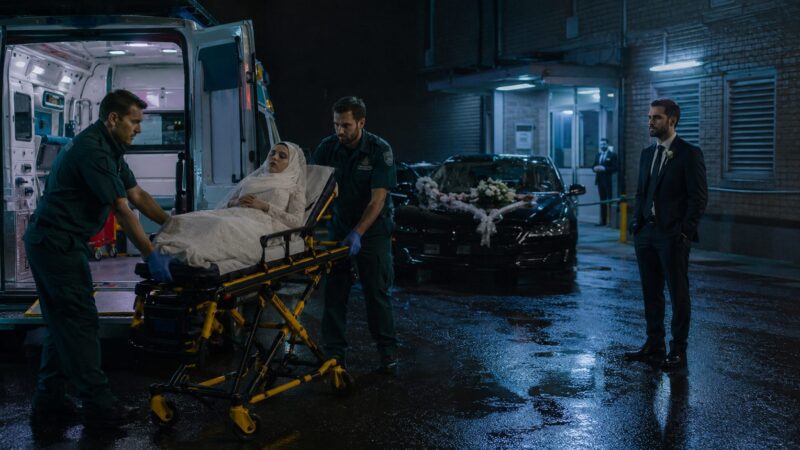
The ambulance arrived without sirens.
Its lights flashed once across the rear wall of St. Mary’s Hospital, then went dark as it rolled toward the service entrance where the dead were unloaded. Behind it came three black cars still decorated with white ribbons and wedding flowers. It looked less like a funeral procession and more like a celebration that had somehow taken a wrong turn.
The bride was wheeled in on a stretcher, still wearing her wedding dress.
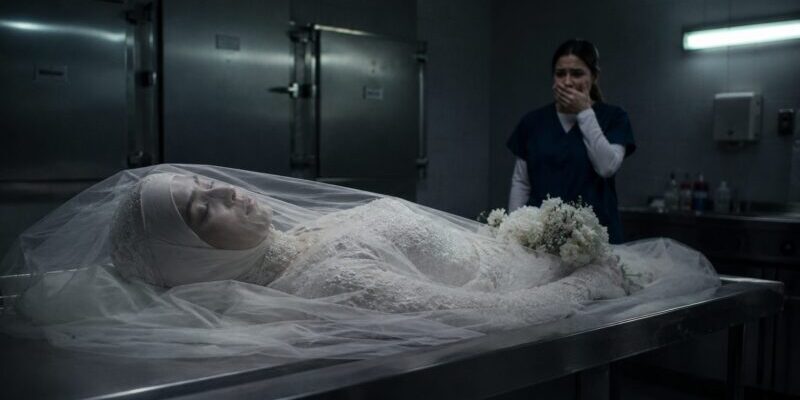
Her veil had been folded neatly over her chest. Her white hijab was pinned perfectly around her face. Too perfectly. Not a single strand of hair showed. Not one edge of fabric had slipped. A cluster of white roses rested in her hands. She looked less like a body than a woman sleeping through her own wedding night.
Her husband walked beside her in silence.
He did not cry.
He did not shout.
He did not touch her.
He only watched as the attendants pushed her through the corridor and into the cold room, his face blank in that strange, unreadable way grief sometimes looks when it is trying too hard to resemble shock.
Emily noticed him immediately.
She had been working nights in the morgue for less than three months. Long enough to stop flinching at covered bodies. Not long enough to stop trusting her instincts.
She noticed the groom because everyone else was drowning in grief.
The bride’s mother was sedated and sobbing into a handkerchief. Two bridesmaids clung to each other in tears. An older man kept repeating that she had been laughing only minutes earlier.
But the groom was silent.
Too silent.
He signed the paperwork with steady hands.
And before he left, he said only one thing:
“Please don’t uncover her face.”
When the family was finally led away, the body remained.
Dr. Carter barely glanced at the bride before checking the file, signing the intake papers, and leaving Emily alone in the cold room.
The room fell quiet again.
Emily stood beside the steel table.
She had seen overdoses before. Drownings. Car crashes. Seizures. Heart attacks. Death changed people quickly. It took their color first. Then their warmth. Then their softness.
This girl had lost almost none of it.
Emily stepped closer.
The bride’s skin looked too warm beneath the fluorescent lights. Not gray. Not waxy. Her lips were pale, but not blue. The small part of her cheek visible beneath the edge of the hijab still held the faintest trace of color, as if life had not fully left her body.
She frowned.
The morgue was always cold.
Bodies cooled quickly here.
Emily reached down and touched the bride’s hand.
Then pulled back instantly.
Warm.
Not hot.
But wrong.
Slowly, more carefully this time, she touched the wrist again.
The skin was soft.
Not stiff.
Not cold.
Not dead enough.
Her breath caught.
She leaned lower, watching the bride’s chest.
Nothing.
She told herself it was nothing.
Then—
a movement.
So slight she nearly missed it.
A rise.
A fall.
Emily froze.
She bent down and pressed her ear to the bride’s chest.
At first, only silence.
Then—
thump.
Faint.
Deep.
Slow enough to miss.
But there.
A heartbeat.
Emily stumbled backward so hard that she slammed into the metal tray behind her. Instruments crashed across the floor. Her pulse exploded in her throat.
She reached for the emergency phone.
Then stopped.
Because something else caught her eye.
The hijab.
It was not simply covering the bride’s hair.
It was hiding the shape of her face.
Emily looked at the file again.
Amina Rahman.
Female.
Twenty-four.
Then she looked at the covered face on the table.
The jaw beneath the fabric looked wrong.
Too wide.
Too heavy.
Her hands began to tremble as she reached for the first pin.
One pin came loose.
Then another.
Then another.
The fabric shifted just enough to reveal the skin along the cheek.
Emily stopped breathing.
And what she saw beneath the hijab made her realize this was not just a bride who had been declared dead too soon.
This was something far worse.
What did she see?
And what had really happened at that wedding?
The continuation is in the comments 👇
PART 2
Emily’s fingers froze on the last pin.
For a moment, she could not move.
Then she pulled the fabric back a little more.
The face beneath the hijab was not Amina Rahman’s.
It was not the face of a young bride.
It was not even a woman.
It was a man.
A grown man.
His jaw was rough and heavy. His beard had been shaved badly, leaving a dark shadow beneath the skin. Near his ear, Emily saw a small scar, and beneath the lace collar of the wedding dress, the edge of a black tattoo showed through.
The file slipped from her hand.
Amina Rahman.
Female.
Twenty-four.
But the person on the table was male.
Emily stumbled backward, her heart pounding so hard she could barely hear anything else.
Then the door handle moved.
“Miss Walsh?” the groom’s voice came from the hallway. “Is everything ready?”
Emily did not answer.
Her hand flew to the wall panel, and she locked the cold room door.
Outside, the groom paused.
“Miss Walsh?”
His voice was different now.
Lower.
Sharper.
Emily grabbed the phone.
“Security,” she whispered. “Come to the morgue now. And call the police.”
There was silence outside the door.
Then the groom said quietly:
“You should not have uncovered her face.”
That was when Emily understood.
This was not a mistake.
This was a plan.
Minutes later, security rushed into the hallway. The groom tried to leave, but two guards stopped him near the service exit. He did not scream. He did not fight.
He only went pale.
When the police arrived, they checked the hospital cameras, then the hotel cameras from the wedding hall.
And the truth came out piece by piece.
The man in the wedding dress was named Karim Najjar.
He was not Amina’s relative.
He was not a guest.
He was the man helping the groom’s family prepare fake documents.
Amina had discovered everything before the first dance.
Her husband had not married her for love.
His family wanted her inheritance.
That night, Amina heard them talking about papers she was supposed to sign after the wedding. She panicked and tried to run.
But they stopped her.
Karim threatened her in the bridal room. During the struggle, he fell, hit his head on the glass table, and died.
The groom’s family had one dead man.
And one living bride who knew too much.
So they hid Amina.
They dressed Karim’s body in her wedding gown, covered his face with her hijab, pinned it tightly, and carried him into the hall during the panic.
Everyone saw the white dress.
Everyone saw the hijab.
No one saw the face.
By sunrise, the police found Amina locked in an old house outside the city. She was weak, terrified, but alive.
When they opened the door, the first thing she asked was:
“Did someone check the body?”
Emily later heard those words and sat down in silence.
Because if she had obeyed the groom’s request…
If she had never touched those pins…
The world would have believed Amina was dead.
And the real bride might have disappeared forever.
That night, everyone at Saint Mary’s Hospital talked about the woman in the morgue who noticed one strange detail.
Not blood.
Not screams.
Not a confession.
Just a hijab pinned too tightly around a face someone never wanted uncovered.