The Hospital CCTV Caught Me Screaming and Hiding Under My Desk at 4 A.M.… When Security Zoomed In on the Patient’s Wristband, Everyone Went Silent
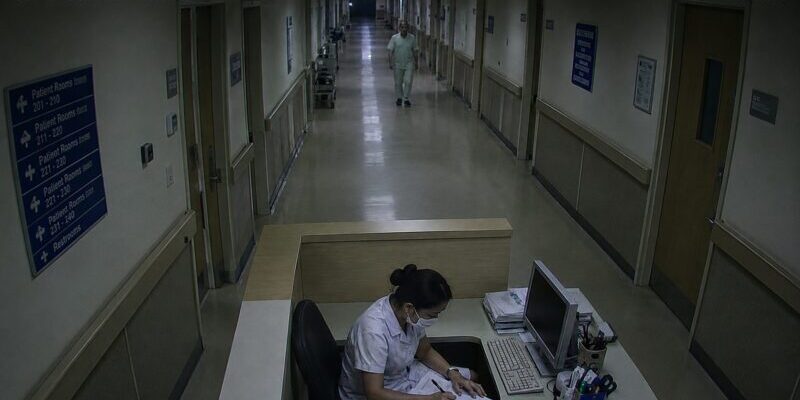
I was completing the night-shift paperwork when I noticed movement at the far end of the corridor.
An elderly man in pale hospital clothes was walking slowly toward my desk. His head was slightly lowered, his shoulders were uneven, and each step looked heavy and uncertain. He was not running or threatening me, but there was something deeply unsettling about the way he moved.
At first, I thought he was simply confused.
“Sir?” I called. “Which room did you come from?”
He did not answer.
He continued walking toward me, staring straight ahead.
I stood up and called again, louder this time, but he did not react. When he came closer, I noticed that his hospital wristband was loose and partly hanging from his arm.
Then he suddenly raised his face and looked directly at me.
The expression in his eyes frightened me so badly that I screamed.
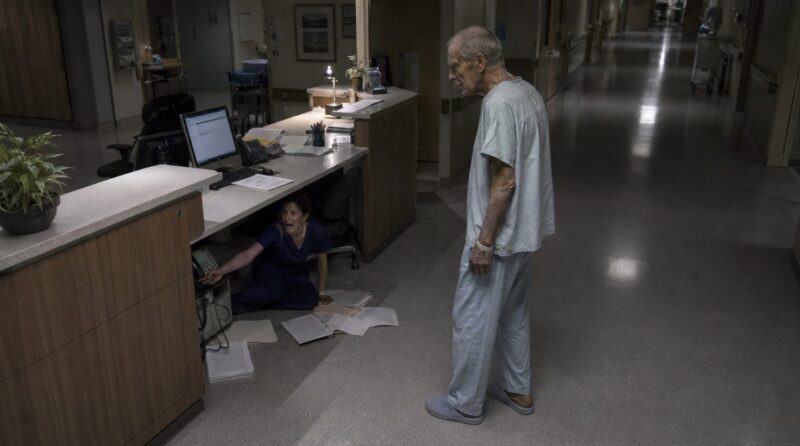
My chair rolled backward and struck the cabinet behind me. Several papers slipped from the desk as I crouched down and crawled beneath the counter, covering my mouth with one hand while trying to reach the telephone with the other.
Through the narrow space beneath the desk, I could see his slippers moving closer.
One slow step.
Then another.
Finally, they stopped directly in front of the reception desk.
I remained under the counter, shaking and afraid to breathe. The man stood there silently for several seconds before whispering one number.
“Two-fourteen.”
Then his feet turned, and he slowly walked away.
When the security guard arrived, we searched the entire hallway, but the man had disappeared. Every patient was still inside their assigned room, and none of the nurses recognized him.
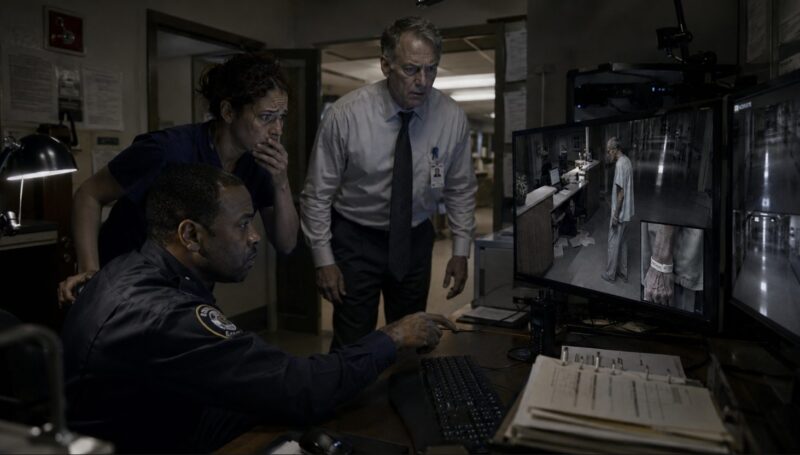
We returned to the security office and replayed the footage.
The camera clearly showed me screaming, pushing the chair away, and hiding beneath the desk while the man approached. When the guard enlarged the image of his wristband, we found a name in the hospital system.
Thomas Reed.
He had been assigned to Room 214.
But according to the records, Thomas Reed had died earlier that same night.
Before we could understand what we were seeing, the hospital administrator entered the security room, locked the door behind him, and looked at the frozen image on the screen.
“Delete the recording,” he said.
The guard asked him why.
The administrator lowered his voice.
Because Thomas Reed was never supposed to be admitted here.”
That was when I realized the man walking toward my desk was not the hospital’s only secret.
And when we finally opened Room 214, we found something that explained why the administrator was willing to destroy the footage before sunrise.
I left the rest in the first comment because Facebook doesn’t let me leave the full story here, and what we found inside Room 214 proved that someone had changed Thomas Reed’s medical records before he appeared in that hallway. Read the continuation here 👉👉‼️‼️⬇️⬇️ If the link doesn’t appear, switch the comments from “Most Relevant” to “All Comments.” 👇👇
Part 2
The administrator’s name was Dr. Warren Hale, and until that night, I had always known him as a calm, careful man who rarely raised his voice.
But in the security room, he looked frightened.
Marcus, the night guard, moved his hand away from the keyboard.
“I’m not deleting anything,” he said.
Dr. Hale stared at him, then looked at me.
“You don’t understand what you saw.”
“I saw a patient walk toward my desk,” I replied. “A patient your system says died at the exact same time.”
“The record is wrong.”
“Then correct it.”
Dr. Hale took a slow breath.
“It isn’t that simple.”
Before he could stop him, Marcus copied the footage onto a small external drive and slipped it into his pocket. Then the three of us returned to the third floor.
The hallway was empty again. Papers were still scattered near my desk, and my chair remained pushed against the cabinet. Seeing everything exactly as I had left it made the man’s disappearance feel even more impossible.
Room 214 was locked.
Dr. Hale used his master card, but the light flashed red. Marcus tried his security key, but it failed too.
That was when Dr. Hale finally admitted that the room had been removed from the electronic access system three days earlier.
“Why?” I asked.
He did not answer.
Maintenance arrived with a physical key and opened the door manually.
The room looked almost empty. The bed had been stripped, the monitor was off, and there were no flowers, bags, or signs that anyone had stayed there.
But a gray coat had been folded over a chair beside the window.
On the bedside table sat a pair of glasses, an unopened bottle of water, and a small black notebook.
Marcus opened it.
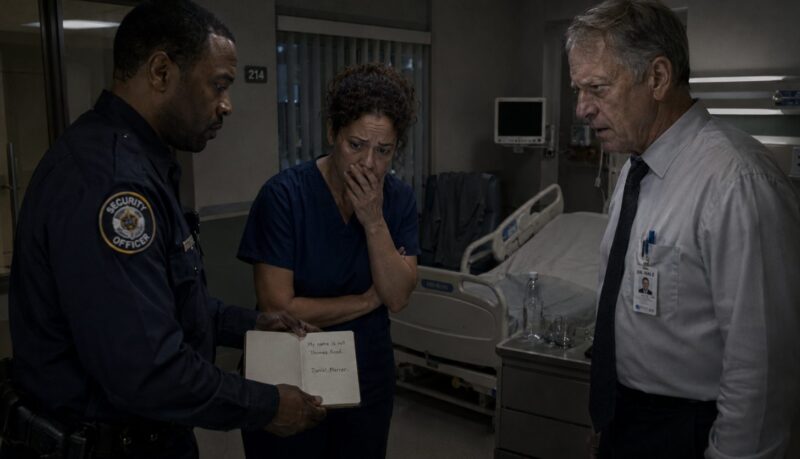
Most of the pages contained dates, medication names, room numbers, and short notes written in shaky handwriting. On the final page, one sentence had been written several times.
My name is not Thomas Reed.
Below it was another name.
Daniel Mercer.
Dr. Hale closed his eyes.
“You knew,” I said.
He slowly sat down on the edge of the empty bed.
He explained that Daniel Mercer was a retired accountant who had discovered irregular payments connected to the hospital. For months, he had been sending anonymous reports to regulators, claiming that patients were being billed for treatments they had never received.
Two nights before he appeared in the hallway, Daniel had arrived at the hospital weak and confused. Someone recognized him.
Instead of registering him under his real identity, they entered him into the system under the name Thomas Reed.
The real Thomas Reed had died in another medical facility three years earlier.
“Why use a dead man’s identity?” Marcus asked.
Dr. Hale looked toward the open door.
“Because a dead patient cannot complain about incorrect bills.”
The hospital had been using inactive identities to create false medical records. Expensive procedures were added to those files, payments were collected, and then the records were quietly closed.
Daniel had discovered the scheme.
When he arrived at our hospital, they placed him in Room 214, heavily sedated him, and entered a false death notice into the system.
They expected him to disappear with the false record.
“But he wasn’t dead,” I said.
“No,” Dr. Hale replied. “He was drugged.”
Around 3:12 A.M., Daniel must have woken up and left the room. The medication explained his stiff steps, blank expression, and inability to speak clearly. He had walked toward my desk because he was trying to find help.
The only thing he managed to say was the room number.
“Then where is he now?” I asked.
Dr. Hale remained silent.
Marcus searched the room and found a torn transfer form inside the cabinet beneath the sink. Most of the page was missing, but one line remained visible.
Destination: Westbridge Rehabilitation Center.
The form had been signed at 3:26 A.M.—only fourteen minutes after Daniel appeared at my desk.
We called Westbridge.
The receptionist claimed that no patient named Thomas Reed or Daniel Mercer had been admitted that night. Marcus asked her to check again.
She put us on hold.
A minute later, the line disconnected.
By sunrise, the police and the state medical oversight office had been contacted. Dr. Hale agreed to provide access to internal records in exchange for protection.
The investigation uncovered dozens of false patient files, altered billing reports, and signatures copied from doctors who had never treated the people listed.
Daniel Mercer was found that afternoon in a private recovery facility nearly forty miles away.
He was alive.
He was weak and heavily medicated, but when investigators showed him a photograph of Room 214, he began to cry.
“I thought no one saw me,” he said.
I visited him two days later.
He remembered walking through the hallway and seeing me at the desk. He also remembered trying to say the room number because he believed the notebook was still there.
“I frightened you,” he said quietly.
“You did,” I admitted.
“I’m sorry.”
I shook my head.
“You were trying to survive.”
The hospital’s financial director and two senior administrators were arrested. Several employees lost their licenses, and every file connected to the scheme was reviewed.
Dr. Hale was not innocent. He had known enough to understand that something illegal was happening, but he had stayed silent because he was afraid of losing his position.
The footage was never deleted.
It became one of the most important pieces of evidence in the investigation.
Months later, when I watched it again, the man in the hallway no longer looked frightening.
He looked exhausted, drugged, alone, and desperate for someone to notice him before his identity disappeared completely.
People later called the recording mysterious and even supernatural. They shared the moment I screamed and hid beneath the desk, but most of them never knew what happened after the camera stopped recording.
The truth was not about a dead man walking through a
It was about a living man whom powerful people had already decided no longer existed.
And sometimes, that is far more frightening than any ghost.
Tell me honestly—would you have hidden beneath the desk as I did, or would you have stayed and tried to help the man approaching you?