

My Neighbor Kept Throwing Tea Bags onto My Balcony. I Warned Him Three Times — Then I Decided to Handle It Completely Differently.
Lately, I had been finding myself thinking more and more about what eleven years of living in the same apartment building can really teach a person.
After living somewhere that long, you begin to notice things that an outsider would never see.
You know which doors slam the loudest when the weather turns cold. You remember which apartment has a family argument every Sunday morning. You know who regularly gets grocery deliveries and who spends their evenings trying to learn an instrument, even though after all these years, their progress has barely changed.
Eleven years is long enough to stop being just a tenant.
You become part of a small world.
People come to you when they need someone to accept a package.
They leave their keys with you when a neighbor goes away.
New residents ask where the trash containers are and who they should call if a pipe suddenly bursts.
That was the kind of neighbor I was.
My name was Margaret Collier.
Apartment 3B.
Eleven years.
During all that time, I had practically never had any conflicts with my neighbors. I always paid on time, never threw loud parties, and tried not to bother anyone.
I looked after other people’s pets when their owners went away.
I accepted packages.
I helped new residents find their way around the building.
I even knew where the forms for various requests were kept in the building management office.
I had grown used to thinking of myself as a calm person.
Easygoing.
Trustworthy.
That was probably why the new neighbor upstairs decided he could get away with a little more with me.
His name was Daniel Hartley.
He had moved into apartment 4B about fourteen months earlier.
For the first few weeks, he made a good impression.
He was around forty, polite, and always neatly dressed. Plants appeared in his apartment almost immediately, and he carried his groceries home in reusable cloth bags.
When we first had a real conversation, I gave him the building management’s number, explained the recycling rules, and told him what hours were considered quiet hours in our building.
He thanked me so sincerely that I thought:
“Looks like there won’t be any problems with this neighbor.”
I was wrong.
It all started with tea bags.
The first one landed on my balcony in November.
I noticed it early in the morning.
It was wet and clearly already used.
I assumed it was an accident.
Probably the wind.
Or maybe Daniel had simply tossed it over the railing without thinking.
I picked it up and threw it away.
A few days later, another one appeared.
Then a third.
By December, it was no longer possible to call it a coincidence.
One morning, I hung freshly washed towels on the balcony.
When I came back a while later, there was a brownish stain on one of them.
And right beside it lay another wet tea bag.
This time, I went upstairs.
Daniel opened the door almost immediately.
I calmly explained what was happening.
He looked genuinely surprised.
“Really? I’m doing that?”
“It has already happened several times.”
He sighed and rubbed his face with his hand.
“I guess I throw them out when I’m not fully awake yet. I don’t even notice.”
When I mentioned the ruined towel, his expression changed.
“Okay. I understand. It won’t happen again.”
He sounded so convincing that as I walked back to my apartment, I even felt a little awkward.
Maybe I really shouldn’t have made such a big deal out of a few tea bags.
The next morning, around seven, another tea bag landed on my balcony.
I heard a short thud against the concrete floor.
But again, I said nothing.
A few more weeks passed.
Later, people asked me more than once why I hadn’t reported it to building management immediately.
The answer was simple.
Because when you live in an apartment building, you have to live alongside other people for years.
If you turn every minor conflict into a war, one day you start being afraid of your own hallway.
So I decided Daniel was simply careless.
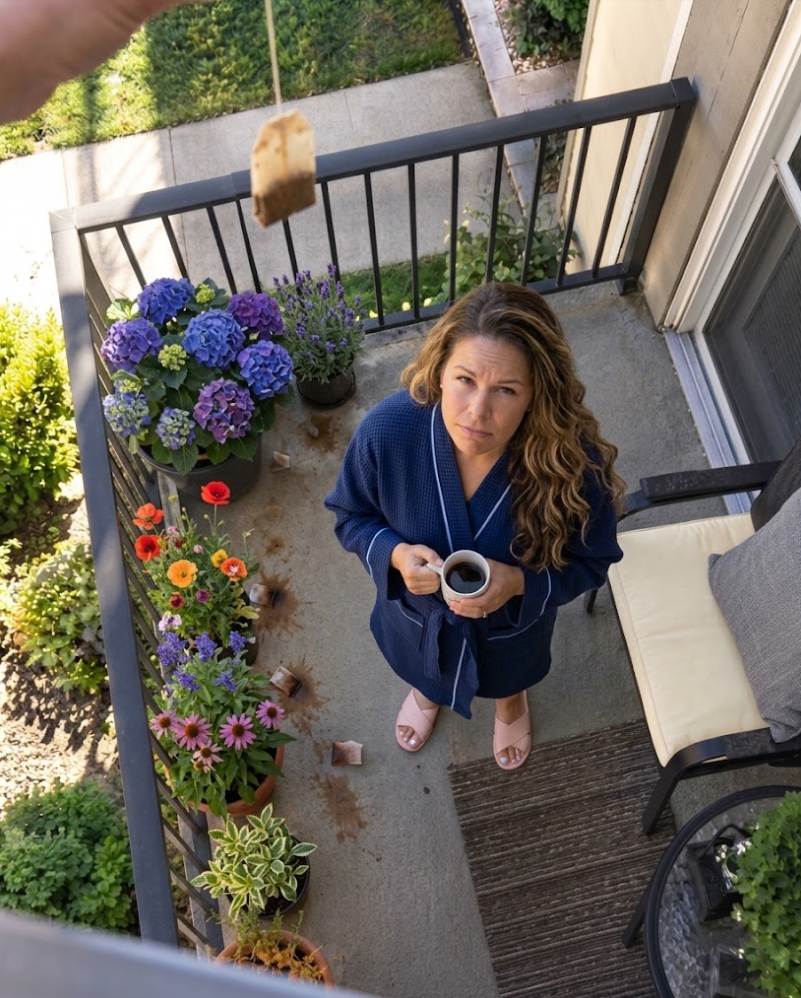
Until one morning, I was sitting on the balcony with a cup of coffee and a book.
Another tea bag landed directly on the light-colored cushion of my chair.
I saw it with my own eyes.
Within seconds, the tea began soaking into the fabric.
I tried to clean the cushion.
The stain remained.
That same evening, I went upstairs again.
This time, Daniel didn’t look embarrassed.
He opened the door, leaned against the frame, and listened to me.
“You threw another tea bag downstairs.”
He shrugged.
“So what?”
“You ruined my cushion. Before that, the towel.”
He looked at me completely calmly.
“Margaret, you live one floor below me.”
For a moment, I didn’t know what to say.
He smiled ironically.
“That’s how it is when you live in an apartment building.”
I reminded him that I had already asked him not to do it.
Then he said:
“You’re lucky it’s only tea.”
I froze.
“What do you mean?”
“Nothing. I’m just saying.”
After those words, he closed the door.
I stood in the hallway for a moment longer.
And then I finally understood one simple thing.
He didn’t think he had to take me into consideration.
He saw me as the quiet neighbor who never raised her voice.
A woman who would ask him a few times to stop, then eventually get tired and let it go.
And perhaps he even wanted to annoy me.
If I started shouting, he would have a convenient story: the emotional downstairs neighbor making a scene over a few tea bags.
I wasn’t going to give him that opportunity.
I went back to my apartment.
I made myself a cup of tea—which seemed almost amusingly ironic—and sat down at the kitchen table.
I decided to wait one more day.
If nothing happened in the morning, I wouldn’t bring it up again.
At 7:04, another tea bag landed beside my flowerpots.
I looked at it.
I finished my coffee.
And I realized that from that moment on, everything would be different.
Before retiring, I had worked for twenty-two years as an archivist at a law firm.
Many people imagine an archivist as someone who simply organizes old documents into folders.
In reality, good archival work requires something completely different.
You have to remember where information is located, understand how documents are connected, be able to quickly find what you need, and above all, never do anything at random.
I was extremely attentive to details.
And I had plenty of time.
So that day, I wasn’t planning to get revenge on Daniel.
I decided to gather evidence.
First, I took out my lease agreement.
Then I carefully read the building’s regulations.
The balconies belonged to the private spaces of the individual apartments.
Throwing objects over the railings was prohibited.
Residents were not allowed to create conditions that made it difficult for others to use their own apartments.
Anyone who caused damage could be held responsible.
Then I found another important clause.
If similar violations continued and were properly documented, building management could initiate an official investigation.
I opened the gallery on my phone.
There were photographs.
Several tea bags.
A stained towel.
A cushion with a stain.
And a photo of the tea bag that had appeared the morning after he promised he would stop.
Seven photos in total.
I reconstructed the dates as accurately as I could and wrote down the approximate time of each incident.
Then I wrote a complaint.
Three pages.
No insults.
No assumptions.
No statements like, “He is deliberately harassing me.”
Just a chronological description of what had happened.
Date.
Time.
What happened.
Which items were damaged.
When I had spoken to Daniel personally.
What he had said to me.
I attached the photographs.
I read everything twice and submitted the complaint on Tuesday evening.
The next morning, I set my alarm earlier.
At 7:06, the balcony door upstairs opened.
I was already sitting there with my phone in my hand.
A minute later, I heard the familiar sound.
The tea bag landed on my balcony.
This time, I turned on the camera.
Twelve seconds of footage.
My balcony was visible in the recording.
The balcony one floor above was also visible in the frame.
You could hear the moment it landed.
The date and time were displayed on the screen.
Nothing more.
Just a fact.
I attached the recording to the complaint I had already submitted.
What happened next unfolded surprisingly quickly.
Building management confirmed receipt of the complaint.
Daniel was sent an official warning along with a reminder of the building’s rules.
After that, the tea bags stopped.
Nothing the next day.
Nothing two days later either.
A week later, for the first time, I sat peacefully on my balcony with a cup of coffee and listened to the ordinary morning silence.
And I realized how pleasant life can be when you don’t have to wait for the next stain on your towel.
About two weeks later, I found a note in my mailbox.
It was handwritten.
“You could have simply talked to me one more time. I would have stopped. You didn’t have to report it to management right away.”
I read it several times.
Then I replied.
“I already talked to you.
After our first conversation, you promised you would stop.
After the second, you told me I should be happy that it was only tea bags.
I didn’t know how else to explain the problem to you.
I’ve lived here for eleven years, and I’ve always tried to treat my neighbors with respect.
I accepted your packages.
I helped you during your first few weeks after moving in.
I didn’t want a conflict.
I needed only one thing: for you not to throw things onto my balcony.
You don’t do that anymore.
As far as I’m concerned, the matter is closed.”
I put the note in his mailbox.
He didn’t reply.
And I never saw another tea bag again.
That could have been the end of the story.
But in an apartment building, things are rarely that simple.
Because behind the doors of those apartments, people live.
And a person isn’t always made up only of the things you have personally seen.
A few weeks later, Mrs. Okafor from apartment 2C came to visit me.
We talked for a while, and suddenly she mentioned Daniel.
“You know, he helped me with my groceries recently,” she said. “The bags were heavy. He carried them upstairs several times.”
I was surprised.
“That was very kind of him.”
But for some reason, Mrs. Okafor didn’t smile.
She was silent for a moment, then added:
“You didn’t know about his mother?”
I shook my head.
It turned out that Daniel’s mother had been seriously ill.
That was exactly why he had moved here—he wanted to live closer to her.
Lately, he had been going to visit her almost every day.
After she passed away, I sat in the kitchen for a long time, staring out the window.
That information didn’t change what he had done.
His problems didn’t give him the right to destroy my belongings.
But suddenly I understood something else.
Sometimes the reason behind someone’s behavior helps us understand it, even though it doesn’t excuse it.
And those are two different things.
The following Sunday, I went to see Daniel.
This time, I knocked without any irritation.
He opened the door almost immediately.
I noticed that he had lost a lot of weight and looked exhausted.
“I heard about your mother,” I said. “I’m very sorry.”
He was silent for several seconds.
Then he quietly replied:
“She’s in a nursing home now.”