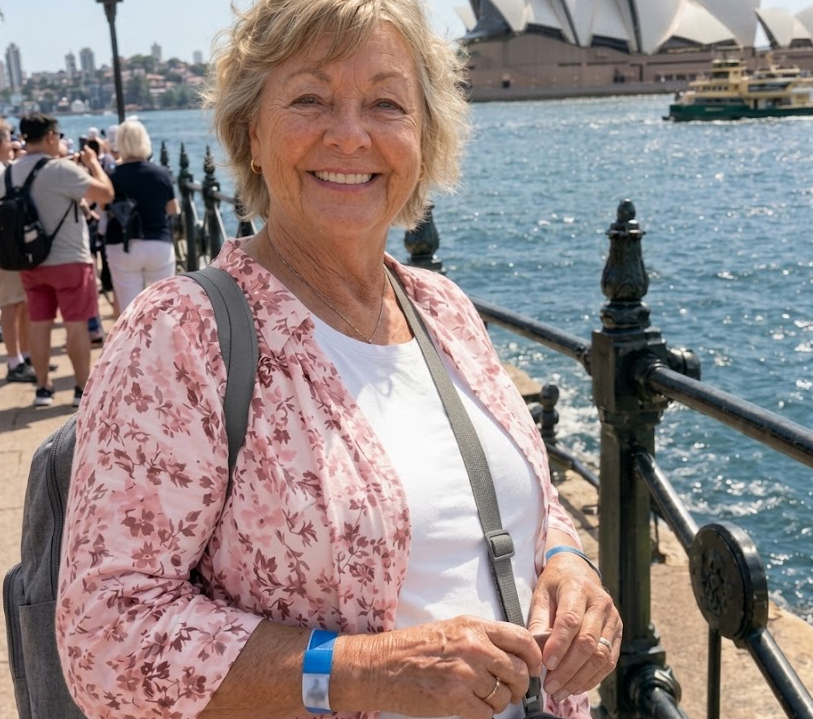
I had already traveled halfway around the world, finally deciding to start living for myself. I never expected that an ordinary invitation for a cup of coffee would lead me to a place where I would come face-to-face with something I thought I had lost more than ten years ago.
I stood frozen in the middle of Arthur’s living room, so suddenly that my handbag slipped from my shoulder.
For several seconds, I couldn’t even hear the kettle humming in the kitchen.
I couldn’t hear the ticking of the clock behind me.
All I could do was stare at what was hanging above his fireplace.
— Abigail?
Arthur’s voice came from behind me.
I turned around.
He was holding two cups of coffee in his hands.
I pointed at the painting above the fireplace.
— Where did you get that?
His expression changed.
And then I understood: this wasn’t some strange coincidence.
I was certain that painting had disappeared long ago.
— Abigail…
— Where did you get it?
He looked at the painting.
And in that moment, I realized that the past I had believed was lost forever had somehow found its way back in front of me.
For almost my entire adult life, I had devoted myself to taking care of others.
My husband, four children, and later my grandchildren.
For 32 years, I worked as a school secretary, prepared lunches for the children, picked up sick children, lent money whenever someone needed it, even though I rarely got it back, and looked after my grandchildren whenever they called.
After my husband Robert died twelve years ago, I became even more “needed.”
It sounds bitter. Maybe there really is some bitterness in it.
My children weren’t bad people. But somewhere along the way, they got used to the fact that I was always there.
When Karen needed me to look after the boys — she called me.
When David was short of money for the rent — he called me.
When Melissa needed help organizing a birthday party — she called me.
When Eric had to pick someone up from the airport — for some reason, I was always the first choice.
And yet weeks could go by without anyone calling just to ask:
“Mom, how are you?”
I told myself it was normal.
Everyone has their own life.
But one day I realized: I had always been their first choice, while they were almost never my first choice.
After my husband’s death, it took me several years to feel like myself again.
One Tuesday morning, I stood in the kitchen looking at a calendar completely filled with other people’s plans.
My grandson’s soccer tournament.
Melissa’s dentist appointment, because I was supposed to look after her daughter.
A reminder to transfer money to David.
There wasn’t a single thing on that entire calendar planned for me.
And suddenly I realized: I was 69 years old, and I had spent most of my life waiting for a day that was never going to come.
Someday we’ll go to Italy.
Someday I’ll see Japan.
Someday we’ll go to Australia.
Someday I’ll sit in a Paris café and order something I won’t even know how to pronounce correctly.
Robert and I had dreamed of traveling after retirement.
But he got sick.
And that “someday” never came.
I realized I no longer wanted to put my life on hold.
I made a decision.
I sold my house and bought a ticket to travel around the world.
The children reacted as if I had sold a family heirloom.
— You’re being selfish, Mom — Karen said.
— What about the grandchildren? — Melissa asked.
David was even more forceful:
— Are you really going to spend all that money on traveling?
Then Eric lost his patience and said something I still remember word for word:
— That house should stay in the family.
I looked at him.
— It’s my house.
He didn’t like my answer.
When I refused to change my plans, Karen and David blocked my number.
It hurt more than I let them see.
But despite everything, I didn’t give up on my decision.
I told myself: as long as I can get through airports on my own, carry a suitcase, climb stairs, and discover the world, I will keep doing it.
For the first time, I decided to do something solely for myself.
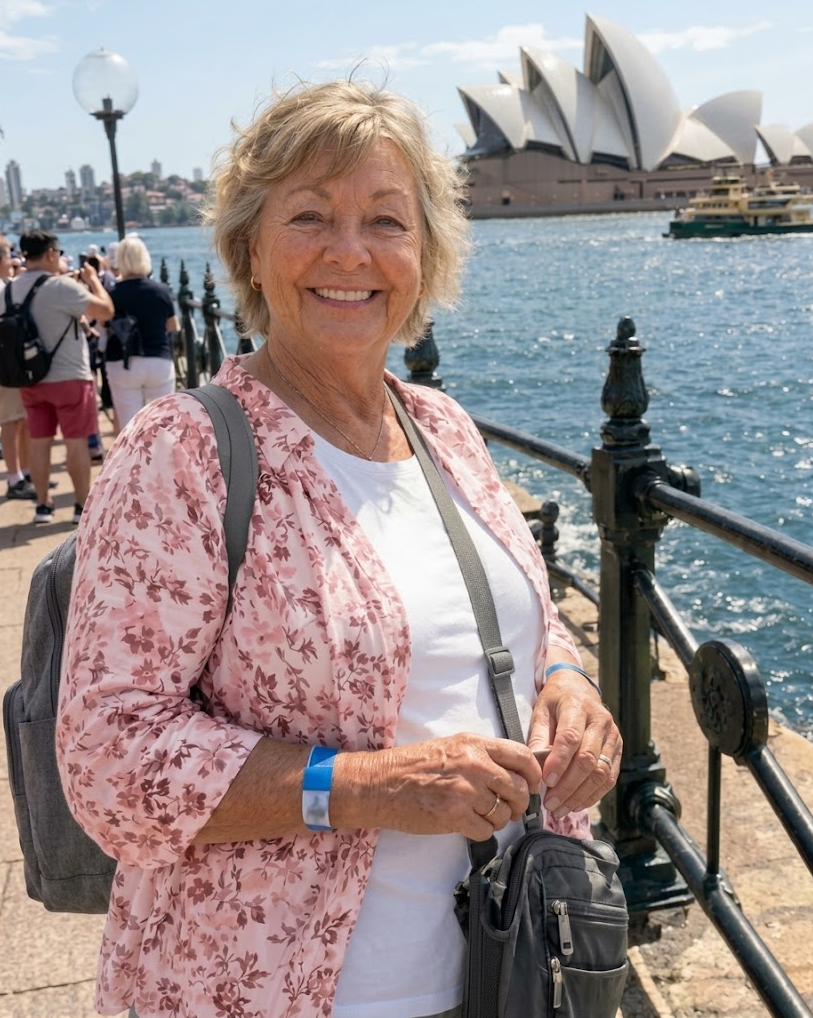
Australia was my fourth stop.
And that was where I met Arthur.
We met in Melbourne, in a small secondhand bookstore.
At the same moment, we reached for the same mystery novel.
He looked at my hand over his.
— I think at our age it would be improper to start a fight over a book.
— At our age?
He smiled.
— All right. I’ll put it differently. You look 35.
— Now I know you’re a liar.
Arthur laughed.
We had coffee that day, and a few days later we met again.
One day we were walking through a garden where, for a full 25 minutes, he tried to convince me that roses were definitely overrated.
— They’re too demanding — he declared.
— They’re just flowers.
— Exactly. Can you imagine how demanding creatures are when they don’t even pay rent?
I laughed with Arthur more than I had in the previous few years.
He loved jazz. So did I.
We both loved old movies and gardening.
Arthur read mysteries, grew tomatoes that kept dying for some reason, and had been married to his wife Anne for 38 years before she passed away.
svgWedding Planning
We didn’t try to pretend we were younger, and we didn’t play any silly games.
We talked about our late spouses.
About our children.
About regrets.
About loneliness.
Once, during a late dinner, Arthur said:
— No one warns you that grief becomes quieter with time, but it never completely disappears.
I understood exactly what he meant.
After a few meetings, Arthur invited me to his home.
— I have an entire shelf of old records you’ll like. Come over for coffee, and I’ll show them to you.
I trusted him.
Arthur’s home was warm and cozy. It was filled with different pieces of furniture that didn’t match at all, books were scattered everywhere, and family photographs lined the hallway.
— I’ll put the kettle on. Make yourself at home — he said.
I walked into the living room.
And froze.
A painting hung above the fireplace.
It showed a small cottage by a lake, two pine trees leaning over the water, and an old wooden pier.
In the lower right corner, almost hidden in the grass, were the initials:
R.M.
It was Robert’s painting.
The same one I believed had been destroyed.
I knew every brushstroke.
I had watched him paint it.
My hands began to tremble.
Arthur placed the cups on the table.
— Abigail, please sit down.
— No.
My voice sounded sharper than I intended.
— I need to know where you got this painting.
He looked at it.
— From Robert.
I froze.
— What did you say?
— Robert sent it to me.
I thought I had misheard him.
— You knew my husband?
Arthur nodded.
My head began to spin.
— How?
He slowly sat down.
— I was 24. Robert must have been 22 or 23. He came to Australia for almost a year.
I knew Robert had once traveled around Australia. I knew he had worked there. But he had almost never talked about that period of his life.
Arthur continued:
— We worked together at a hotel near Melbourne for a few months at first. An awful place. They paid very little.
He smiled.
— Robert was the worst person in the world when it came to carrying luggage.
I smiled involuntarily.
That really was just like him.
Arthur told me they quickly became friends.
On weekends they traveled, listened to records, played cards, and took whatever jobs they could find.
Robert painted whenever he could afford the supplies.
— That cottage — Arthur pointed to the painting — was inspired by a place near the lake where we once lived. He painted the first version there.
— But he painted this one after we got married.
Arthur fell silent.
— He painted it again.
I didn’t understand.
— Years later, he recreated it from memory. The first version had been destroyed. Then he created a third one — the one hanging here now.
I looked at the painting.
That was why it seemed so familiar.
— Why did he send it to you?
Arthur stood up.
— I have something I need to show you.
He left the room.
A minute later, he returned with a wooden box.
He placed it on the table and opened it.
Inside were dozens of letters.
The sender’s name was written on every envelope.
Robert.
I picked up the first letter.
The return address belonged to our old house.
— How long did you correspond?
— From time to time. For several decades.
I looked at Arthur.
— Robert never told me about this.
He shook his head.
— He wasn’t hiding anything from you, Abigail.
— That’s not what I said.
— But it’s what you thought.
I almost laughed. He was right.
Arthur explained that after Robert returned to America, they occasionally wrote to each other.
Then life took over.
Marriage.
Children.
Work.
Sometimes years passed between letters.
But when Robert became ill, he found Arthur again through an old mutual friend.
They began corresponding again.
— Why did he never tell me?
Arthur lowered his eyes.
— Because most of his letters were about you.
I froze.
— Me?
He nodded.
Arthur took out one envelope.
— He sent it along with the painting.
The envelope was sealed.
My name was written on it.
I immediately recognized Robert’s handwriting.
But I couldn’t bring myself to open the letter.
— Why do you have it?
Arthur looked at me.
— Because Robert asked me to keep it.
— For how long?
— Until you found him.
— Why?
Arthur smiled sadly.
— He hoped that one day you would come to Australia and visit the same bookstore he had once told you about. After his last letter, I came there every day. I hoped I would meet you.
I stared at him, unable to believe my ears.
Then he told me what Robert had written in his final letters.
He had worried about me.
Not because he thought I couldn’t manage money or couldn’t live on my own.
He worried because I had never believed I had the right to choose myself.
— He said you gave everything away — Arthur said. — Your time. Your money. Your strength.
I lowered my eyes.
— Robert said you were happiest when you were planning trips you never got to take.
My throat tightened.
Arthur continued:
— He wrote that his greatest regret wasn’t dying before retirement. He regretted helping you believe that life could always be postponed until later.
Tears rolled down my cheeks.
Finally, I opened the envelope.
Robert’s letter was four pages long.
I couldn’t read it all aloud without stopping, but one passage broke my heart.
“Abigail,
if you’re reading this in Australia, it means you finally did what we dreamed about when we were young.
And if I’m no longer here, don’t turn this journey into a monument to my memory.
See the world because you want to see it yourself.
Eat foods I would never even dare to try.
Stay longer in a beautiful place.
Leave a boring one sooner.
Spend money on yourself and don’t explain why to anyone.
The children love you. But don’t let your love for them become the reason you never live without someone else’s permission.”
I covered my mouth with my hand.
Arthur turned away to give me some privacy.
I read the final paragraph.
“I asked Arthur to keep this letter because Australia was always the place where my life first truly belonged to me.
Perhaps it will become the same for you.
And if Arthur is still there, make him pay for the coffee.
He still owes me $12.”
I laughed through my tears.
— He really mentioned that?
— Of course.
— After all these years, the interest would probably be unfair.
I laughed even harder.
And then I cried.
But these weren’t the tears I had shed at Robert’s funeral.
They were something completely different.
As if grief and relief had entered the same room at the same time.
For more than ten years, I had carried a quiet sense of guilt whenever I did something I wouldn’t have been able to do if Robert were still alive.
Sell the house.
Travel alone.
Simply have fun.
Part of me had been afraid that moving forward meant leaving him behind.
And now his handwriting was right in front of me.
And he himself was asking me to live.
Arthur and I sat there talking until the coffee went completely cold.
He told me stories about Robert I had never heard before.
How Robert once fell asleep during a jazz concert.
How he got lost while insisting the entire time that he knew the way perfectly.
How he once tried to cook a fish over a campfire and somehow managed to drop it straight onto the ground.
— That is completely like him — I said with a laugh.
Arthur smiled.
— In his final years, your husband talked about you a lot.
svgFamily Games
I was surprised.
Then I realized something.
— You knew I existed before we met?
— Of course.
— So when we met at the bookstore…
— I didn’t know it was you.
It turned out Arthur hadn’t seen any of my recent photographs, and my married surname was fairly common.
It was only after our second meeting, when I mentioned Robert and the place where we had lived, that he began to suspect something.
— Why didn’t you tell me right away?
He smiled.
— Imagine it: you’re traveling alone through Australia, and suddenly a strange man says, “By the way, I knew your late husband and I’ve been keeping his letters for the last twelve years.”
I smiled.
— That really would have been unforgettable.
— That’s why I decided coffee would be safer.
I raised an eyebrow.
— So you invited me here deliberately?
— Partly because of the painting.
— And the other reason?
Arthur looked slightly embarrassed.
— I wanted to meet my best friend’s wife. The woman he loved with all his heart.
After those words, everything around me seemed to change.
I looked at Robert’s letter.
And suddenly I felt that light, almost forgotten excitement in my chest.
Arthur reached his hand across the table, palm facing upward.
For several seconds, I stared at his hand.
Then I placed mine in his.
I stayed in Australia for another three weeks.
Arthur showed me places tourists usually didn’t know about.
We listened to records and ate terrible sandwiches on the beach.
He took me to the lake near where he and Robert had once lived.
The cottage had been gone for a long time.
But the lake was still there.
We stood on the shore.
— I thought it would be difficult for me to come here — I said.
— Is it difficult?
I thought for a moment.
— A little.
Then I smiled.
— But not only that.
I didn’t cancel the remaining stages of my journey.
Arthur traveled with me during the next two stops.
Then I set off on my own again.
Over time, the children began calling me.
svgFind a Nanny
Karen was the first to apologize.
Then Melissa admitted she had been angry with me because my trip forced her to realize how dependent she had been on me.
David needed more time.
And one day Eric said:
— I think I thought that as long as the house remained, you would always be nearby.
I replied:
— I’m still your mother. I’m just not a piece of furniture anymore.
We both laughed.
Arthur and I stayed in touch.
Every day.
Six months later, I returned to Australia.
Not because Robert had somehow “sent” me there.
Not because my children had turned away from me.
But because I wanted to.
Arthur was waiting for me at the airport holding a small cardboard sign:
“ABIGAIL — YOU STILL OWE ME A COFFEE!”
I laughed so hard that I started crying again.
I still travel.
Sometimes with Arthur.
Sometimes alone.
And the painting now hangs in the small apartment that Arthur and I share for part of the year.
Beside it, in a frame, is Robert’s letter.
And next to it — the receipt for that first coffee Arthur bought me after I returned.
Exactly $12.
At 69, I thought selling my house meant leaving behind the life I had built myself.
I was wrong.
In truth, I had finally stepped into the part of my life I had been postponing all along.
And somewhere on the other side of the world, I found a piece of the man I had loved, as well as a man I never expected to meet.
For the first time in my life, I wasn’t waiting for some day in the future anymore.
I was already living it.