I’m 61 years old, and I was flying alone to see my granddaughter for the very first time. I never expected a complete stranger to turn my journey into a real test of patience.
I had specifically paid extra for a window seat. I wanted to get through the long flight peacefully, read a book, and occasionally gaze at the clouds.
Unfortunately, the passenger sitting next to me decided he had the right to take up part of my seat simply because I was a short woman.
He was around fifty, tall, broad-shouldered, and dressed in elegant, expensive clothes.
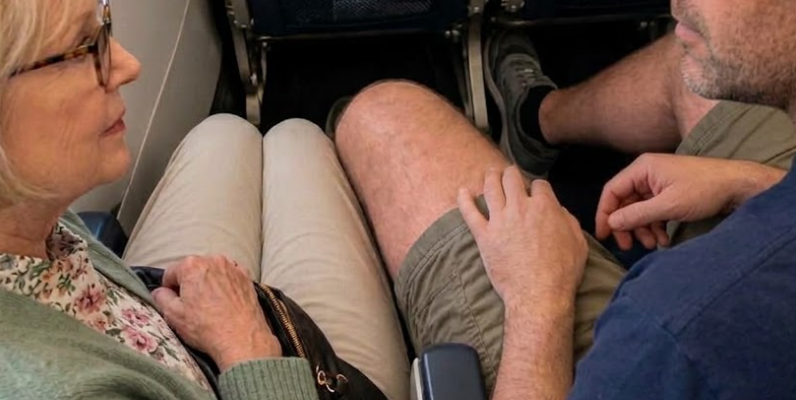
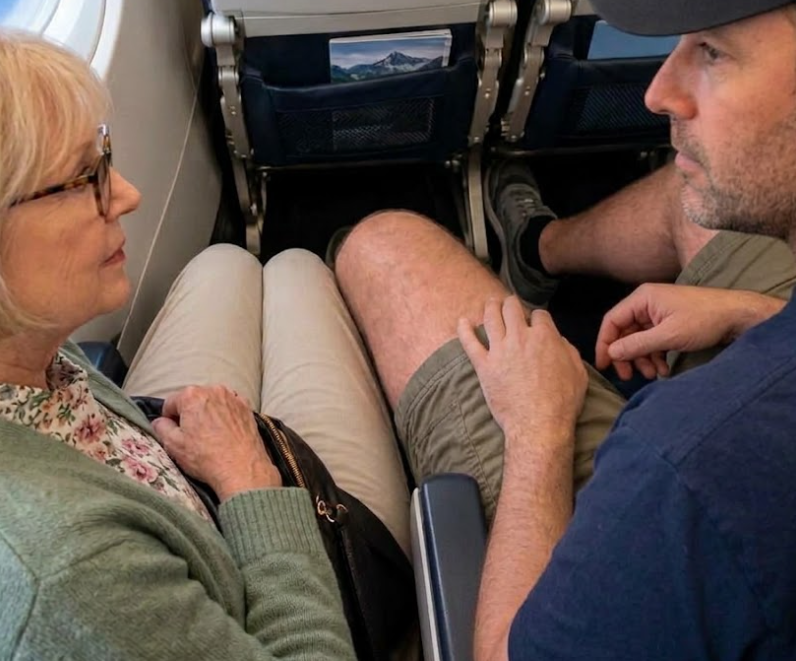
Even before takeoff, his knee was pressing against mine.
I moved closer to the window, hoping he would take the hint.
Instead, he spread his legs even wider.
“Excuse me, could you move over a little?” I asked politely.
He looked at me and burst out laughing.
“You’re so tiny! Why do you need so much space?”
For a moment, I didn’t know what to say. I genuinely couldn’t believe that a grown man could say something like that with a completely straight face.
For the next four hours, he behaved as though half of my seat belonged to him. He pressed his thigh against mine, took up the entire armrest, rested his elbow on my side, and stretched his leg underneath my seat.
My leg began to hurt.
I asked him to stop several times.
Each time, he either pretended not to hear me or responded with another sarcastic remark.
“I’m almost six-foot-six! Where exactly am I supposed to put my legs?” he finally snapped.
“Wherever the space you paid for ends,” I replied.
He rolled his eyes.
“If you’re not using all the space anyway, what’s the problem?”
Then he put on his headphones and smirked, as though he had just said something incredibly clever.
I turned toward the window. I felt helpless and wanted to cry.
My husband, who had passed away a year earlier, often told me that I was too polite, even when other people were clearly crossing the line.
For a long time, I believed that avoiding conflict was a sign of maturity. That day, however, I began to see things differently.
Four hours into the flight, the man finally unfastened his seat belt.
“I’m going to the bathroom,” he announced as he stood up.
When he disappeared into the aisle, I could finally stretch my numb leg freely for the first time in hours.
I looked at his empty seat and remembered his words:
“If you’re not using all the space anyway, what’s the problem?”
That was when an idea came to me.
I noticed a flight attendant approaching and discreetly called her over.
“Excuse me, could I ask you for some help?”
“Of course, ma’am.”
I explained what had been happening over the past several hours. I told her that my seatmate kept taking up my space, ignored my requests, and had made sitting so uncomfortable that my leg was beginning to hurt.
The flight attendant’s expression immediately grew serious.
“Why didn’t you report this to me earlier?”
“I didn’t want to cause any trouble,” I answered quietly.
She shook her head.
“You’re not causing any trouble. You have the right to use your own seat comfortably.”
Then she checked something on her device.
“We have an available aisle seat two rows away. Would you like to move there?”
Surprise and relief washed over me.
“Yes, please.”
I picked up my handbag and book and followed the flight attendant.
In my new seat, I could finally stretch both legs freely. Nobody was touching me, nobody was taking up my space, and nobody was treating me as though I had no right to speak up.
I thought the worst was over.
I was wrong.
When the man returned from the bathroom, he stopped beside our row. He looked at the empty window seat and then noticed me sitting two rows away.
His face turned red.
“WHAT HAVE YOU DONE?!” he shouted furiously.
Several passengers turned around.
I calmly lifted my eyes from my book.
“I changed seats.”
He opened his mouth in disbelief.
“You complained about me?!”
“I explained to the flight attendant why I could no longer sit beside you.”
He pointed his finger at me.
“You’re making me out to be some kind of monster!”
Before I could answer, the flight attendant stepped between us.
“Please lower your voice, sir.”
The man threw his arms out in outrage.
“She never once told me she had a problem!”
That was when an older passenger sitting near my former seat spoke up.
“What do you mean she didn’t? I heard her ask you at least four times to move your leg.”
The man froze.
“I also heard you making fun of her and telling her she didn’t need so much space,” the older passenger added.
A woman sitting on the other side of the aisle nodded in agreement.
“I heard it too.”
Suddenly, the man who had tormented me for four hours lost all his confidence.
The flight attendant looked him straight in the eyes.
“Every passenger has the right to the seat they paid for. Please return to your own seat.”
This time, he didn’t argue. He turned around and walked away.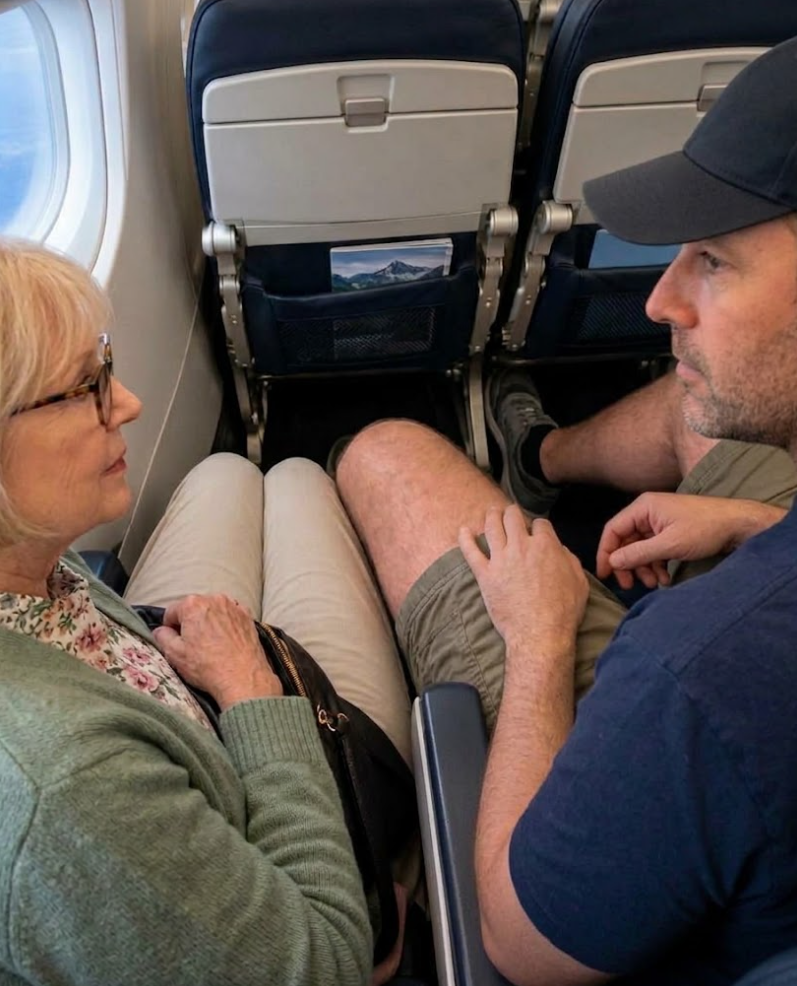
I thought that would be the end of the whole matter.
However, about twenty minutes later, he approached my seat again.
This time, he spoke much more quietly.
“Please listen. I’m sorry, all right?”
I studied him carefully.
“What exactly are you apologizing for?”
He hesitated.
“For causing you trouble.”
After a moment, he leaned toward me and added:
“But you’re not going to file an official complaint, are you? I travel for business quite often.”
That was when everything became clear.
He wasn’t worried about how he had treated me. He didn’t care that I had been in pain for several hours and had been forced to endure his dismissive remarks.
He was afraid of the consequences.
I closed my book.
“I haven’t made up my mind yet.”
His face immediately hardened.
“Do you really want to ruin my reputation over a little legroom?”
I looked him straight in the eyes.
“No. You are responsible for your own behavior. I’m simply going to tell people what happened.”
He stared at me silently for a moment. Then he walked away without another word.
After we landed, I made my way to the passenger service desk and filed a written complaint.
I wasn’t asking for compensation or any special privileges. I simply wanted the entire incident to be officially documented.
Only then did I feel that I could finally put the unpleasant experience behind me.
An hour later, I spotted my daughter waiting for me at the airport exit. She was holding my tiny granddaughter, Rose, in her arms.
When my daughter handed me that delicate little bundle and I held her close for the very first time, tears began streaming down my cheeks.
“Mom, what happened?” she asked, worried.
I smiled through my tears.
“Nothing bad, sweetheart. Grandma just learned something very important today.”
I looked at Rose’s tiny face.
For sixty-one years, I had believed that staying calm meant remaining silent, even when someone treated me unfairly.
Now I understood that this wasn’t true.
My husband had been right. He used to tell me that kindness was a beautiful quality, but it should never mean giving up my own self-respect.
You can be polite and still set firm boundaries.
You can avoid unnecessary arguments and still speak up when someone crosses the line.
And above all, neither height, age, nor gender gives anyone the right to treat another human being as though they matter less.
When Rose wrapped her tiny fingers around mine, I made myself a promise.
I would never again apologize for taking up the space that rightfully belongs to me.