
The alarm clock rang at five in the morning.
This time, I didn’t hit the snooze button. I turned it off and quietly slipped out of bed, trying not to wake my husband.
Daniel was still asleep. I put on a gray sweatshirt, walked down the old wooden stairs, and entered the kitchen.
Through the window, the lake looked like a black mirror. The house was silent, broken only by the soft hum of the old refrigerator.
My mother’s kitchen.
That morning, those words meant something special to me.
Mom had a small summer cottage by the lake. Two stories, wooden siding, a green metal roof, three upstairs bedrooms, and an old porch overlooking the water.
Nothing luxurious. The orange kitchen countertops were straight out of the late seventies, and the living room couch was older than I was.
But Dad had loved that place dearly.
He bought the house the year I was born. He had saved the money he earned working countless hours of overtime at the paper mill. He always said it was the best investment he had ever made.
When I was nineteen, Dad died of a heart attack on the dock while fishing.
After his death, Mom nearly sold the house. For the first two years, she couldn’t bring herself to go there. But one June morning, she called me and said:
“I think it’s time we opened our little cottage again.”
From then on, she spent every summer there. She paid the property taxes, repaired the roof, tended the garden, and planted flowers herself.
Once, she even climbed a ladder and painted the shutters blue, although I spent the entire week criticizing her for not asking anyone for help.
“Your dad always dreamed of having blue shutters,” she explained.
That was my mother. She could devote an entire day to some little detail that reminded her of the man she had loved.
In the spring, I married Daniel. Our wedding was modest: a ceremony at the church, a reception in an old barn, strings of lights, and a taco food truck.
That summer, our families spent so much time together for the first time.
When Daniel’s parents, Susan and Richard, were supposed to visit the lake, Mom was terribly nervous. She called me every evening for an entire week.
“What do they like to eat for breakfast?”
“Just ordinary things, Mom.”
“And does Susan drink tea or coffee?”
“I think coffee.”
“Is Richard allergic to anything?”
“Not that I know of.”
But Mom couldn’t calm down.
She bought new bedding, fluffy white towels, little bottles of lotion, and even scented candles for the bathroom.
When I arrived on Friday, I found her kneeling on the floor. She was scrubbing the baseboards with an old toothbrush.
“Mom, what are you doing?”
“I want them to feel comfortable here.”
“It’s a cottage by the lake, not a five-star hotel!”
She smiled.
“We’re one family now. I want them to feel welcome.”
At the time, I didn’t think much of her words.
But soon, I realized that this very kindness had turned against her.
Summer was beautiful. Almost every weekend, we came to the lake: Daniel and me, his parents, and my mother.
Eventually, every weekend began to look the same.
Mom got up at six in the morning, made breakfast for everyone, washed the dishes, laundered the towels, and cleaned the rooms. Then she drove into town to buy groceries, came back, cooked lunch, washed the dishes again, and prepared dinner in the evening.
She made salmon, roast dinners, chicken in sauce, homemade pasta, and cakes.
One day, Richard casually mentioned that he liked peach dessert. From then on, Mom baked one every Saturday especially for him.
Susan spent her weekends very differently.
She arrived on Friday evening, looked around the house, and always said:
“How lovely it is here!”
Then she went out onto the porch, claimed the largest lounge chair with the best view of the lake, put on her sunglasses, and took out her phone.
And that was the extent of her activity.
For eight weekends, she never once offered to help.
She didn’t carry a plate to the sink, chop vegetables, wipe the table, or even put away her own coffee mug.
Every morning, Mom found her mug beside the lounge chair. She picked it up, washed it, and wiped away the marks Susan had left on the little table.
At first, Susan would say:
“Thank you, Maggie.”
By the middle of the summer, she had stopped even saying that.
What irritated me most was that Mom could spend hours cooking and place a full plate in front of Susan, who would simply start eating as if the meal had appeared on the table by itself.
One evening, I brought it up with my husband.
“Your mother doesn’t help at all.”
“I know.”
“She doesn’t even thank my mom.”
“I know.”
“Why don’t you say something to her?”
Daniel sighed.
“She’s always been like that. At home, Dad takes care of everything. Mom is used to other people doing everything for her.”
“But this isn’t her house.”
“I understand.”
He promised to talk to his parents, but he never did.
And I continued to stay silent, hoping the situation would change on its own.
Until one day, Mom placed six new flower boxes on the porch.
She had spent several weeks building them in the garage, painted them blue, and planted bright red geraniums in them. She was very proud of her work.
“Your dad adored red geraniums,” she said, showing me photographs. “He used to say they made the house look happier.”
On Saturday morning, Mom arranged all six flower boxes along the porch railing.
Blue boxes, red flowers, and the blue lake in the background.
It looked absolutely beautiful.
“Mom, they’re gorgeous!”
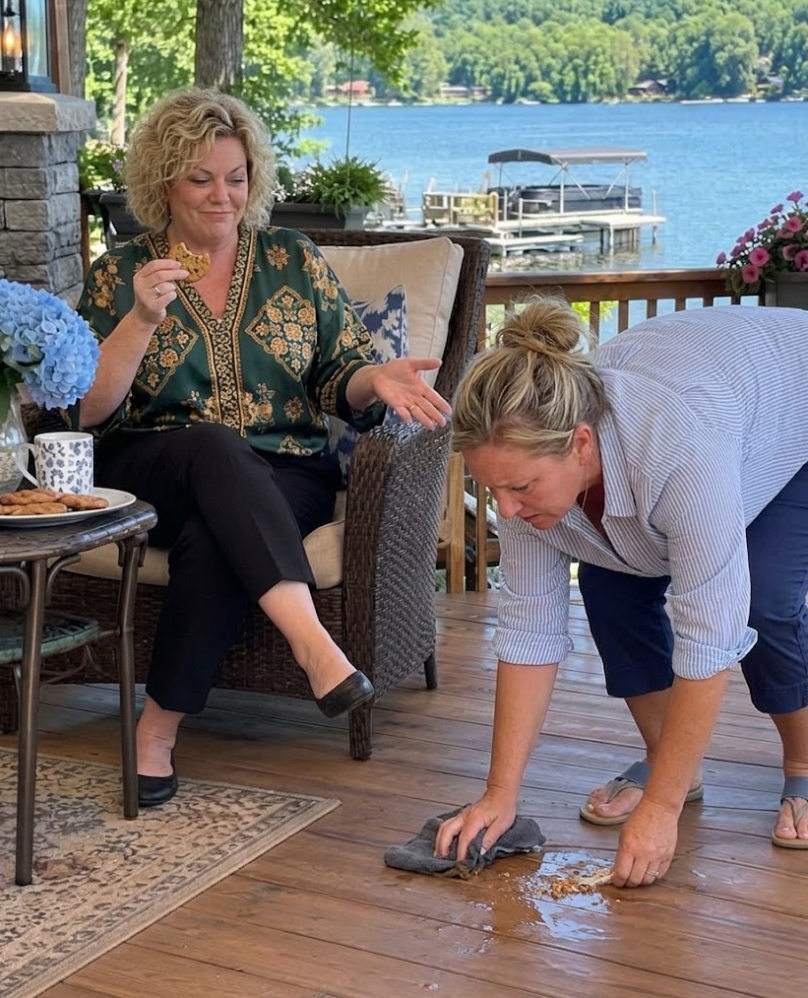
She smiled as if she were a young girl again, decorating her own home for the very first time.
Then Susan appeared.
She was wearing a white linen cover-up, holding an iced tea in one hand, with oversized sunglasses perched on her nose.
She walked over to her lounge chair, settled in comfortably, and then noticed the flowers.
Her face twisted with displeasure.
“Oh, no.”
Mom was standing in the doorway with a tray full of blueberry muffins.
“What’s wrong?” she asked.
Susan pointed at the flower boxes.
“They’re blocking my view of the lake. I lie here every morning, and now I can’t see anything. Don’t do things like this again.”
For a moment, I couldn’t believe my own ears.
This was my mother’s house. My mother had planted the flowers. Even the lounge chair stood on her porch.
Yet Susan spoke as if she had arrived at her own resort and discovered that the staff hadn’t followed her instructions.
Mom lowered her eyes.
“I’m sorry. I didn’t think about that.”
She set down the tray and began moving the heavy flower boxes.
All six of them.
Behind the grill, into a far corner of the porch, beside the garbage bins.
Susan didn’t even get up from her lounge chair.
When Mom finished, my mother-in-law adjusted her sunglasses and said with satisfaction:
“That’s much better now. Thank you, Maggie.”
I watched Mom and felt my anger growing.
I knew her too well. She could endure discomfort indefinitely as long as it meant not offending anyone. She would move those boxes a hundred times if it helped preserve peace between me and my husband.
But I could no longer pretend everything was fine.
That evening, I didn’t say anything to Susan. I didn’t want to create a scene that would leave her telling all her friends what a terrible daughter-in-law she had.
Instead, I went upstairs and set my alarm for five in the morning.
“What are you planning?” Daniel asked.
“I don’t know yet. But I’m not going to keep watching my mother work for everyone while your mother relaxes.”
He fell silent, then admitted:
“You’re right. I should have stepped in much earlier.”
The next morning, at 5:07, I had an idea.
An old whiteboard sat on the kitchen counter. Mom used to write grocery lists on it and leave me messages before my school exams.
I placed it on the table, grabbed a black marker, and wrote in large letters:
WEEKEND CHORES
Then I divided up the tasks.
Daniel — clean up after breakfast.
Richard — grocery shopping.
Me — lunch.
Susan — breakfast.
Dinner would rotate, with a different person cooking each evening. Saturday would be Susan’s turn.
At the very bottom, I wrote:
Maggie — enjoy her own home.
I underlined the word “own” twice.
I was still looking at the board when Mom walked into the kitchen wearing a fluffy pink bathrobe.
“What are you doing? It’s five in the morning!”
She stepped closer, read the words, and went pale.
“No. Erase that.”
“Mom, this is your house.”
“They’re our guests!”
“They’ve been coming here every weekend for two months.”
“You can’t assign chores to invited guests!”
I looked her straight in the eyes.
“And can someone tell a host where she’s allowed to put her own flowers?”
Mom pressed her lips together.
“Susan didn’t mean any harm.”
“Then why did you move all six flower boxes behind the garbage bins?”
“They’re just flowers.”
“No, Mom. This isn’t about the flowers. It’s about how you keep putting everyone else’s comfort ahead of your own.”
She reached for the board, but I lifted it off the table.
“Please, just try going one day without doing everything for everyone else. Let people take care of themselves.”
“But I like taking care of people.”
“I know. But loving the act of caring for others doesn’t mean you have to let them treat you like a servant.”
My words hurt her. I immediately regretted saying them so harshly.
Mom, however, didn’t answer.
She simply pulled out a chair and sat down.
She didn’t turn on the coffee maker, open the refrigerator, or take out the eggs.
For the first time that summer, she simply sat in her own kitchen.
Fifteen minutes later, Susan came downstairs.
She walked over to the coffee maker, only to discover that it was empty and cold.
She opened one cupboard, then another, and then a third.
“So nobody made coffee today?”
Mom instinctively began to stand up.
I gently touched her wrist.
She stopped.
Susan turned around and saw her sitting at the table.
“Oh…”
Then she noticed the board.
She read the words and laughed.
“What kind of joke is this?”
“The weekend chore list,” I replied.
She looked at the board again.
“So I’m supposed to make breakfast?”
“Exactly.”
Her smile disappeared.
“You’re serious?”
“Absolutely.”
“But your mother invited us here herself!”
At that moment, Daniel appeared on the stairs. He read the list and stopped beside me.
“Mom,” he said calmly, “this is Maggie’s house. She isn’t obligated to wait on us every time we visit.”
Susan looked at her son as if he had suddenly started speaking a foreign language.
“I’m a guest!”
“Yes,” Daniel replied. “But you come here almost every weekend. We can all help.”
“I can’t cook like Maggie.”
“Then make something simple. Scrambled eggs, toast. Nobody expects a restaurant menu.”
Richard came downstairs too. He read the board, then looked at his wife.
“Actually, I can go grocery shopping. And I think it’s about time I offered to help myself.”
Susan crossed her arms.
“I can’t believe you’re all giving me a hard time over a few flower boxes!”
“Nobody is giving you a hard time,” I said. “We just don’t want Mom doing all the work alone anymore.”
Mom sat silently, as if she were afraid that anything she said would start an argument.
Then Daniel turned to her.
“Maggie, I’m sorry. I should have noticed this sooner.”
She looked up at him.
“I just wanted everyone to feel comfortable.”
“We know,” he replied. “But now it’s our turn to take care of you.”
Those words seemed to change something in her expression.
For the first time that morning, she smiled.
Susan was still unhappy. She muttered something about people becoming too sensitive, then set about making breakfast.
The scrambled eggs were too salty, the toast was burnt, and the coffee was too strong.
Still, we sat down at the table and ate.
And Mom didn’t clean up a thing.
After breakfast, Daniel washed the dishes, Richard wiped the table, and I put away the groceries.
Susan sat on the porch, but this time she had to carry her own mug into the kitchen.
Later, I walked toward the grill and saw Mom standing beside the flower boxes.
She was looking at the red geraniums hidden away in the corner.
“Let’s put them back,” I said.
Mom shook her head.
“I don’t want to upset Susan again.”
I crouched beside her.
“Mom, you don’t have to ask anyone’s permission to decorate your own home.”
She was silent for a long moment.
Then she grabbed one of the boxes by its handles.
I helped her lift it, and together we carried the flowers back beneath the porch railing.
Then we brought the other five back as well.
When we finished, Mom stepped back a few paces and looked at the porch.
The red geraniums were back in the sunshine.
“Your dad would have been happy,” she said quietly.
I put my arm around her shoulders.
“He would have been proud of you.”
That day, Susan barely spoke to me. During lunch, she was cold and let out several pointed sighs.
But that evening, something unexpected happened.
When it was time to prepare dinner, she opened the refrigerator herself and asked:
“Maggie, where do you usually keep the vegetables?”
Mom looked at her in surprise.
“In the bottom drawer.”
“Okay. I’ll make a salad.”
It wasn’t an apology. And I wasn’t going to pretend that one salad could make up for everything that had happened over the previous two months.
But for the first time, Susan had offered to help on her own.
The next day, she packed her things and announced that she and Richard needed to head home.
Before leaving, she approached Mom.
“Thank you for the weekend, Maggie.”
Mom smiled.
“You’re welcome.”
Susan’s gaze lingered on the flower boxes.
“By the way, those geraniums really are beautiful.”
Mom didn’t answer. She simply smiled even more broadly.
The following weekend, we returned to the lake.
This time, Richard brought the groceries, Daniel made breakfast, and Susan helped set the table. After dinner, we all cleaned the kitchen together.
Mom still loved cooking for us. Sometimes she would get up early and bake her blueberry muffins. But nobody considered it her responsibility anymore.
She could sit peacefully on the porch, read a book, drink her coffee, and admire the lake.
And the flower boxes stayed exactly where they belonged.
A few weeks later, I noticed that Mom had stopped getting nervous before our visits. She no longer called me to ask what our relatives liked to eat, and she no longer tried to turn an ordinary summer cottage into a luxury hotel.
One morning, I stepped onto the porch and saw her sitting in her favorite armchair. She had a book on her lap, a cup of coffee beside her, and the red geraniums were gently swaying in the breeze.
“What are you thinking about?” I asked.
Mom looked at me and smiled.
“That your dad was right. This house becomes more precious with every passing year.”
“Because of the flowers?”
She shook her head.
“No. Because of the memories. And because of the people around whom I can truly be myself.”
I sat beside her and took her hand.
That was when I understood something simple: sometimes, setting boundaries doesn’t mean pushing people away. It means giving them a chance to learn how to respect others.
My mother will never stop caring for the people she loves. It’s part of who she is, and I wouldn’t want to change that.
But now she knows that her kindness doesn’t obligate her to sacrifice her own peace.
And I learned something important: silence doesn’t always preserve harmony. Sometimes, it simply teaches other people that our loved ones will put up with absolutely anything.
And if I ever had to write that list on the whiteboard again, I would do it without a moment’s hesitation.
Because my mother’s house isn’t a resort where she is obligated to serve her guests.
It’s the place my father built and fell in love with, the place my mother preserved after his death, and a place she has every right to call her own.
And nobody else will ever decide for her where her flowers are allowed to stand.