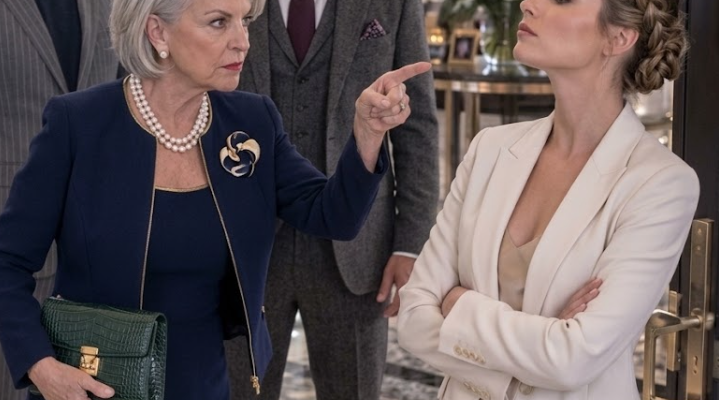

After the divorce, I discovered that my former mother-in-law still had access to my apartment, and perhaps even to my finances. But when the lawyer stepped in, secrets came to light that changed everything.
My divorce had officially been finalized less than twenty-four hours earlier.
I was standing barefoot in the kitchen of my Manhattan apartment, holding a cup of coffee, when the doorbell rang.
I thought it was the building manager or one of the neighbors.
But when I opened the door, I saw Victoria Bennett.
My former mother-in-law.
She was wearing a beige coat and carrying a Hermès handbag. Behind her stood Richard, my ex-husband.
— Sophia — Victoria said, as if nothing unusual had happened. — Can I come in?
I didn’t answer immediately.
Just yesterday, I had been Richard’s wife.
Now I was his ex-wife.
And yet, for some reason, I had the feeling that Victoria had no intention of taking that difference seriously.
— What do you want? — I asked.
— To talk to you.
Richard stood behind her, avoiding my eyes.
Then Victoria raised her hand.
She was holding an old brass key.
There was a blue plastic cover on its end.
I recognized it immediately.
Three years earlier, I had given Richard two spare keys. He gave one to the housekeeper, and the other — without asking my permission — to his mother.
During the divorce, my lawyer asked Richard whether everyone had returned their keys.
Richard said yes.
And now Victoria was standing in front of me with one of them.
— Where did you get that? — I asked.
She smiled.
— My son gave it to me.
Then she simply inserted the key into the lock.
She turned it.
The lock clicked.
Instinctively, I closed the door and put on the security chain.
Victoria tried to open it wider, but the chain stopped her.
— Take it off — she said.
— No.
— Sophia, this is my son’s home.
— I’m not his wife anymore. And this is my apartment.
Richard finally spoke.
— Mom, let’s go.
Victoria looked at him.
— After everything I’ve done for her?
At that moment, something inside me changed.
Victoria was talking about having access to my home as if she were also entitled to access my money.
This wasn’t a coincidence.
I called the building security.
A few minutes later, two security guards arrived. Victoria protested, while Richard tried to convince me that there was no need to make such a scene.
One of the guards photographed the key and then took it from her.
— She can’t keep this key — I said.
Victoria looked at me.
— Richard gave it to me years ago.
Richard lowered his head.
— I didn’t know she still had it.
Victoria gave a short laugh.
— Of course you didn’t.
That evening, I called Gabriel Torres, the lawyer handling the financial part of my divorce.
The next morning, he asked:
— Sophia, can you send me the bank statements and credit-card statements from the last twelve months?
— Why?
— Because something doesn’t add up.
What the credit-card statements revealed
Victoria had had an additional card connected to my platinum credit card for nearly five years.
At first, Richard had asked me to let her use it temporarily.

— Just for a charity dinner — he said at the time. — She needs to pay for a few things in advance.
“Temporarily,” however, turned from months into years.
Christmas shopping.
Hotels in Palm Beach.
Expensive restaurants.
Shoes.
Handbags.
Flowers.
Sometimes she spent more in a single month than we paid to maintain our apartment.
Whenever I pointed it out to Richard, he always replied:
— She’s my mother. I’ll talk to her.
He never did.
Until one day Victoria’s card was declined at Bergdorf Goodman.
Richard called me that evening.
— Mom felt completely humiliated.
— Why was it declined?
— Because of the card.
— Maybe it’s time to cancel it.
There was silence.
— Sophia, that won’t help right now.
When Gabriel reviewed the statements, he found dozens of transactions I knew nothing about.
Bergdorf Goodman.
Saks.
Restaurants.
A resort in Naples.
A limousine.
Florists.
And something else.
A storage facility in Westchester County.
As well as administrative payments connected to Bennett Legacy Services.
And donations.
— Do you know anything about the Bennett Legacy Fund? — Gabriel asked.
— Only that Edward created it.
Edward was Richard’s father.
He had died four years earlier.
He was the only Bennett who never made me feel that I had to prove I deserved my place in the family.
He was careful with money.
Sometimes he was even uncomfortable with Victoria’s spending.
During one Thanksgiving family dinner, Victoria complained about why I hadn’t paid for the renovation of a hotel room in Paris.
Edward looked at me.
Later, when we were alone, he quietly said:
— If there’s something you don’t want to do, you can tell us.
I didn’t understand what exactly he meant at the time.
Now I did.
Gabriel also found a document.
A power of attorney from three years earlier.
My name was on it.
And my signature.
Except it wasn’t my signature.
The document authorized certain administrative and charitable expenses related to the family’s assets.
— This isn’t my signature — I said.
Gabriel studied it for a long time.
— I know.
The documents concerning the storage facility in Westchester also listed me as the person responsible for payments.
Edward had originally rented the storage facility.
After his death, Victoria changed the contact information, but not the payment method.
According to Gabriel, that was why the bills were still being sent to me.
A few days later, we found the storage facility.
Inside was a gray folder.
And inside it were documents from the Bennett Legacy Fund.
Edward had created the fund to support charitable organizations and provide limited resources to certain family members.
But the documents also contained a letter to Richard.
Edward had written it.
He wrote that he was afraid Victoria was treating the family’s assets as if they were her own money.
The fund had not been created to finance her lifestyle.
One sentence from the letter stayed with me in particular:
“Even now, Sophia is carrying more on her shoulders than this family should ever have expected of her.”
Gabriel later found two different versions of amendments to the fund.
In one of them, Victoria was given significantly more control.
But the signatures didn’t match.
Edward’s signature differed from the one appearing on the original, notarized estate documents.
There were also questions concerning the witness’s signature.
That was when the matter stopped being an ordinary family conflict.
Edward’s storage facility
A few days later, Richard called me.
— They’re reviewing Mom’s accounts.
— I know.
— Her lawyer says you’re challenging the documents concerning my father’s assets.
— I’m not the one challenging them. The documents speak for themselves.
There was silence.
— Did you know about the storage facility? — he asked.
— No.
It was the first time I heard genuine uncertainty in his voice.
A few days later, an official complaint was filed against me.
It claimed that I was harassing Victoria and unlawfully interfering in the Bennett family’s financial affairs.
Victoria claimed that I had voluntarily helped the family, and that now, because of the divorce, I was trying to rewrite the past.
Because the complaint was official, the documents were also subjected to a formal investigation.
Then Richard asked me to meet him.
We met at a small café near Gabriel’s office.
He placed a folder in front of me.
— I found it in Mom’s study.
— What’s inside?
— My father’s documents.
I opened the folder.
Then I looked at Richard.
— What did she say?
— She claims Dad asked her to take care of everything.
— And you believe her?
He was silent for a long time.
— I think… I let her use you.
I shook my head.
— You didn’t just let her use me. Every time I tried to set a boundary, you took her side.
Richard lowered his eyes.
— I know.
I pushed the folder toward him.
— Give it to your lawyer.
Richard finally confronted his mother
The hearing took place several weeks later.
Victoria wore a navy suit and a string of pearls.
Richard sat separately.
Gabriel presented the documents one by one.
Credit-card statements.
The disputed signature.
Documents concerning the storage facility.
Edward’s original documents.
And the photograph of the key.
Victoria’s lawyer argued that this was simply a family dispute that had escalated after the divorce.
But the judge simply said:
— They are already divorced.
Then he added:
— Previous access does not mean permanent permission.
The financial restrictions and investigation remained in place.
Questions concerning the signatures and Victoria’s official complaint were referred to the appropriate authorities.
There were no handcuffs.
There was no dramatic confession.
There were only documents, procedures, and consequences.
After the hearing, Victoria stopped me in the hallway.
— After everything I’ve done for you.
Richard stepped between us.
— That’s exactly the problem, Mom.
Victoria looked at him in disbelief.
I simply said:
— Being a member of the family doesn’t mean you have unlimited access to someone’s life.
— As long as you wanted to be part of the family, you were happy to pay for everything — Victoria replied.
— Yes. I paid. For years. But I won’t anymore.
The house on East 73rd Street
The legal and financial matters continued for several more months.
Some of the disputed money was returned.
Some expenses were reimbursed.
But the family’s finances clearly changed once they were no longer being funded with my money.
Six months later, the house on East 73rd Street was put up for sale.
For a long time, I had felt like a guest there.
Even though I had paid a great deal to make it look like a real family home.
Victoria hosted Christmas dinners there.
Thanksgiving gatherings.
Charity events.
Engagement dinners.
Once, during one of the charity evenings, she introduced me this way:
— Sophia, Richard’s wife. Very intelligent, which is extremely convenient considering Richard’s fondness for expensive things.
Everyone laughed.
I laughed too.
At the time, I thought it was just an awkward joke.
Now I knew it was much more than that.
I invested some of the recovered money into a nonprofit initiative.
Together with two financial advisers and an organization providing legal assistance, we began helping women who were experiencing financial control.
Women whose partners controlled their salaries.
Women who didn’t know what their credit history looked like.
Women whose names were used to take out loans.
Women who were told that asking questions about money meant a lack of trust.
We needed a permanent place.
This house was perfect.
The organization purchased it in an ordinary transaction.
Not so I could sleep in Victoria’s bedroom.
Not for revenge.
I didn’t live there.
We named it:
The Edward House for Financial Freedom.
We named it after Edward.
He was the only Bennett who saw what was happening.
And the only one who quietly showed me that I had the right to say “no.”
We turned the ballroom into a financial consultation space.
The dining room became a legal-aid office.
The upstairs rooms became temporary workspaces and private consultation offices.
The long table where Victoria once seated guests according to their social status was replaced with simple desks.
Three weeks before the opening, I received an envelope.
There was no return address.
I recognized the handwriting immediately.
It was from Victoria.
There were only four words:
“You ruined my life.”
I placed the letter in the same drawer where I kept the old brass key.
Richard brought his father’s books
A few days before the opening, Richard came to visit me.
He was moving to Boston.
He brought two boxes with him.
They contained Edward’s books.
History books.
Economics.
Biographies.
Novels.
— They’ll have a better place here than in storage — he said.
He looked around.
— Mom would probably like this place.
I said nothing.
— I’m sorry, Sophia.
I looked at him.
— Not just for the card. Or the key. For everything.
This time, he didn’t try to justify himself.
He didn’t defend his mother.
He didn’t say it was a misunderstanding.
He simply apologized.
— Do you think people can change? — he asked.
— Yes.
— Me too?
— That depends on you.
He nodded.
— Would you ever want to visit me in Boston?
— Maybe.
He smiled.
— And do you think that… someday we could be friends again?
I was silent for a moment.
— You can become a different person, Richard. But that person doesn’t have to be with me.
He nodded.
He didn’t ask me to forgive him again.
He didn’t ask for another chance.
Perhaps that was the first real sign that he truly understood what he had done.
The last key
One year after the divorce, the receptionist called me.
— Sophia, do you remember Denise?
Of course I remembered her.
We had met three months earlier.
She had a poor credit history.
Almost no savings.
Her husband transferred her salary into an account Denise couldn’t access.
We helped her.
Now she had a new job.
Her own bank account.
Her own lease.
And the keys to a new home.
When I saw her, tears filled her eyes.
—I did it — she said.
I hugged her.
The old brass key was still in my drawer beside Victoria’s letter.
The blue plastic cover was already scratched.
For a long time, I thought victory would be getting the money back.
Or the card.
Or the house.
Or hearing Victoria finally hear me say “no.”
But that wasn’t victory.
Victoria believed the key meant the right to enter.
The Bennett family treated almost everything the same way.
A credit card as the right to spend money.
Marriage as the right to make demands.
Generosity as a lifelong debt.
And family as the right to unlimited access to another person’s life.
A year later, Victoria stopped at the gate of The Edward House for Financial Freedom.
She was wearing a simple gray coat.
For a long moment, she stared at the sign.
Her husband’s surname was displayed on the wall of the former family home.
— You really did it — she said.
— Yes.
— Do you enjoy watching me lose everything?
I shook my head.
— I stopped financing your life. That’s not the same thing.
Victoria looked away.
— Edward would hate what you did with his house.
I looked at her.
— His house now helps other people keep what truly belongs to them.
She didn’t answer.
She turned and walked away.
Later, the receptionist handed me an envelope.
— Denise left this for you.
I opened it.
Inside were keys.
Denise had lived in temporary housing for eleven months.
Now she had her own home.
Her own lease.
Her own bank account.
Her own decisions.
She held the keys in her hand, and for the first time, they truly belonged to her.
I watched through the window as she walked out onto the street.
The old key was still in my drawer.
Beside Victoria’s letter.
But it no longer meant anything.
It was simply a reminder that once, someone had tried to enter my home with a key that never belonged to them.
A year earlier, a woman had stood at my door with a key that wasn’t hers.
Now I stood before another door and watched women walk out with keys that truly belonged to them.
And this time, I was the one deciding who could walk through those doors.