
When I visited my married daughter Kelly, I was not prepared for what I would see. She lived in a small garden cottage, standing under the scorching August sun, where the temperature reached 40 °C. There was no shade, shelter, or ordinary comfort around. “No entry for outsiders,” she said in a trembling voice, barely opening the door.
The road from Riverside seemed endless. Three hours behind the wheel of my old van made my hands stiff and my back tired. But thoughts of Kelly wouldn’t let go. For three weeks, she barely spoke: calls went straight to voicemail, and short replies in messages felt distant. Usually open and energetic, she would laugh freely at her own jokes. Now her words were dry, carefully measured. A stranger. Or at least someone forced to be a stranger.
Oakridge welcomed me as I drove onto the main street. Houses with red roofs, well-kept lawns, tall oaks casting long shadows across the asphalt. I remembered my first visits to Kelly after her wedding two years ago: always polite smiles, subtle hints that I came from a different background, that my efforts didn’t meet this family’s standards.
The houses were getting bigger, more spacious, impeccably maintained. The Kits family residence, where Landon and his parents live, stood at the end of the street. My old van seemed pitiful next to the shiny car at the gate.

The door opened even before I could reach the doorbell. Marjorie Kits—perfect hairstyle, crease-free cream dress, a look that both welcomed and pushed away.
“Auguste,” she said, her voice soft but cold as glass. “What brings you here?”
“I came to see my daughter,” I replied calmly. “Just like that.”
Marjorie nodded, her smile polite. “She’s in the back. She needs space to work on her projects.” The word “projects” sounded like a barrier, a wall between us.
I went through the kitchen to the inner courtyard. Everything around gleamed: the pool reflected the sunlight, shiny granite and stainless steel in the kitchen—a symbol of prosperity. But my eyes settled on the small wooden house—narrow, roofless, without normal ventilation. The heat was almost physically overwhelming.
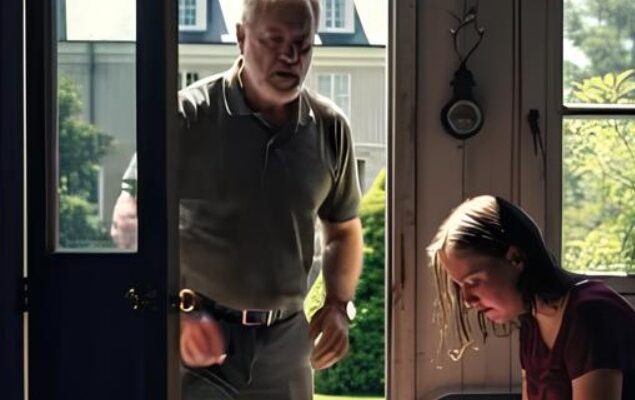
I walked across the lawn. Each step was heavy, a mix of heat and anxiety. I knocked.
“Kelly?”
“Dad?”—her voice trembled, and the trembling was not only from the heat.

The door opened, and I saw my daughter. Dark hair plastered to her forehead from sweat, her face flushed. Inside— a cramped crib, plastic containers with clothes, a small fan barely moving the hot air.
“What is this?” I asked quietly, trying to hide the mixture of anxiety and anger.
“Dad… I’ve been living here since Landon left for his contract,” she said, her eyes wandering, unable to fully meet my gaze. “Marjorie said it was temporary. No one is allowed in the house.”
Her gaze was tired, but deep down a determination still smoldered. The fire I had seen when she was little, learning to set boundaries and say “no.”
“Have you been trying to manage on your own?” I asked gently but firmly.
“I thought I could handle it,” she whispered. “Just temporarily… I was waiting for Landon to come back.”
I took her bag, carefully, as if it were a delicate cargo, and said, “It’s time to change this situation.”
We returned to the house. The air conditioning sharply contrasted with the heat, but the tension did not disappear. Marjorie and Silas stood there, faces calm, arms crossed. Every movement of theirs was carefully measured.

We have provided Kelly with appropriate living conditions,” Marjorie said, her smile remaining cold.
“Three months in a hot little house without normal conditions—is that appropriate?” I asked quietly.
The conversation remained polite, but my message was clear: the situation needed to change. I explained to Kelly that her love for Landon should not be a source of excessive restrictions, that family is support, not control.
The next day, we found safe ways to improve her living conditions. Neighbors, specialists, and the sheriff confirmed that Kelly had been forced to live in uncomfortable conditions. Power and status cannot justify neglecting loved ones.
Landon returned a week later, learned the truth, and supported Kelly. They moved into a small apartment, where Kelly took a job at a construction company, and later at a charitable organization, helping families struggling with emotional and financial difficulties.
The garden cottage became a safe place for those who feel trapped, a quiet monument to care and attention that builds bridges, not walls.
Sometimes patience, determination, and support can change even the toughest circumstances. Goodness and justice are revealed through care, understanding, and small but meaningful steps.