My husband abused me every day. One day, after I lost consciousness, he rushed me to the hospital, insisting that I had fallen down the stairs…😱 🥺
For years, my husband made me believe that what I was experiencing wasn’t violence. Just “marital arguments.” Just “misunderstandings.”
My name is Luciana Herrera. And for a long time, I learned to stay silent.
See more
Stairs
stairs
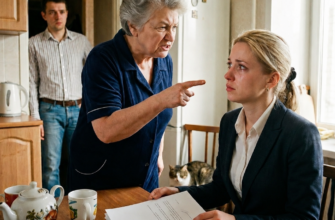
Daniel, my husband, knew exactly how to break me without leaving visible marks. A humiliation delivered in a calm tone. A brutal gesture presented as an accident. A scream, louder every day. I worked a few hours in a small neighborhood shop, but he controlled everything: money, my phone, my relationships. Behind the walls of our home, no one saw anything.
The night everything changed looked like any other. He didn’t like dinner. The plate hit the wall. Then came the blow. I remember the cold floor, the ringing in my ears, and his distant voice repeating that I had “asked for it.” I tried to get up. Then nothing.
When I opened my eyes again, I was in the hospital. White lights. Smell of disinfectant. Daniel was there, holding my hand, smiling too much, speaking too fast.
— She fell down the stairs, he kept repeating. She’s clumsy.
A young doctor, Dr. Rios, examined me with unusual attention. She rolled up my sleeve, palpated my ribs, observed my wrists. Her gaze was calm but precise. Daniel squeezed my hand with every breath.
When the results came, the silence became heavy.
— These injuries did not come from a single fall, she said. Some are old.
Daniel’s hand froze. His face drained of all color.
— I am activating the domestic violence protocol.
At that precise moment, I understood one thing: there would be no turning back.
👉 The rest in the first comment… 👇👇

The words “someone she knows” fell like a stone. I saw Daniel’s eyes slide toward the door, calculating, searching for a way out of a situation that, for once, no longer obeyed him.
He laughed briefly, a dry, joyless laugh, insisting I was clumsy. The doctor didn’t react. She had seen this kind of performance before.
When he was finally asked to leave, the door closed. The air changed. For the first time in years, I felt like I could breathe without asking permission.
The doctor sat next to me. She asked one question, slowly, carefully, as if she knew that the truth could be dangerous when one has to go home afterward.
— Lucía… are you safe at home?
My throat tightened. No one had ever asked me that. Neither my family nor my friends. Not even those who saw me fading away.
I stared at the blanket, then the wall, and whispered no. One tiny syllable, heavier than all the blows, because it changed the story.

The doctor didn’t flinch. She didn’t judge. She didn’t question me like a morbid curiosity. She explained my options simply: available support, guidance, safety. And above all, my right to refuse without losing care.
What I feared most wasn’t the paperwork. It was retaliation. Fear had become a reflex.
She recognized that. She called in a social worker, whose role was not to force me, but to help me choose.
When Daniel returned, he tried to regain control. But something had changed. The looks, the postures. The system no longer cooperated.
And I realized this: silence had never protected me. It had protected him.
That evening, I walked out through another door. Not to escape. To create distance.
And sometimes, distance is the first form of safety.