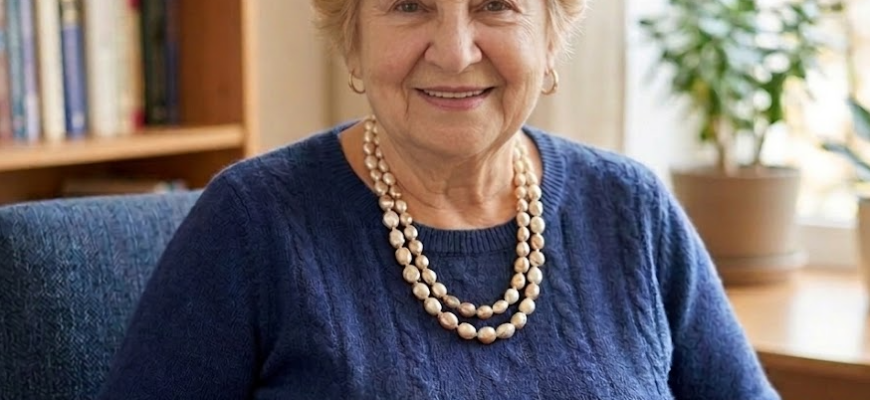

When I was 68, my son convinced me to transfer the house to him… and a month later I discovered that a strange woman was already living in my own room.
After my husband’s death, I couldn’t recover for a long time. We had spent forty-two years together. Everything in the house felt like a living memory of him: the old cracked cup in the kitchen, his armchair by the window where he used to fall asleep in the evenings, the smell of wood and tobacco in the storage room that lingered even after months. Sometimes I felt that if I walked quietly enough down the hallway, he might still answer me from the next room.
My son started visiting more often then, and at first it warmed my heart. Before, he was always too busy — work, responsibilities, constant rushing around. And suddenly there were daily phone calls, bags full of groceries, long conversations in the kitchen, a caring tone that made me feel for the first time in a long while that I truly mattered to someone, instead of simply waiting out the rest of my life in silence.
— Mom, you can’t be alone.
— At your age, it’s already dangerous.
— We need to stay close to you, you understand.
I listened and nodded, because loneliness can sometimes sound louder than any betrayal, and a person begins to agree to anything just so they no longer have to hear it.
Later, he carefully returned to the subject of the documents.
— It’s just a formality, Mom. So there won’t be problems later.
— We’re family. Everything stays in the family.
— The house will be mine someday anyway, you understand.
I didn’t object. Not because I was certain, but because I was tired of life. Tired of being strong. Tired of being alone in the house that my husband and I had built over nearly ten years, saving on everything and denying ourselves even basic comfort. I remember sewing my own coat so we could afford more bricks, my husband taking extra construction jobs after his shifts, counting every penny, and still laughing because we believed it was our home, our life, our future.
But my son spoke so calmly and confidently that my doubts slowly melted away. Sometimes trust is not a choice, but simply the habit of loving someone.
Two weeks after signing the papers, the house began to change, as if someone had quietly rewritten not only the documents but reality itself. First came the unfamiliar little things: women’s perfume in the bathroom, creams on the shelf, strange shoes in the hallway standing there as confidently as if they had always belonged. Then my son brought her home.
Her name was Lara. A young woman with a perfect smile, carefully styled hair, and eyes that examined every corner of the house a little too closely. She didn’t ask for permission — it looked as if she had been living there for a long time already and had only now finally received the keys.
— Mom, meet Lara.

She nodded at me the way one nods at the owner of a house who soon will no longer be its owner.
A few days later, my son said it during dinner as casually as if he were talking about moving furniture:
— It will be uncomfortable for you and Lara to stay on the same floor.
— We thought… you’d feel calmer in the small room upstairs.
At first, I didn’t understand what he meant. The small room upstairs… it was the attic, where jars of jam, old boxes, and winter clothes used to be stored. A room nobody entered unless necessary.
That night I went up there by myself. Not because I agreed, but because I wanted to witness the moment when a person is slowly erased from their own home. I sat there in the dust and silence without turning on the light, and for the first time in many years I understood that loneliness has different faces: one is being alone, and another is being unwanted.
And during the night, laughter drifted up from downstairs. Strange, light, confident laughter. The laughter of people who already felt like the owners of the house.
A month later, my son said something that finally broke something inside me:
— We decided to sell the house and buy an apartment. It’ll be easier for everyone that way.
I looked at him for a long time, as if trying to find in his face the little boy who once held my hand and was afraid of the dark.
— But this is your father’s house…
— Dad is gone, Mom. We have to move on.
At that moment, I understood not only the words. I understood the meaning: to him, I too had become part of the past. Not a person — an obstacle.
That night I couldn’t sleep. I lay there listening as the house we had built over an entire lifetime no longer sounded like mine for the very first time.
In the morning, I opened my husband’s old folder. My hands were trembling not from fear, but from something colder — the silence inside me. And there I found a document I had almost forgotten about: years ago, my husband had insisted that part of the house be registered as my personal property, inherited from my mother. At the time, it had seemed like a mere formality. It turned out to be protection.
For the first time in years, I went to a lawyer without tears and without pleading. Simply as a person who had finally stopped apologizing for her right to exist.
A few weeks later, my son received a letter from the court. It turned out that selling the house without my consent was impossible. And that I had the full legal right to live there for the rest of my life.
When he arrived, at first he didn’t speak — he shouted. Loud enough that the neighbors opened their windows.
— You hid all this on purpose!
— You ruined my life!
And I looked at him and felt a strange emptiness. Not pain — emptiness. Because standing before me was a grown man in whom there was barely anything left of the little boy I had once raised.
The worst part was not the betrayal itself. The worst part was how easily he stepped over me, as if I were part of the house’s furniture and not a human being.
After that, Lara stopped smiling. The confidence disappeared from her eyes. The house she had believed she had secured suddenly no longer felt safe.
They began visiting less often. Then only calling. Then the conversations became short and formal. And then they disappeared completely.
And for the first time in a long while, the house became quiet. Not empty — quiet. Without footsteps that weren’t yours. Without voices making decisions for you. Without the feeling that you were a guest in your own life.
Recently, my neighbor asked me:
— Aren’t you sad that your son hardly visits anymore?
I looked out the window for a long time as evening slowly fell, and I realized that sorrow is still a kind of bond. And I no longer wanted to be tied to pain.
— It would be far worse to live every day beside someone who loves not you… but what belongs to you.