
All our lives, my husband and I lived modestly, trying to give our children everything we ourselves had once lacked. We never complained. We simply got used to putting our own desires “aside for later.” First — because of the mortgage. Then — for the children. And later — because it already felt too late to change anything.
When Michael and I first got married, we had almost nothing. A small apartment with thin walls, an old Ford, a noisy refrigerator that had to be smacked with a hand to stop buzzing at night, and two wedding cups. One of them had a tiny crack, but it was always the one I used for my morning tea.
We were young and firmly believed that happiness did not depend on money. Happiness was having someone with whom you could share the exhaustion of the evening.
Then the children came, and life sped up so much that the years began to blur into one huge memory. Work, sleepless nights, school performances, illnesses, bills, endless shopping lists, doctor visits, parent meetings, extra jobs. We denied ourselves almost everything. For many years I wore the same coat because Brian needed winter boots. Michael didn’t replace his cracked phone until Amy went to prom.
But strangely enough, we never felt unhappy.
In the evenings the children would climb onto the couch under blankets, Michael would put on old movies, and I would bring apple pie or hot chocolate. The house was small, noisy, cramped — but alive. Back then, I thought it would never end.
But one day, everything disappeared almost without notice.
First Brian left for college in another state. Then Amy got a job in Chicago. The rooms began to empty one by one. The kitchen became too clean. No one slammed the refrigerator door at night anymore. No one shouted from the bathroom that the shampoo had run out. No one argued about whose turn it was to wash the dishes.
There were only the two of us left and a strange silence.
At first, we even liked it. At last we could sleep in. Drink coffee peacefully in the morning. Watch a movie all the way through without stopping every five minutes. But then I began to notice strange things.
More and more often, I turned on the television just for the sound.
Sometimes I cooked too much food out of habit and then stared for a long time at the nearly untouched table. Michael disappeared into the garage more and more often for no reason, sitting there for hours going through old tools. And in the evenings we fell silent more and more often, as if we were afraid to say aloud the same thought: the house had stopped feeling like a home.
I think that was the first time I was truly afraid of old age.
Not wrinkles. Not illness. Not age itself.
Only that silence.
That autumn day, the wind was especially strong. Yellow leaves swirled across the porch, and the gray sky hung so low it seemed darkness would fall any moment. I had just made tea when someone knocked on the door.
A young woman stood on the doorstep.
Very young. No older than twenty-five. Dark curly hair tousled by the wind, a thin scarf slipping from her shoulder, and the phone in her hands almost out of battery.
“Excuse me…” she said uncertainly. “I think I may have the wrong address.”

She looked embarrassed and exhausted, as if she already regretted knocking on the door at all.
I was just about to give her directions and close the door. But instead, I suddenly found myself asking:
“Would you like some tea?”
Later, Michael said that was the moment everything changed.
The young woman looked at me with such surprise, as if she hadn’t heard ordinary human kindness in a very long time.
“Actually… yes,” she answered quietly.
Her name was Sophie.
She had recently moved to our neighborhood, rented a small apartment, and worked remotely as a designer. She hardly knew anyone in the city. Her parents lived in Oregon, her friends stayed behind in another town, and in the evenings, as she put it, the walls of her apartment “were too loudly silent.”
When she said that, Michael and I looked at each other.
Because we understood exactly what she meant.
At first Sophie was very tense. She carefully held the cup with both hands and kept apologizing — for the wet footprints on the floor, for bothering us, for interrupting our evening.
But then Michael unexpectedly played an old Bruce Springsteen song we used to listen to when we were young, and suddenly the atmosphere changed.
I served banana bread that I had baked that morning. Sophie tasted a piece and suddenly smiled.
“It tastes like home.”
And for some reason, I felt tears fill my eyes.
After that evening, she started stopping by from time to time. At first rarely. Then more and more often.
Sometimes she brought blueberry muffins from a small bakery near her apartment. Sometimes she helped me with my phone. It was Sophie who finally set up video calls properly so that for the first time I could actually see my grandchildren instead of just the ceiling and half of someone’s forehead.
And sometimes she simply sat with us in the kitchen over tea.
And the silence was no longer empty.
Slowly, life began to return to the house again. First through small, almost unnoticeable things. Another scarf appeared on the coat rack. Almond milk that Sophie liked appeared in the refrigerator. Sometimes her books or laptop lay on the table.
One day, I caught myself smiling when I heard a knock at the door.
As if I were waiting for someone again.
On my birthday, Sophie arrived with a small cake and one candle.
“I didn’t know how old you were,” she said shyly. “So I thought one candle would work for everyone.”
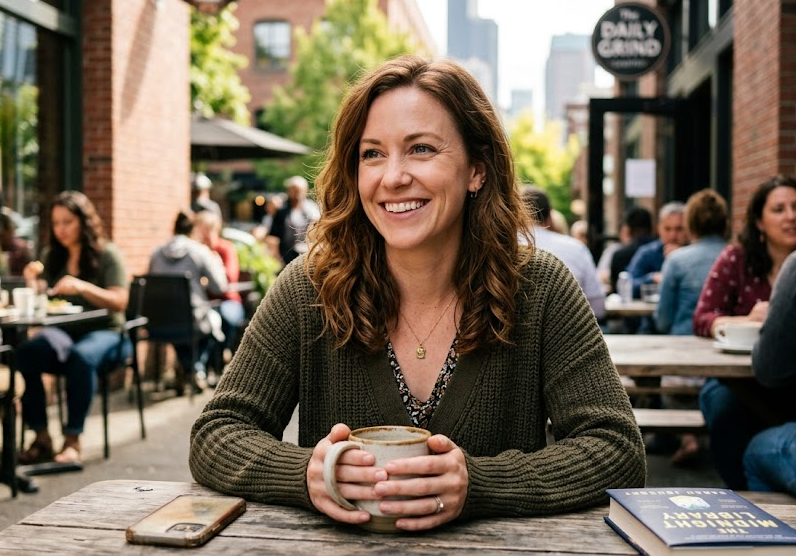
We laughed so hard that Michael had tears in his eyes.
And late that evening, after Sophie had gone home, he suddenly said quietly:
“You know… our house has a sound again.”
At first, I didn’t understand.
“What?”
“There used to be only silence here. And now there’s life again.”
And then I realized he was right.
It felt as though we had woken up after Sophie came into our lives.
I signed up for a pottery class I had dreamed about for twenty years. Michael bought a used camera and started photographing sunsets again, just like he used to when he was young. We began leaving the house more often, inviting neighbors over for dinner, laughing for no reason at all.
But the strangest thing happened later.
One day Sophie didn’t come by.
Then she didn’t come the next day either.
I told myself it was silly, but I started to worry. Michael looked out the window several times. That evening I caught myself listening for footsteps outside the door.
And only then did I realize one frightening thing.
We had grown attached to her far more than we thought.
On the third day, someone finally knocked.
I almost ran to open the door.
Sophie stood on the doorstep with red eyes and trembling hands.
And then suddenly she burst into tears.
“I’m sorry…” she whispered. “I just didn’t know who else I could go to.”
And then I understood: it had never really been just about tea.
Sometimes strangers appear in our lives precisely when the warmth inside us is beginning to fade. And then they become part of the home as naturally as if they had always belonged there.
Much later, I found an old photograph: Michael and I, young, sitting by a lake with cheap sandwiches and an old thermos, laughing as if everything were only just beginning.
I showed the photo to my husband and smiled.
“Do you remember how we dreamed of a peaceful old age?”
Michael looked first at me, then at the kitchen where Sophie was arguing with him about making the coffee too strong, and smiled softly.
“And yet it turned out to be a happy one.”
And you know… sometimes a second life comes not when you go looking for it.
But when one day you simply decide not to close the door.