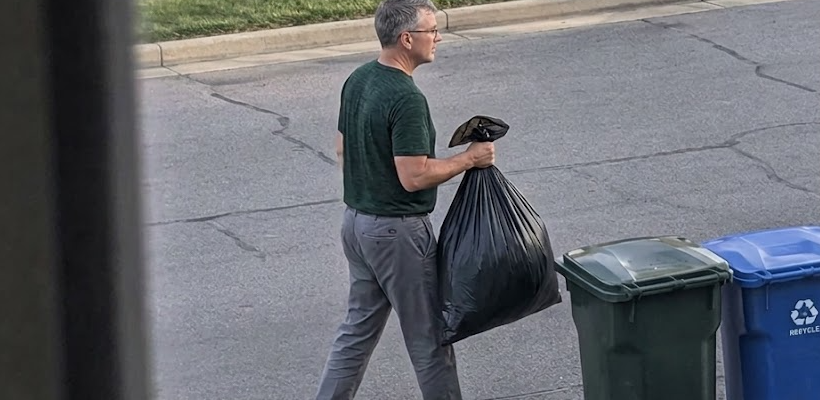
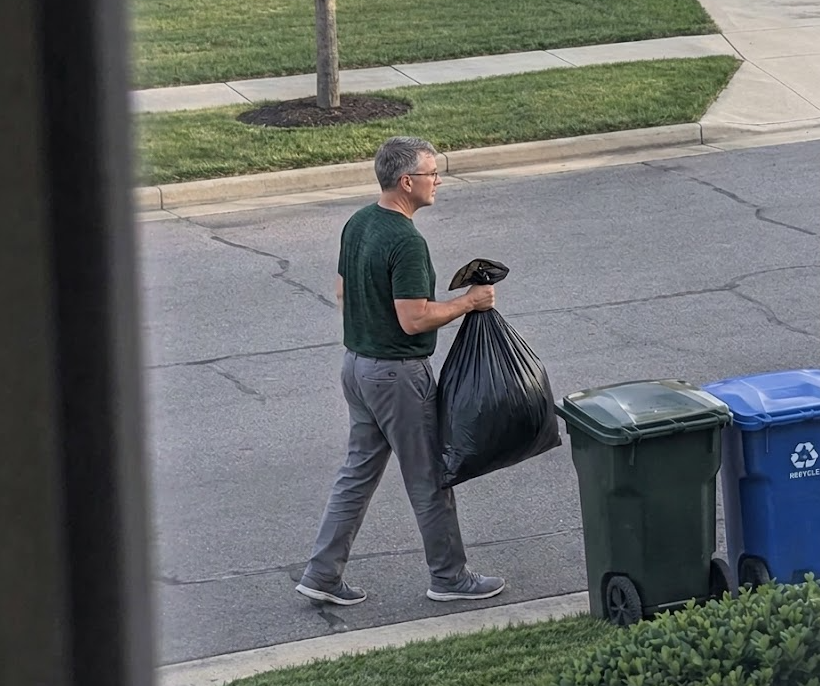
For twenty-nine years, my husband treated taking out the trash as if it were a personal punishment.
So when Robert suddenly started taking out the trash himself every evening, I knew something was wrong.
And I decided to follow him.
For nearly three decades of our marriage, taking out the trash had somehow become my responsibility.
We had never officially divided up the household chores. Robert simply hated taking out the trash.
Strangely, other unpleasant household chores didn’t bother him at all.
He washed the dishes, even when nobody asked him to. He could spend an entire day cleaning the bathroom. Once, he spent several hours cleaning the gutters in freezing weather and, if I remember correctly, he actually seemed to enjoy it.
But carrying one plastic bag twenty steps?
That was almost unbearable for him.
I had seen him stack empty boxes on top of an overflowing trash can just so he wouldn’t have to tie the bag.
I usually laughed at him about it.
— One day that tower is going to fall on you.
He would shrug.
— I’ll deal with it then.
So when Robert got up after dinner on Monday evening, tied up the trash bag, and headed toward the back door, I laughed.
— Who are you, and what did you do with my husband?
Normally, he would have responded with some sarcastic joke.
But that evening, he said nothing.
— I’ll do it myself, he simply said.
And he walked out.
I didn’t think much of it. Maybe at fifty-eight, he had finally decided to defeat his greatest enemy — household trash.
But Tuesday evening, the same thing happened again.
Exactly at nine-thirty, while we were watching television, Robert stood up.
— I’ll take out the trash.
I looked toward the kitchen.
— There’s almost nothing in there.
— I’m taking it out anyway.
He disappeared through the back door.
This time, he was gone for almost fifteen minutes. Usually, taking out the trash took him less than two.
When he came back, I asked why he had taken so long.
— The dumpster lid got stuck.
There was just one problem.
The lid of our dumpster had never gotten stuck.
Not once.
My name is Diane. I had been Robert’s wife for twenty-nine years, and until that week, he had never given me a serious reason not to trust him.
Robert wasn’t a mysterious man. He told me practically everything.
If he went to the hardware store, he’d later tell me exactly what the cashier had said to him. If he got stuck in traffic, I’d receive a detailed report.
He was predictable — in that comforting way people become after they’ve spent many years together.
That’s exactly why his little lie bothered me so much.
It wasn’t serious.
But Robert wasn’t a man who lied without a reason.
And when someone who almost never lies suddenly starts doing it, it’s hard not to wonder: what big truth is he trying to hide behind that little lie?
On Wednesday evening, I started watching him.
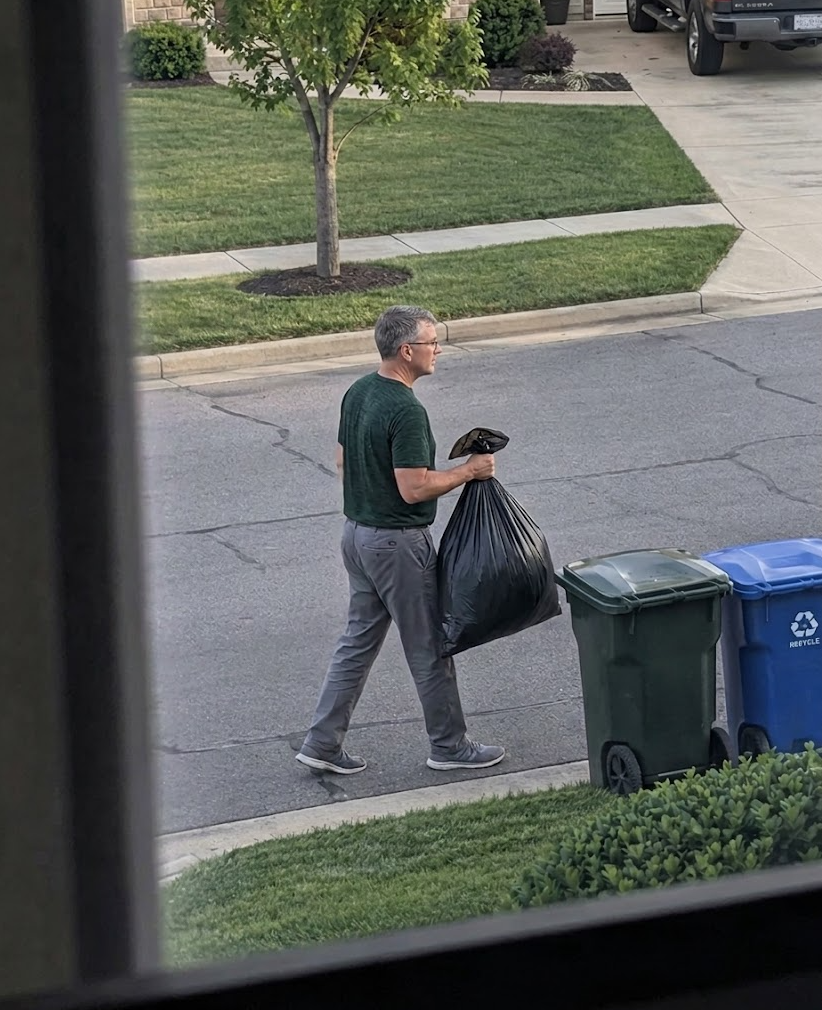
Exactly at nine-thirty, he got up, picked up a half-full trash bag, and went outside.
I said I was tired, went upstairs, then stood behind the curtain in the bedroom and began watching the yard.
Robert walked toward the trash containers.
Then he walked right past them.
My stomach tightened with nerves.
He kept going, passed the garage, walked past the hedge, and entered a narrow alley behind the houses.
Twelve minutes later, Robert returned.
He walked slowly, his hands in his pockets.
The trash bag was gone.
When he came upstairs, I was lying in bed pretending to read.
He kissed my forehead, wished me good night, and lay down beside me.
I barely slept.
My mind immediately went to the worst possible place.
An affair.
What else was I supposed to think?
My husband had suddenly found a reason to leave the house at the same time every evening. He lied about where he was going, disappeared into a dark alley, and returned without the bag he supposedly had taken out.
By Thursday, I needed answers.
At nine-thirty, Robert took another trash bag.
I waited until the back door closed, counted to thirty, put on my shoes and coat, and went out through the front door.
Robert walked past our trash containers and headed down the alley.
He stopped two houses away, beside an old detached garage belonging to a couple who spent most of the year in Florida.
Robert opened the trash bag.
My heart began pounding.
He pulled out a small package wrapped in brown paper.
I recognized the paper immediately. We kept exactly the same kind in the cabinet where we stored packing materials for fragile items.
Then a woman stepped out from behind the garage.
Young. She looked twenty-seven, maybe thirty.
She was wearing a long coat, and her hair was bright blue.
Robert handed her the package.
I stopped breathing.
Then the woman said:
— She still doesn’t know?
Robert shook his head.
— Not yet.
— How long are you going to keep this hidden?
— Until Saturday.
I took a step backward.
My heel landed on an empty plastic bottle.
The crack echoed through the alley.
Robert spun around.
— Diane.
I stepped into the light.
— What’s going on here?
— Please, let me explain.
— That’s what people usually say when they’re caught doing something they shouldn’t be doing.
He carefully took a step toward me.
— Let’s go home and talk.
— No.
I looked at the woman.
— We can talk here.
— Diane…
— I just watched you walk down a dark alley with a fake trash bag, take a package out of it, and hand it to a woman I’ve never seen before.
My voice trembled.
— And then I heard you talking about how much longer you could keep something from me. So nobody is going anywhere until someone tells me the truth.
He looked devastated.
The young woman looked even more so.
I prepared myself for anything.
Then she said:
— I’m Claire’s daughter.
I froze.
— What?
— My mother was Claire.
The alley seemed to tilt beneath my feet.
Claire.
My younger sister.
My only sister.
Who had died twenty-three years ago.
I stared closely at the young woman.
Before that, I had only noticed her blue hair.
Now I saw her face.
A narrow chin. Slightly raised corners of her eyes.
A face I had known practically throughout my entire childhood.
Claire’s face.
Claire’s eyes.
— Oh, God…
The woman swallowed.
— My name is Amelia.
Of course.
I knew that name.
The last time I saw Amelia, she was seven years old. She was standing in the driveway in front of her father’s house, holding a stuffed rabbit as I got into my car.
Claire had died only a few months earlier.
I waved to her then.
Amelia didn’t wave back.
She simply stared.
At the time, I thought she was a grieving child trying to understand why her mother would never come back.
I thought I would see her again soon.
But it turned out to be the last time I saw her for twenty-three years.
I looked at Robert.
— You found her.
He nodded.
— Yes.
— How?
— I searched online for old information, trying to find anything connected to Claire, and I saw Amelia’s name. I wrote to her.
— When?
Robert hesitated.
— About six weeks ago.
Six weeks.
My husband had known for six weeks where my sister’s daughter was.
The child I had never stopped thinking about for twenty-three years.
And he hadn’t told me.
— You knew?
My shock turned into anger.
— Six weeks?
Amelia stepped forward.
— Please, don’t blame him for everything. It wasn’t entirely his decision.
I looked at the package.
— What’s in there?
Amelia carefully unwrapped the brown paper.
First, she took out a photograph.
I recognized it immediately.
Claire and I were teenagers in it, sitting beside a lake. Claire was wearing an absurdly bright yellow swimsuit she adored.
I had my arm around her.
We were both laughing in the sunlight.
Amelia pulled out another photograph — Claire holding little Amelia in her arms.
Then there was a birthday card, an old envelope, and a small silver picture frame.
I turned toward Robert.
— You took all of this from Claire’s box?
— One thing at a time — he admitted.
— And you hid them in trash bags?
— I had to get them out of the house somehow without making you start asking questions.
I stared at him.
— That’s why you started voluntarily taking out the trash?
The same household chore he’d avoided since the 1990s?
Amelia gave a quiet laugh.
Under different circumstances, it would have been funny.
But I wasn’t laughing.
— Why did you hide all of this?
My voice broke.
— You know what Amelia means to me. You know how deeply I grieved losing her.
Before Robert could answer, Amelia looked at the photograph of Claire holding a baby.
— Because I didn’t believe him.
I looked at her.
— What didn’t you believe?
— That my mother’s family really wanted to see me.
I couldn’t breathe.
— What are you talking about?
— Dad told me you didn’t want me.
— That’s not true.
My voice came out sharply, and Amelia flinched.
I immediately softened.
— No. Amelia, please listen to me. It wasn’t like that at all.
She slowly nodded.
— Robert told me the same thing.
Then memories from the past twenty-three years came crashing over me.
Phone calls nobody answered.
Birthday cards I sent every year.
Christmas presents.
Once, a package came back because they had moved and hadn’t left a new address.
I called relatives and friends — everyone who had any connection to Claire.
Nobody knew anything.
Eventually, I stopped asking because every new “I don’t know” felt like another loss.
But I never stopped thinking about Amelia.
— I thought your father wanted us to disappear from your lives — I said.
— For twenty-three years, I wondered whether I had said something wrong after Claire’s death.
Amelia’s eyes filled with tears.
— I thought you had forgotten me.
That sentence hurt the most.
— I never forgot you.
I stepped closer.
— Not once, Amelia.
— Not for a single day.
Tears streamed down her cheeks.
Robert quietly looked away.
I wanted to hug her.
At the same time, I wanted to scream at my husband.
But instead I said:
— Let’s go home.