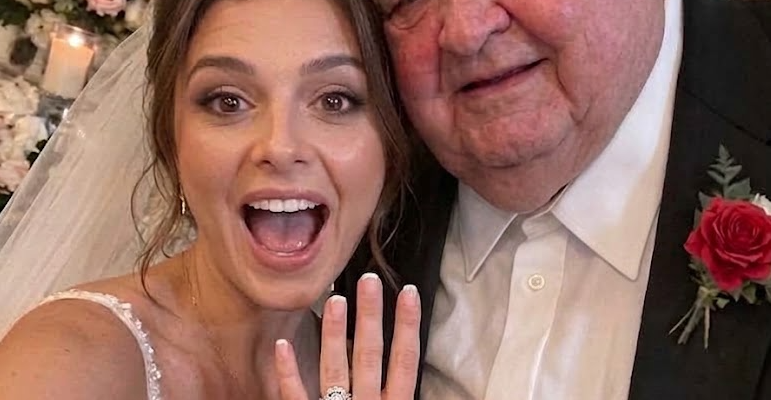
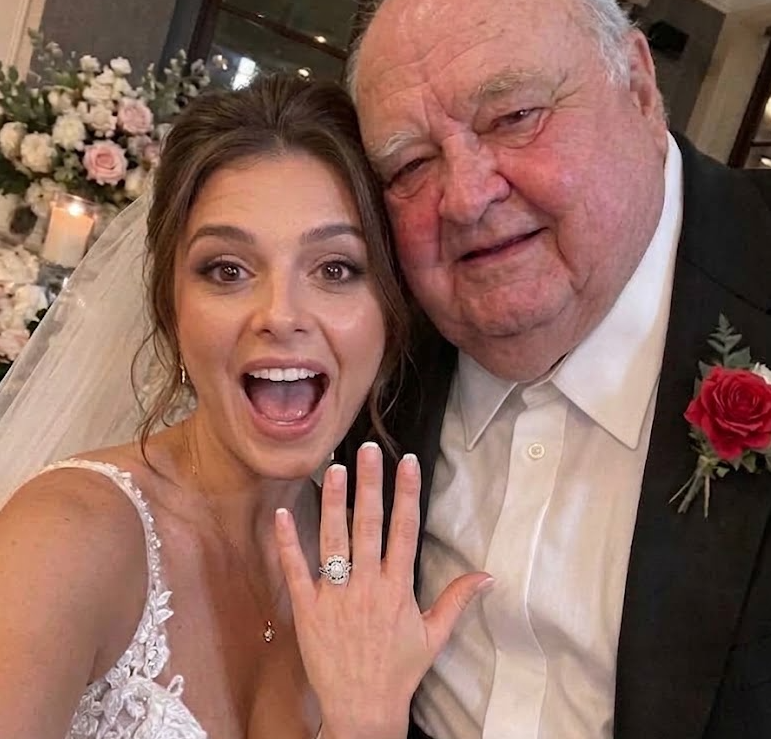
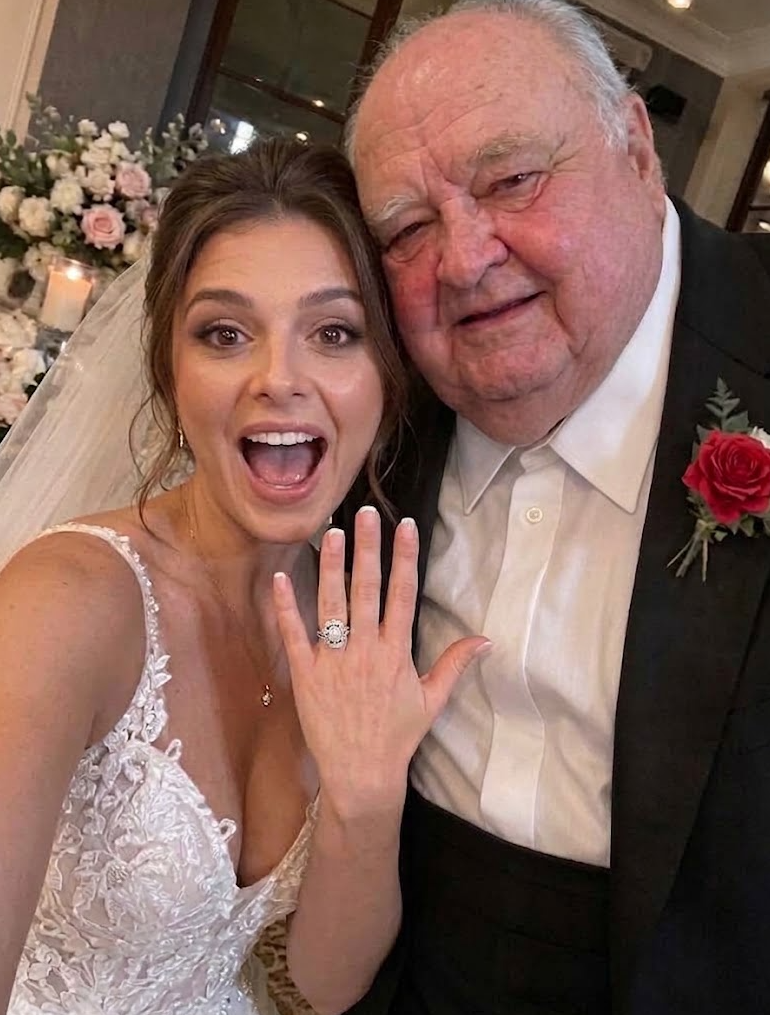
Everyone thought I had married Richard for his money.
And they weren’t entirely wrong.
I was thirty-two years old. I was drowning in bills, and missing just one paycheck could have been enough for me to lose my apartment.
Richard was seventy-three. He was a wealthy widower and a lonely man — in the way wealthy people sometimes try to hide their loneliness behind marble floors, expensive watches, and enormous houses.
We met at a charity dinner where I was serving champagne.
I barely noticed him. He sat away from the main table, watching the guests while everyone else talked about business, travel, and expensive cars.
When I approached him, he asked:
— What’s your name?
I told him, and I was about to walk away when he unexpectedly looked at my legs and asked:
— Have you been standing all evening? Don’t your legs hurt?
Even that surprised me.
It was such a simple question.
But for years, no man had asked me if I was tired.
I smiled and told him I was fine.
Still, for some reason, that brief conversation stayed with me.
A few days later, Richard found a reason to contact me again. We started talking. At first briefly, then more and more often.
Three months later, Richard proposed.
My friends thought I had lost my mind.
There were forty-one years between us, and I understood perfectly how it looked from the outside.
His children were even more hostile.
During a family dinner, his daughter Rebecca pulled me aside.
— You really think you’re going to get this house? — she whispered. — You’re getting nothing.
I said nothing.
Richard heard her.
He simply looked calmly at his daughter and said:
— She will get exactly what she deserves.
I pretended his words didn’t hurt me.
For a while, I tried to convince myself that I didn’t care what other people thought.
Because the truth was, I liked the feeling of security.
I liked waking up in the morning without worrying about whether the electricity bill had been paid.
I liked being able to buy groceries without checking my bank balance first.
I liked the warm home, the quiet mornings, and the feeling that, for the first time in my life, I wasn’t just one difficult week away from losing everything.
But Richard was good to me.
Much better than I expected.
He remembered what kind of coffee I liked. He noticed when I was tired. Whenever I came home late, he always asked how my day had gone.
He listened to me even when what I was talking about didn’t really matter.
One day, I spent several minutes telling him about a little shop near my old home and the shopkeeper who always saved my favorite bread for me.
I finished the story and laughed.
— I don’t even know why I’m telling you this.
Richard shrugged.
— Because it matters to you. So it matters to me too.
I didn’t answer him then.
But moments like that gradually changed my feelings for him.
Somewhere along the way, almost with shame and a certain awkwardness, I stopped pretending that I didn’t care.
I truly fell in love with him.
And the more time passed, the less I cared about what other people thought.
I no longer saw Richard as a wealthy older man who could solve my financial problems.
I saw a man who asked me in the morning whether I had slept well, who noticed my mood, and who never made me feel small or indebted when I was with him.
And then Richard got sick.
Everything happened frighteningly fast.
At first, we thought he simply needed more rest.
Then came the tests, the doctors, and the long conversations that neither of us wanted to end with words about the future.
Six weeks after the diagnosis, I was already standing at his funeral.
His children looked at me as if I were personally responsible for their father’s death.
Rebecca barely looked at me.
I stood among people who had known Richard for decades, and I felt completely alone.
And yet I cried.
Not because of the house.
Not because of the money.
But because the man who had made me feel safe for the first time in many years was no longer beside me.
After the funeral, Richard’s lawyer asked me to come to his office.
When I walked in, all three of Richard’s children were already there.
No one greeted me.
On the lawyer’s desk sat a small wooden box.
There was no will in sight.
No huge piles of documents.
Just that box.
Rebecca leaned back in her chair with a barely noticeable smile.
The lawyer looked at me.
“Richard left very clear instructions.”
Everyone was silent.
Slowly, he pushed the wooden box toward me.
Then he said:
“He made sure you received exactly what you deserve.”
Rebecca quietly laughed.
I looked at her but said nothing.
And when I reached for the lid, a strange feeling suddenly came over me.
I began to wonder whether Richard knew something about me that I had never told him.
Part 2
My hands were shaking as I opened the wooden box.
There was no jewelry inside.
No money.
No key to Richard’s enormous mansion.
Inside was a folded letter, an old photograph of the two of us, and a small brass key.
Rebecca smiled mockingly.
“See? I told you.”
I ignored her and opened the letter.
The very first sentence made me hold my breath.
“Anna, I knew why you married me.”
I stopped reading.
Richard knew.
For several seconds, I simply stared at those words.
I wanted to close the letter, put it back, and pretend that nothing had happened.
But I kept reading.
In the letter, he wrote that from the very beginning, he understood that the desire for security was one of the reasons I had agreed to become his wife.
He was seventy-three years old.
He wasn’t a foolish man.
He completely understood the age difference between us and saw how afraid I was of being left without money and stability again.
But then he wrote:
“I wanted to understand why you stayed when you no longer had to.”
My eyes filled with tears.
I remembered the final months of our life together.
During the last few weeks, Richard had offered to transfer some money into my account.
I refused.
I told him his children would think I was simply waiting for him to die.
I had even asked him to leave the family home to his children.
“It’s their home,” I had said. “I don’t want them to think I’m trying to take their life away from them.”
I didn’t know that he had told his lawyer about that conversation.
Then I reached the next paragraph.
“My children will inherit my companies, investments, and the house where they grew up. You never tried to take any of that away from them.”
Rebecca’s smile disappeared.
I looked at the brass key.
Finally, the lawyer said:
“Six months before his illness, Richard purchased a property.”
He placed a document in front of me.
It was the deed to a small house by the lake.
I recognized the address immediately.
We had spent a weekend there once.
It was a peaceful place, far from the city. One morning, I walked onto the porch with a cup of coffee and stared at the water for a long time.
That was when I joked:
“If I could choose anywhere to spend my old age, I would choose something exactly like this.”
Richard said nothing.
He only smiled.
I had completely forgotten that conversation.
He hadn’t.
He remembered my words.
The house belonged to me.
It was completely paid off.
For several seconds, I couldn’t say a word.
Then the lawyer turned the page.
It turned out Richard had also established a trust.
It wasn’t the enormous fortune that everyone believed I had been trying to obtain, but it was enough money that I would never again have to fear losing the roof over my head or having to choose between paying for housing and buying food.
Rebecca stared at me.
“So she’s getting money after all?”
The lawyer looked at her.
“Your father’s wishes were completely clear.”
Silence filled the room.
I looked at the letter again.
The lawyer picked it up and read the final sentence aloud:
“She entered my life because she was looking for security. But she gave me something no amount of money could ever buy. Make sure she never has to be afraid again.”
That was when I broke down crying.
Not because I had received an inheritance.
But because Richard knew the most uncomfortable truth about how our relationship had begun…
and yet he believed that what it had become in the end mattered far more.
Three months later, I moved into the small house by the lake.
For the first few weeks, I could barely get used to the silence.
Sometimes I would wake up in the morning and instinctively want to tell Richard something I had dreamed about or remembered from the previous day.
Then I would realize he was gone.
But over time, the house stopped being a symbol of inheritance and became a place where I could begin a new life.
I planted several flowers beside the porch.
I placed his favorite mug in the kitchen, the one I had once taken from our home.
And every evening, I went out onto the porch and looked at the water.
To this day, I keep the wooden box on the dresser in my bedroom.
The brass key is still inside, even though I no longer need it.
Sometimes I open the box and read the letter again.
Not because I need a reminder about the money.
But because Richard left me something far more important in those words.
He wasn’t trying to prove to his children that they had been wrong.
He only wanted me to know after his death: he saw me exactly as I truly was.
He knew that, at the beginning, I needed security.
But he also saw who I became beside him.
And every time I remember Richard saying that I would receive exactly what I deserved, I finally understand what he meant.
He didn’t leave me his fortune.
He left me a home, a future, and one final reminder that sometimes love can begin for the wrong reason…
and still become real.