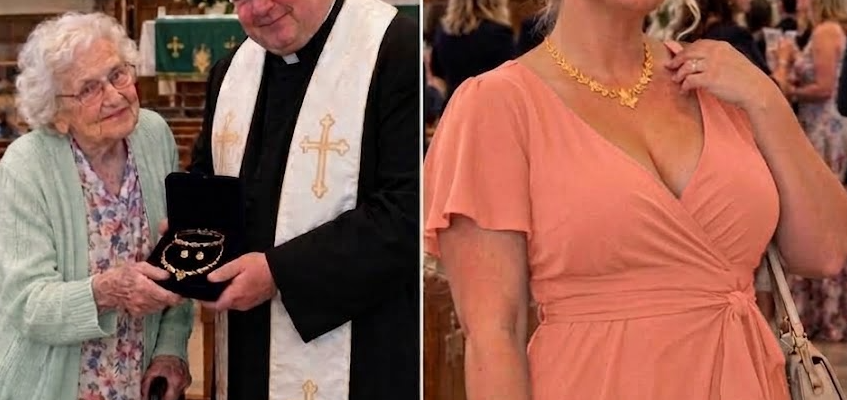
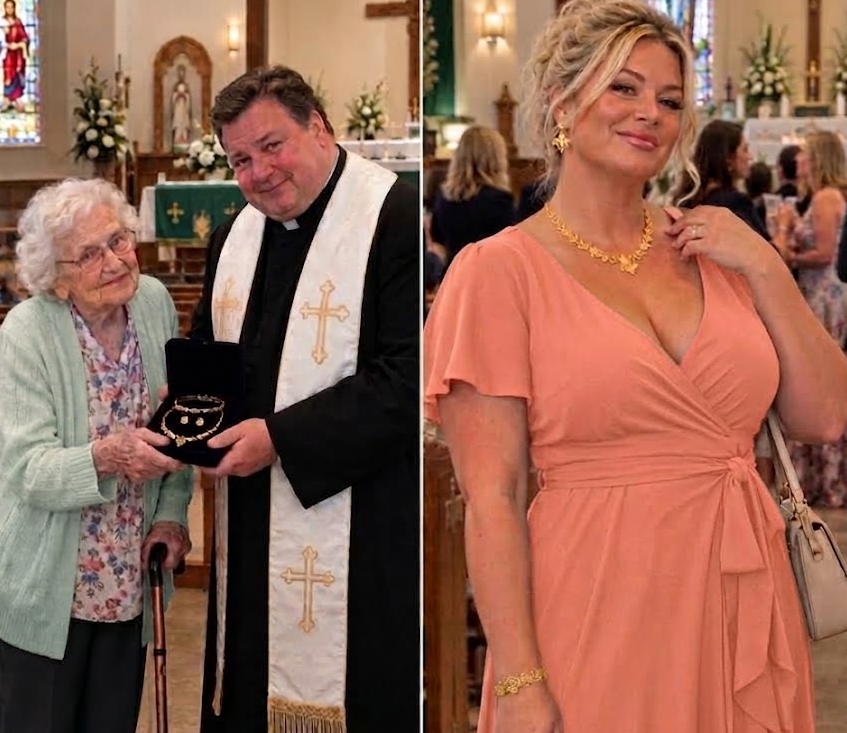
I only wanted to understand how my grandmother’s necklace, which she had donated to the church, ended up around the pastor’s wife’s neck. Instead, I discovered something much bigger than the story of a single piece of jewelry.
My grandmother Ruth had attended the same small church for forty-three years.
Even in the final years of her life, she never allowed herself to miss Sunday service.
— You can barely make it up these stairs.
— I have a cane.
— And arthritis.
— And you worry enough for both of us. — She smiled. — You’d even apologize to a chair if you accidentally bumped into it.
She was right.
Three weeks before she died, Grandma showed me a velvet box.
I opened it.
— Grandpa’s wedding set?
— After twenty-five years of marriage, that man finally developed good taste.
I laughed.
— Grandpa would have loved what you just said.
— I want Pastor Michael to put this jewelry up for a charity auction, she said. — They’re raising money for families who can’t even afford food.
— Are you sure? You treasured it so much your whole life.
— I’m sure. I want it to be useful to someone.
That Sunday, I helped her climb the church steps. She held her cane in one hand and the velvet box in the other.
After the service, she personally handed the box to Pastor Michael.
— For the charity auction.
— Ruth, this is an incredibly generous gift.
Grandma smiled.
— Then make sure it really helps someone.
He hugged her and promised that it would. I took a picture of them because Grandma looked so proud.
Twelve days later, she died.
The Sunday after the funeral, I was just leaving the church when someone touched my shoulder.
— Are you all right?
It was Mrs. Dalton, one of my grandmother’s longtime friends from church.
— Not really.
— Ruth would tell you that you should eat something.
— That sounds exactly like her.
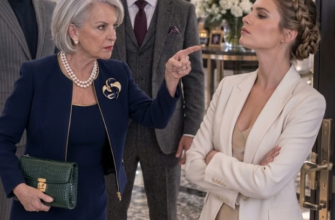
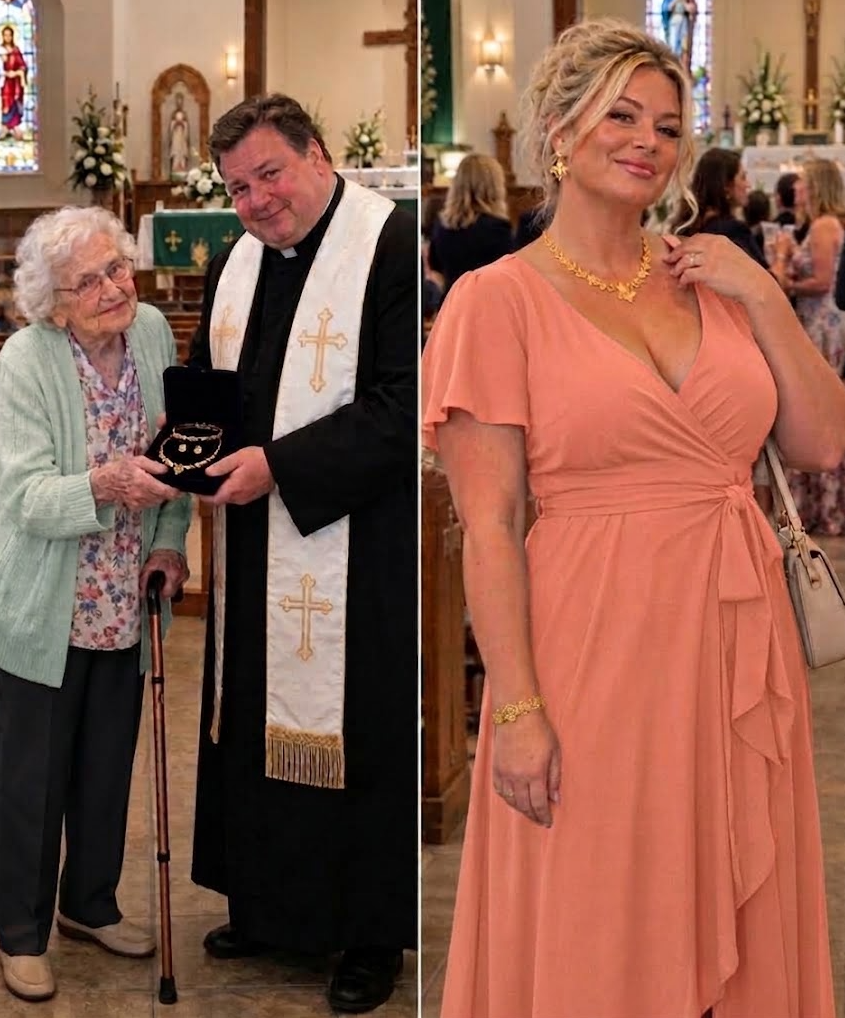
At that moment, Susan, Pastor Michael’s wife, walked past us.
I froze.
— What happened? — Mrs. Dalton asked.
— The necklace.
— What?
— That’s my grandmother’s necklace.
She was also wearing the matching bracelet and earrings.
After the service, I caught up with Susan.
— Beautiful jewelry.
— Thank you.
— This little dent near the clasp… Was it there before?
She touched it.
— I think so.
— Where did you get the set?
— From my mother. I received it after she died.
She lied straight to my face.
Then she smiled again.
— Family jewelry of special value is priceless, isn’t it?
I swallowed my anger.
— Of course.
She smiled.
So did I.
She had no idea that the tiny dent near the clasp had just told me more than she could have imagined.
The following Sunday, I entered the church carrying a new gift box.
Pastor Michael noticed it immediately.
— Is that something else Ruth left to the church?
His eyes lit up.
I handed him the box.
— Grandma wanted the church to receive one more thing.
— How generous.
He opened the box and pulled out a photograph.
His smile disappeared.
— Ruth with the jewelry?
— At my parents’ wedding anniversary.
Under the photograph, he found an appraisal document.
— What did you do?
— Nothing.
— Then why did you bring this?
— Because the dent near the clasp is clearly visible in the photograph. And the document confirms that it’s the exact same set.
— And?
— That’s when I realized I still didn’t know how the auction had ended.
His jaw tightened.
— What exactly do you want to know?
— How much was my grandmother’s jewelry sold for?
— Susan bought it.
That wasn’t the answer I expected.
— What?
— Before the auction, he said quickly. — She liked the set, so she made an offer. There was no point waiting.
— And the money?
— It went into the charity fund.
I could have believed him. But one thing still didn’t add up.
And then Susan appeared behind him.
— What are you two talking about?
— Ruth’s jewelry, Michael replied.
Her expression changed for barely half a second.
I asked:
— You bought it?
— Yes.
— From the church?
— Yes.
I looked at the necklace around her neck.
— Then why did you say you got it from your mother?
Susan crossed her arms over her chest.
— I panicked.
— Why?
— You were grieving. I knew you would recognize the jewelry, and I didn’t want to seem insensitive.
Michael nodded vigorously.
— Exactly.
— So that’s really what happened?
— Yes, Michael said. — It was just a misunderstanding.
Grandma had taught me to look for an explanation first and suspect bad intentions only afterward.
That instinct had helped me stay calm my entire life. This time, it would help me disturb that calm.
— All right.
Michael smiled.
— I’m glad we cleared everything up.
— Then show me the payment receipt.
His smile disappeared again.
— What receipt?
— The amount Susan paid.
— The church keeps financial records.
— Great. Then finding it shouldn’t be difficult.
Michael closed the box.
— I’ll find it.
— When?
— This week.
I smiled.
— Great.
As I walked out, one question kept haunting me:
If everything had been done properly, why were two completely innocent people so afraid to show me the payment receipt?
Five days passed.
Michael didn’t call.
I sent him a message.
ME: Did you manage to find the receipt?
Several hours later, he replied:
MICHAEL: I’m still looking. We’ve had a bit of a mess in the accounting department lately.
I could almost hear Grandma’s voice.
“Don’t start an argument until you know the whole story.”
— You’d tell me to leave it alone, wouldn’t you?
In my head, she immediately answered:
“I’d tell you to check carefully what you’re talking about first.”
I sighed.
— All right. Susan paid. The documents are probably just disorganized.
Even I didn’t sound convinced.
At the grocery store, near the cereal aisle, I ran into Mrs. Dalton.
— Your grandmother literally helped me after my husband died, she said. — She used to bring me food from the church.
— She loved you.
— She loved everyone.
— You said she helped you. What changed?
She sighed.
— Everything looks a little different now.
— What do you mean?
— Nothing.
— No. Tell me.
She hesitated.
— The food distribution program has been pretty poor lately.
— But they’re still collecting donations.
— I know.
— How bad is it?
She nodded.
— Last month I got pasta, two cans of beans, and cereal.
— For the whole month?
She nodded.
— Michael said there are fewer donations.
That conversation was about to tear Michael’s entire story apart.
— Are they going to organize another fundraiser soon?
— Yes. Susan mentioned it.
At home, I found last year’s charity fundraiser poster.
A designer handbag donated by the Harris family.
I stared at the photograph.
— No. That’s impossible.
I had seen that handbag before.
Before I could decide what to do with that thought, my phone rang.
Michael.
— Good news, he said. — I found the receipt.
— Great. How much was it?
I looked at Grandma’s jewelry appraisal document.
— Eight hundred dollars.
— Michael, the set was appraised at nearly twelve thousand.
— An appraised value doesn’t mean it could have been sold for that amount.
— No. But eight hundred?
— Susan made an immediate offer. No commission, no risk.
— And other people had the opportunity to make offers?
There was silence.
— I don’t like where this is going.
— I’m just asking a question.
— Your grandmother wanted to help people. Susan paid eight hundred dollars. Ruth’s jewelry helped people.
— So that’s enough?
— What do you mean?
— As long as the church received some money, it doesn’t matter how much what she donated was actually worth?
— I didn’t say that.
— That’s more or less what you just said.
— I think we’ll end this here.
He hung up.
I stared at my phone.
— No, Michael. I think we’re just getting started.
I looked at the charity fundraiser poster again.
One designer handbag could have been a coincidence.
There was a simple way to find out.
And I called one person.
Then another.
After the fourth call, I knew there was a pattern.
I spread the documents from previous charity fundraisers across the table and carefully reviewed my notes.
— Oh no. This can’t be.
I checked everything again.
The answer was the same.
I wasn’t going to call Michael and demand an explanation.
That would only give him time to prepare.
Instead, I remembered Mrs. Dalton’s food package.
Two cans of beans.
And once again I heard Grandma’s voice:
“Make sure it really helps someone.”
—I will.
I looked at the date of the charity fundraiser on the poster.
Two weeks remained.
Somewhere between the phone calls and Grandma’s words, a plan began forming in my mind.
Not just to get her jewelry back.
But also to make sure Michael couldn’t explain everything behind the closed doors of his office.
I picked up my phone.
— All right, Grandma. Let’s see how much he really cares about transparency.
I called Michael.
— I need to apologize.
— I’m glad you’ve thought everything through.
— I was upset. Grandma had just died, I saw Susan wearing her jewelry, and I jumped to conclusions.
— I understand.
— I still want to do something in Grandma’s memory during the fundraiser.
His voice immediately became warmer.
— Of course.
— Just give me a few minutes during the event.
— Why?
— I want people to remember why she donated the jewelry in the first place.
— I think she would have liked that, he said.
— I think so too.
For the next two weeks, I was the most helpful woman in the entire church.
— I’ll organize the tables with the donated items, I told Michael.
— You don’t have to do that.
— I want to.
I handed him one of my new cards.
— Donor, estimated value, starting bid, final sale price.
He looked at it.
— It looks professional.
— Transparency can encourage people to be more generous.
— Of course.
Susan even patted me on the shoulder.
— I’m glad we put this little misunderstanding behind us.
— Me too.
The evening before the fundraiser, Michael watched me arrange the items on the tables.
— Are you still going to say something tomorrow?
— Yes.
— About Ruth?
— Mostly.
He laughed.
— Should I be nervous?
I looked at him.
— Is there any reason to be nervous?
He laughed again.
— Of course not.
— Then get a good night’s sleep.
He didn’t understand that we were talking about completely different things.
The next day, the hall quickly filled up.
One woman stopped beside one of my cards.
— Will it show here how much everything actually sells for?
— Down to the last dollar.
— Why haven’t we done this before?
— Good question.
Michael took the microphone.
— And now Ruth’s granddaughter has prepared a special surprise in memory of her grandmother.
That was my signal.
I rolled a covered display stand forward.
— If I’m wrong, forgive me, I whispered.
Michael looked at me.
— What?
— Nothing.
I removed the cloth.
At the center of the stand was a photograph of Grandma wearing the gold necklace, bracelet, and earrings.
Under the photograph was a sign:
DONATED BY RUTH. APPRAISED VALUE: $11,800. SOLD PRIVATELY BEFORE THE AUCTION: $800.
Silence filled the room.
— What is this? Michael asked.
— My grandmother’s donation.
— Eight hundred? someone called out.
— Exactly what Pastor Michael told me Susan paid.
— For a set worth $11,800?
Susan touched the necklace.
— It wasn’t that simple.
Michael grabbed the microphone.
— Let’s not jump to conclusions based solely on an appraisal…
Of course. Another misunderstanding.
Don’t worry, Michael. I prepared four more things for you.
— Of course. That’s why I’m not accusing anyone of anything.
— It was a private transaction, Susan said.
— With whom?
— Michael.
— Grandma donated the jewelry to the church, not to Michael personally.
Michael lowered his voice.
— Maybe we should discuss this privately?
All my life, I had a habit of moving difficult conversations somewhere quiet so everyone would feel more comfortable.
But not this time.
— You told me everything had been done according to the rules.
— It had.
— Great. Then there’s nothing shameful about showing the numbers.
Susan snatched the microphone from him.
— Fine. We’ll pay the difference.
— Susan… Michael began.
— No. Obviously, that’s what she wants.
— Actually, it isn’t.
Susan looked at me.
— What else could you possibly want?
I looked at Michael.
— You told me Grandma’s jewelry had helped people anyway because the church received eight hundred dollars.
— Yes.
— And I started wondering how many other donations had helped people in exactly the same way.
Susan fell silent.
Michael laughed.
— I have no idea what you’re talking about.
— You’ll find out soon.
I walked over to another table where another covered display stand stood.
This was the part they didn’t know about.
I removed the cloth.
Four photographs.
A designer handbag.
A coffee machine.
Two antique watches.
A designer coat.
Beside each item was the donor’s name and the estimated value.
— What is this? someone asked.
— The reason I made four phone calls.
I pointed to the handbag.
— Mrs. Harris donated it last year.
— That was my handbag! Mrs. Harris shouted.
— And she had no idea who bought it.
Someone shouted:
— Susan, doesn’t your sister have one just like that?
— She bought it, Susan answered sharply.
— At the auction? Mrs. Harris asked.
Susan didn’t answer.
I pointed to the coffee machine.
— The donor told me Susan claimed she bought it.
— For how much? someone asked.
— The donor was never told.
Susan grabbed Michael’s hand.
— This is absurd.
— Then explain the watches.
George stood up.
— I donated them.
— Do you know who bought them?
— No.
I looked at Michael.
— But I saw one of them on your brother-in-law.
An uneasy murmur moved through the room.
— That proves nothing, Michael said.
— I know. That’s why I called one more person.
I pointed to the coat.
— The donor also didn’t know who bought it. But I knew where I had seen it before.
A voice from the room called out:
— In your niece’s holiday photos.
Susan grabbed Michael’s arm.
— You have to stop this.
I looked at Michael.
— One thing could have been a coincidence. But four?
Grandma’s necklace hadn’t revealed just one questionable transaction. It had revealed an entire pattern.
Michael grabbed the microphone.
— Nothing was stolen. These were private sales. The church received the money anyway.
— Then tell us how much each of these items sold for.
He froze.
— We don’t have the accounting documents here, Susan said.
— Strange. You had a problem with the documents concerning my grandmother’s jewelry too.
— Were there even any auctions? someone shouted.
Mrs. Harris stepped forward.
— How much did your sister pay for my handbag?
Susan looked at Michael.
George crossed his arms.
— And how much did your brother-in-law pay for my watch?
— Enough! Michael said.
— No, someone objected. — I want to hear this.
The room erupted in loud voices.
Michael raised the microphone.
— These were private sales. Nobody stole anything.
— Then why weren’t the donors told how much their items sold for?
He had no answer.
— And why did all these favorable purchases end up with your family?
Silence fell.
And then I knew it was over.
Susan turned to me.
— You planned all of this.
— Yes.
— You lied when you apologized.
— No. I said I had jumped to conclusions.
— You made us believe you had put everything behind you!
— That was exactly the point.
She stared at me.
Four phone calls had turned one necklace into a series of questions Michael could no longer answer.
And the church board was about to ask even harder questions.
A month later, someone from the church board called me.
— How serious was the situation?
— Serious enough.
Michael and Susan returned everything they had and paid the remaining amount. From then on, all future sales had to be approved by the church board.
Then Grandma’s velvet box was placed on the table.
— We thought you might want to take it.
For a moment, I really did.
— No. Grandma didn’t donate it without a reason.
At the next charity fundraiser, her jewelry was put up for a real auction.
— Twelve thousand.
— Twelve and a half thousand.
— Sold.
A few weeks later, Mrs. Dalton called me.
— They gave me the whole package.
I smiled.
Grandma had donated her jewelry with one wish:
“Make sure it really helps someone.”
In the end, that’s exactly what happened.